
Salt Lake City, UT · metro guide
Water Damage Restoration in Salt Lake City: Snowmelt, Cooler Curbs, and Basements
Two local sources dominate: meltwater against a frozen slope, and a roof-mounted cooler that has been leaking since June.
Metro snapshot
Salt Lake City in numbers
Sources named below each block
- Population
- 1.3M
- Households
- 450K
- Housing units
- 475K
- People / household
- 2.83
- population ÷ households
Owner-occupied homes 67%
The rest are rented. Owners are the ones who commission most exterior work.
Single-family detached 61%
Detached houses carry their own roof, gutters and exterior walls.
Built before 1980 42%
Older housing stock shapes what fails first: gutters, flashing, pipe material.
Season
The year in Salt Lake City
- Precipitation
- 15.5 in
- Snowfall
- 51.9 in
Average temperature by month, °F — the shape of the year is what decides when exterior work gets done.
Precipitation by month, inches.
Snowfall by month, inches.
| Month | Average temperature (°F) | Precipitation (in) | Snowfall (in) |
|---|---|---|---|
| January | 31.4°F | 1.43 in | 12.7 in |
| February | 36.6°F | 1.30 in | 10.7 in |
| March | 45.8°F | 1.75 in | 5.9 in |
| April | 51.8°F | 2.16 in | 2.9 in |
| May | 61.5°F | 1.82 in | 0.1 in |
| June | 71.6°F | 0.95 in | 0.0 in |
| July | 81.1°F | 0.49 in | 0.0 in |
| August | 79.1°F | 0.58 in | 0.0 in |
| September | 68.4°F | 1.06 in | 0.0 in |
| October | 54.6°F | 1.26 in | 0.5 in |
| November | 41.7°F | 1.32 in | 7.0 in |
| December | 32.2°F | 1.40 in | 12.1 in |
NOAA 1991–2020 climate normals, station SALT LAKE CITY INTL AP, UT US (USW00024127). Station observations, not a metro-wide average — a metro that spans a mountain range can differ by more than this record shows.
Population, households and housing shares: U.S. Census Bureau, American Community Survey 2024 5-year estimates, metropolitan statistical area.
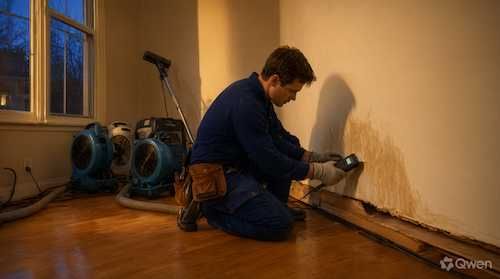
Water damage along the Wasatch Front has a seasonal shape that is peculiar to the valley. Snow accumulates on the benches and in the canyons through winter, and when it melts in spring the ground beneath is often still frozen or already saturated, so the water runs across the surface and along foundations rather than soaking away. In summer the dominant source is different and entirely local: the evaporative cooler on the roof, whose pan, curb and water line sit above the ceiling of a bedroom. Between those two seasons, a failed irrigation line or a supply break fills in the rest of the calendar.
Meltwater with nowhere to go
The spring pattern here is like the upper Midwest's: a large snowpack releases over a short period, and the ground cannot accept it fast enough. Water reaches the foundation wall, finds the cove joint and the window wells, and appears in a basement that was dry all winter. Grading that has settled toward the house over twenty years is usually part of the story. Ask where the water is entering, whether the grade and downspouts can be corrected first, and what drying is needed if the basement is finished. Redirecting a downspout is cheap; replacing a finished basement is not.
The cooler on the roof is a water appliance
An evaporative cooler holds water in a pan, recirculates it through pads, and bleeds a continuous trickle to keep minerals from concentrating — all of that above the living space. Rusted pans, failed float valves, disconnected bleed lines and perished curb flashing are ordinary failures, and they leak slowly enough that the damage is often found when the ceiling sags rather than when the water first appears. Ask when the pan and pads were last replaced, whether the curb flashing is intact, where the bleed line discharges, and how the unit is shut down and covered for winter. A cooler that is drained and covered properly in autumn is far less likely to be the source of a January ceiling repair.
The irrigation system breaks in spring
Sprinkler lines that were not blown out before the first hard freeze split at the backflow assembly or at a low head, and the failure is discovered at start-up in April when water begins moving. A break under turf can run for days before it surfaces. Ask who performs the winterization and the start-up, whether the backflow device is tested and drained, and whether the system has a master valve or a flow sensor that would shut it down after a break. These are small components that convert a flooded yard or a wet foundation into an inconvenience.
Basements, sumps, and the spring water table
Where a basement exists, spring is the season that tests it, and the sump pump is the component that decides whether the test is passed. A pump that has not run since the previous spring is exactly the pump that fails on the first night of continuous operation, and a discharge line that still ends where the frost pushed it is sending water back to the wall. Ask when the pump was last serviced, whether there is a battery or water-powered backup, and where the discharge terminates. Also ask whether the problem is groundwater or a sewer backup, because the two look similar in a basement and are treated very differently.
What to document before anything is removed
Photograph the water line, the affected materials and contents, and get the moisture readings in writing — which rooms, which materials, what the dry standard is. In a dry climate surfaces dry quickly, which can make a wet assembly look finished before it is, particularly where water has run under a hard floor or inside a wall cavity. Ask for a recheck with readings before the rebuild is scheduled, and ask how the contractor's scope reconciles with the insurer's.
Questions to ask on site
Where this page stops
This page does not assess a specific loss and publishes no prices. Sewage, mold and active intrusion require on-site assessment, and coverage questions belong to your insurer and the policy documents.
Salt Lake City metro context
The 2024 ACS 5-year estimates report about 1.28 million residents in 450,170 households and 474,627 housing units, with 67.0% owner-occupied and 60.9% single-family detached. About 42.3% of units predate 1980, which is the share most likely to have older basements, original window wells and first-generation drainage. A climate station is not reported for this metro in the site dataset, so no precipitation or snow figures are published on this page.
Salt Lake City housing and ownership indicators
| Indicator | Value | Source |
|---|---|---|
| Housing units built before 1980 | 42.3% | U.S. Census Bureau |
| Single-family detached share | 60.9% | U.S. Census Bureau |
| Owner-occupied share | 67.0% | U.S. Census Bureau |
| Metro households | 450,170 | U.S. Census Bureau |
| Housing units | 474,627 | U.S. Census Bureau |
| Metro population | 1,275,870 | U.S. Census Bureau |
No NOAA climate normals are shown for this metro because no station record is held in the site dataset. Snowpack and melt timing differ considerably between the valley floor, the benches and the canyons.
Frequently Asked Questions
Why does my basement get wet in spring rather than in winter?
Because that is when the accumulated snow releases, and the ground is often still frozen or saturated underneath, so the water cannot drain downward. It reaches the foundation wall instead. Grading, downspouts and window well covers are the first things to correct.
How can I tell if my swamp cooler is leaking?
Look for staining or sagging on the ceiling below the unit, water at the curb on the roof, or a bleed line that never stops running. Because leaks are slow, the ceiling is often the first place it shows. Checking the pan and curb each spring is cheaper than repairing drywall.
Does a swamp cooler need to be drained for winter?
Yes. Draining, cleaning and covering the unit, and isolating its water supply, prevents freeze damage to the pan, the float valve and the lines, and it removes a standing water source above the ceiling during the coldest months.
Should I test my sprinkler backflow device?
Many jurisdictions require annual testing, and the device is also the part most likely to be damaged by a missed blowout. Confirm the local requirement and ask your contractor to drain and winterize the assembly properly.
Is a sump pump necessary here?
Where the basement takes water during melt or heavy rain, yes, with a backup for power loss. It only helps if the discharge line carries water away from the wall. If the water is coming up through a floor drain rather than seeping at the wall, that is a sewer backup and needs a different solution.
What should I photograph first?
The water line on walls and stored items, damaged flooring and furniture, the visible source, and any readings taken. Documentation made before cleanup is what insurers rely on, and it cannot be reconstructed after the fact.
Sources and review date
- American Community Survey 2024 5-year estimates (CBSA tables) — U.S. Census Bureau, 2024 ACS 5-year estimates.
Reviewed on 2026-11-18.