
Seattle, WA · metro guide
Landscaping in Seattle: Dry Summers and Wet Winters
Seattle gardens get most of their water in the wrong season. The plan has to survive a dry August and a saturated January.
Metro snapshot
Seattle in numbers
Sources named below each block
- Population
- 4.1M
- Households
- 1.6M
- Housing units
- 1.7M
- People / household
- 2.53
- population ÷ households
Owner-occupied homes 60%
The rest are rented. Owners are the ones who commission most exterior work.
Single-family detached 56%
Detached houses carry their own roof, gutters and exterior walls.
Built before 1980 43%
Older housing stock shapes what fails first: gutters, flashing, pipe material.
Season
The year in Seattle
- Precipitation
- 39.3 in
- Snowfall
- 6.3 in
Average temperature by month, °F — the shape of the year is what decides when exterior work gets done.
Precipitation by month, inches.
Snowfall by month, inches.
| Month | Average temperature (°F) | Precipitation (in) | Snowfall (in) |
|---|---|---|---|
| January | 42.8°F | 5.78 in | 1.8 in |
| February | 44.0°F | 3.76 in | 2.2 in |
| March | 47.1°F | 4.17 in | 0.4 in |
| April | 51.3°F | 3.18 in | 0.0 in |
| May | 57.5°F | 1.88 in | 0.0 in |
| June | 62.0°F | 1.45 in | 0.0 in |
| July | 67.1°F | 0.60 in | 0.0 in |
| August | 67.4°F | 0.97 in | 0.0 in |
| September | 62.6°F | 1.61 in | 0.0 in |
| October | 53.8°F | 3.91 in | 0.0 in |
| November | 46.5°F | 6.31 in | 0.2 in |
| December | 42.0°F | 5.72 in | 1.7 in |
NOAA 1991–2020 climate normals, station SEATTLE TACOMA INTL AP, WA US (USW00024233). Station observations, not a metro-wide average — a metro that spans a mountain range can differ by more than this record shows.
Population, households and housing shares: U.S. Census Bureau, American Community Survey 2024 5-year estimates, metropolitan statistical area.
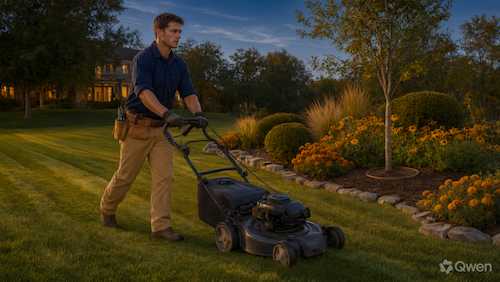
Seattle's rainfall is famously plentiful and famously mistimed. About 39.3 inches a year fall mostly between October and April, while July averages 0.6 inches. A landscape planted for the annual total will struggle in August, and one designed only for summer irrigation will drown in January. Good plans here are built around that split.
Plants for a summer-dry climate
Ask which plants are proposed and why they suit the site: sun exposure, soil, and how much summer water is available. Many plants sold locally are adapted to wet winters but need irrigation in their first summers. Ask how the plan handles establishment without committing the owner to permanent heavy watering.
Winter drainage matters more
Ask how the plan grades water away from the foundation and where it goes in a wet month. Heavy clay soils and low corners can stay saturated for weeks. Rain gardens and swales can help, but they need to be designed for the actual volume and the soil, not added as a finishing touch.
Irrigation should be temporary by design
Ask whether the plan expects permanent irrigation or a temporary establishment system that can be reduced over time. Ask how zones are set up and whether the controller responds to weather. In a region with a dry summer, a small efficient system is often more appropriate than a full lawn schedule.
Lawn area and maintenance
Ask how much lawn the design keeps, why, and how it will be maintained through a dry summer. Reducing lawn is often the simplest way to cut both water use and maintenance, but it changes how the yard is used. That is a household decision, not a contractor one.
Questions to ask before approving a plan
Where this page stops
This page does not design a landscape or estimate cost for a specific property. Plant suitability, drainage requirements, and permit needs vary by city and by site, and should be confirmed locally.
Seattle metro context
The 2024 ACS 5-year estimates put the metro at about 4.1 million residents and 1.6 million households. About 60.0% of occupied homes are owner-occupied, and about 56.0% of housing units are single-family detached. About 42.7% of housing units were built before 1980. NOAA's Sea-Tac station records January averaging 42.8°F, January precipitation of 5.78 inches, July 67.1°F, and July precipitation of 0.6 inches.
Seattle reference station and housing indicators
| Indicator | Value | Source |
|---|---|---|
| January precipitation | 5.78 in. | NOAA NCEI |
| July precipitation | 0.6 in. | NOAA NCEI |
| Annual precipitation | 39.3 in. | NOAA NCEI |
| Metro population | 4,061,920 | U.S. Census Bureau |
| Owner-occupied share | 60.0% | U.S. Census Bureau |
| Single-family detached share | 56.0% | U.S. Census Bureau |
Station normals are historical averages for one location, not a forecast. Census values describe the metro area, not an individual property.
Frequently Asked Questions
What should a Seattle landscaping estimate include?
Ask for the plan drawing, plant list with sizes, soil preparation, mulch, drainage and grading work, irrigation layout and controller, hardscape, disposal, a schedule, exclusions, and the establishment or warranty terms.
Why do plants struggle in summer here?
Most rain falls outside the growing season, so summer is effectively dry. Plants need to be chosen for that pattern and watered through establishment rather than relying on rainfall.
How do I keep the yard from staying saturated in winter?
Grading away from the foundation, defined runoff paths, and drainage where water collects are the usual measures. Ask the plan to show where water goes during a wet month.
Is irrigation necessary in Seattle?
New plantings usually need summer water to establish, and some designs keep permanent irrigation. Ask whether the system can be reduced over time and how the controller is set.
Who replaces plants that die in the first year?
It depends on the contract. Ask whether replacement is included, for how long, and under what conditions, such as proper watering or maintenance by the owner.
What is the population of the Seattle metro area?
The U.S. Census Bureau's 2024 ACS 5-year estimates report about 4.1 million residents in the metro area. The figure describes regional scale, not the number of homes or providers.
Sources and review date
- American Community Survey 2024 5-year estimates (CBSA tables) — U.S. Census Bureau, 2024 ACS 5-year estimates.
- 1991–2020 station normals — SEATTLE TACOMA INTL AP, WA US (USW00024233) — NOAA National Centers for Environmental Information, 1991–2020 climate normals.
Reviewed on 2026-11-17.