
Seattle, WA · metro guide
Roofing in Seattle: Rain, Moss, and What to Compare
Seattle roofs fail slowly and quietly. Persistent moisture, organic growth, and attic ventilation matter more than the occasional storm.
Metro snapshot
Seattle in numbers
Sources named below each block
- Population
- 4.1M
- Households
- 1.6M
- Housing units
- 1.7M
- People / household
- 2.53
- population ÷ households
Owner-occupied homes 60%
The rest are rented. Owners are the ones who commission most exterior work.
Single-family detached 56%
Detached houses carry their own roof, gutters and exterior walls.
Built before 1980 43%
Older housing stock shapes what fails first: gutters, flashing, pipe material.
Season
The year in Seattle
- Precipitation
- 39.3 in
- Snowfall
- 6.3 in
Average temperature by month, °F — the shape of the year is what decides when exterior work gets done.
Precipitation by month, inches.
Snowfall by month, inches.
| Month | Average temperature (°F) | Precipitation (in) | Snowfall (in) |
|---|---|---|---|
| January | 42.8°F | 5.78 in | 1.8 in |
| February | 44.0°F | 3.76 in | 2.2 in |
| March | 47.1°F | 4.17 in | 0.4 in |
| April | 51.3°F | 3.18 in | 0.0 in |
| May | 57.5°F | 1.88 in | 0.0 in |
| June | 62.0°F | 1.45 in | 0.0 in |
| July | 67.1°F | 0.60 in | 0.0 in |
| August | 67.4°F | 0.97 in | 0.0 in |
| September | 62.6°F | 1.61 in | 0.0 in |
| October | 53.8°F | 3.91 in | 0.0 in |
| November | 46.5°F | 6.31 in | 0.2 in |
| December | 42.0°F | 5.72 in | 1.7 in |
NOAA 1991–2020 climate normals, station SEATTLE TACOMA INTL AP, WA US (USW00024233). Station observations, not a metro-wide average — a metro that spans a mountain range can differ by more than this record shows.
Population, households and housing shares: U.S. Census Bureau, American Community Survey 2024 5-year estimates, metropolitan statistical area.
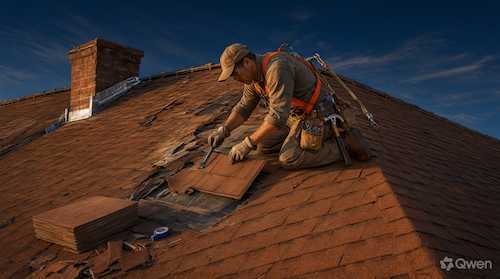
Seattle does not punish roofs with heat or hail. It wears them down with time and moisture. The metro receives about 39.3 inches of precipitation a year at the Sea-Tac station, and the mild temperatures — January averaging 42.8°F, July 67.1°F — mean roofs stay damp for long stretches instead of drying out quickly. The failures that matter here are rarely dramatic; they are slow, and they start in the details.
Organic growth and debris
In a damp climate, organic material on the roof stays wet longer. Ask how the proposal handles debris in valleys and gutters, and whether any treatment for organic growth is included. Cleaning and inspection belong in the comparison, because a new covering installed over the same collection points will face the same conditions.
Rain, flashing, and underlayment
Ask whether flashing is replaced or reused at chimneys, skylights, and wall transitions, and what underlayment is specified. In a wet climate, the underlayment is doing much of the waterproofing work. A scope that names the shingle but not the layer beneath it is quoting the visible half of the roof.
Attic moisture and ventilation
Moisture that cannot escape the attic can condense on the underside of the roof deck. Ask whether the proposal includes ventilation improvements and how the attic will be checked for existing moisture or mold. Ventilation is not a cosmetic upgrade here; it is part of how the assembly manages water vapor.
What to compare in the proposal
Compare the roof area, removal and installation scope, underlayment, flashing, ventilation, deck repair allowances, disposal, permit handling, and warranty terms. Ask how deck repair is priced if soft spots are found after removal, and whether the contractor will document the condition under the old covering.
Questions to ask before approving work
Where this page stops
This page does not inspect a roof or publish local prices. Roof condition, moisture in the attic, and permit requirements must be confirmed at the property and with the responsible authority.
Seattle metro context
The 2024 ACS 5-year estimates put the metro at about 4.1 million residents and 1.6 million households. About 60.0% of occupied homes are owner-occupied, and about 56.0% of housing units are single-family detached. About 42.7% of housing units were built before 1980, so many roofs have already been replaced once. NOAA's station records January averaging 42.8°F, July 67.1°F, about 39.3 inches of precipitation, and 6.3 inches of snow in a typical year.
Seattle reference station and housing indicators
| Indicator | Value | Source |
|---|---|---|
| January mean temperature | 42.8°F | NOAA NCEI |
| July mean temperature | 67.1°F | NOAA NCEI |
| Annual precipitation | 39.3 in. | NOAA NCEI |
| Annual snowfall | 6.3 in. | NOAA NCEI |
| Metro population | 4,061,920 | U.S. Census Bureau |
| Housing units built before 1980 | 42.7% | U.S. Census Bureau |
Station normals are historical averages for one location, not a forecast. Census values describe the metro area, not an individual property.
Frequently Asked Questions
How do I deal with moss or organic growth on a Seattle roof?
Ask the contractor how the growth will be removed and whether the treatment is safe for the covering and the surrounding plants. Removing growth without addressing shade, debris, and moisture may only postpone the problem.
What should a roofing proposal include in Seattle?
The roof area, removal and installation scope, underlayment, flashing, ventilation, deck repair handling, debris and gutter work, disposal, permit responsibilities, and warranty terms.
Why does attic ventilation matter in a mild climate?
Moisture that cannot escape can condense on the roof deck, especially in a damp climate. Ask whether ventilation improvements are included and how the attic will be checked for existing moisture.
How often should a roof be inspected?
There is no universal interval. Tree cover, shade, roof age, and previous repairs affect how often debris and flashing should be checked. Ask a contractor to document findings rather than relying on a calendar rule.
Can a roof be repaired instead of replaced?
Sometimes. It depends on the extent of the problem and the condition of the underlayment and deck. Ask each contractor to describe the same scope so the options can be compared.
What is the population of the Seattle metro area?
The U.S. Census Bureau's 2024 ACS 5-year estimates report about 4.1 million residents in the metro area. The figure describes regional scale, not the number of homes or providers.
Sources and review date
- American Community Survey 2024 5-year estimates (CBSA tables) — U.S. Census Bureau, 2024 ACS 5-year estimates.
- 1991–2020 station normals — SEATTLE TACOMA INTL AP, WA US (USW00024233) — NOAA National Centers for Environmental Information, 1991–2020 climate normals.
Reviewed on 2026-11-17.