
Portland, OR-WA · metro guide
Roofing in Portland: Moss, Rain and the Case for Metal
The problem here is not heat or snow — it is that the roof stays wet for eight months a year.
Metro snapshot
Portland in numbers
Sources named below each block
- Population
- 2.5M
- Households
- 1.0M
- Housing units
- 1.1M
- People / household
- 2.50
- population ÷ households
Owner-occupied homes 62%
The rest are rented. Owners are the ones who commission most exterior work.
Single-family detached 60%
Detached houses carry their own roof, gutters and exterior walls.
Built before 1980 46%
Older housing stock shapes what fails first: gutters, flashing, pipe material.
Season
The year in Portland
- Precipitation
- 36.9 in
- Snowfall
- 4.2 in
Average temperature by month, °F — the shape of the year is what decides when exterior work gets done.
Precipitation by month, inches.
Snowfall by month, inches.
| Month | Average temperature (°F) | Precipitation (in) | Snowfall (in) |
|---|---|---|---|
| January | 41.9°F | 5.03 in | 1.7 in |
| February | 44.1°F | 3.68 in | 1.2 in |
| March | 48.3°F | 3.97 in | 0.1 in |
| April | 52.8°F | 2.89 in | 0.0 in |
| May | 59.4°F | 2.51 in | 0.0 in |
| June | 64.2°F | 1.63 in | 0.0 in |
| July | 70.2°F | 0.51 in | 0.0 in |
| August | 70.6°F | 0.54 in | 0.0 in |
| September | 65.4°F | 1.52 in | 0.0 in |
| October | 55.6°F | 3.42 in | 0.0 in |
| November | 47.1°F | 5.45 in | 0.0 in |
| December | 41.6°F | 5.77 in | 1.2 in |
NOAA 1991–2020 climate normals, station PORTLAND INTL AP, OR US (USW00024229). Station observations, not a metro-wide average — a metro that spans a mountain range can differ by more than this record shows.
Population, households and housing shares: U.S. Census Bureau, American Community Survey 2024 5-year estimates, metropolitan statistical area.
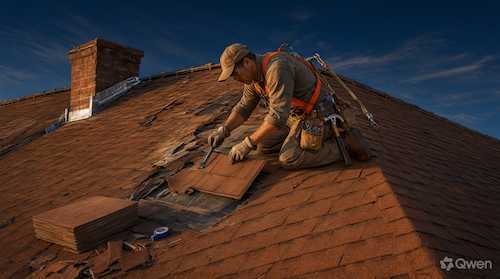
Portland's roofing problem is prolonged wetness. The reference station records 36.9 inches of annual precipitation with 5.03 inches in January and only 0.51 inches in July, so the roof is wet for most of the year and dry for a few weeks. Asphalt shingles are designed to shed water quickly, not to sit damp: moss establishes in the shaded, slower-drying areas, its root structure lifts the shingle edges, and water gets under the tabs. Nearly 46% of the housing predates 1980, so plenty of roofs here are on their second or third covering over original boards, and the low-slope porch and addition roofs common on older houses have their own set of failures.
Moss is the local failure mode
Moss grows where water lingers: north slopes, under tree cover and in the shadow of a dormer. By the time it is visible as a green mat, the roots are already under the shingle edges, and lifting a shingle does not put it back. Clearing it by pressure washing makes the surface look better and takes granules with it, which shortens the roof's life. Ask how moss is being treated, whether the covering is being replaced or cleaned, and what is specified to slow its return on the shaded elevations — because it will return.
Eight wet months and the details that fail
In a climate where the roof is wet for most of the year, the details that matter are the ones that have to stay watertight without any drying time: valleys, pipe boots, step flashings at a wall, and the transition from a pitched roof to a low-slope porch. Metal flashings here can last decades while the sealant around them fails in a few seasons. Ask how the flashings are being detailed and what material is used, whether sealant is being relied on where a proper flashing belongs, and how the wall-to-roof junctions are being handled.
Porches, additions and low-slope roofs
Older houses here frequently have a rear porch or an addition at a pitch below what strip shingles are meant for, and that is where the leaks start. A membrane appropriate to low slope, correctly terminated at the wall and the drip edge, is the answer; a second layer of shingles is not. Ask what pitch is being measured, which product is specified for the low-slope areas, and whether the old layers are being removed to the deck.
Choosing for the climate rather than the price
Because moss and constant moisture are the enemies here, the material choice matters more than it does in a dry climate. Metal and some synthetic products shed water and resist growth better than an organic-mat shingle, and they cost more up front. Whatever is chosen, the shaded elevations will still need attention. Ask what the expected service life is in this climate specifically rather than in general, what maintenance the product needs, and whether the gutters and downspouts are sized for the rainfall.
Ventilation and the underside of the deck
In a climate where the roof is damp for months, ventilation is not only about heat. An attic or roof space that cannot dry keeps moisture against the underside of the decking and the rafters, and the rot is discovered when the covering comes off. That is why the ventilation detail belongs in a roofing estimate here rather than in a separate conversation. Ask how intake and exhaust are balanced, whether anything is exhausting into the roof space, and whether the deck will be checked for moisture while it is exposed.
What to pin down in the estimate
Where this page stops
No prices are quoted and no roof is assessed here. Deck condition and structural questions require inspection, and any historic or permit requirement belongs to the local authority.
Portland metro context
The 2024 ACS 5-year estimates describe about 2.52 million residents in 1,010,265 households and 1,062,495 housing units, with 61.7% owner-occupied and 60.2% single-family detached. About 45.5% of units predate 1980. At the Portland reference station January averages 41.9°F and July 70.2°F, with 36.9 inches of annual precipitation and 4.2 inches of snow.
Portland reference station and housing indicators
| Indicator | Value | Source |
|---|---|---|
| January mean temperature | 41.9°F | NOAA NCEI |
| July mean temperature | 70.2°F | NOAA NCEI |
| Annual precipitation | 36.9 in. | NOAA NCEI |
| Metro population | 2,520,987 | U.S. Census Bureau |
| Owner-occupied share | 61.7% | U.S. Census Bureau |
| Housing units built before 1980 | 45.5% | U.S. Census Bureau |
Station normals are historical averages for one location, not a forecast. Rainfall concentrated outside summer is what keeps a roof damp for months, and it is the reason moss rather than heat decides the covering's life here.
Frequently Asked Questions
Should I pressure wash the moss off?
It is usually the wrong tool. Pressure washing strips granules and shortens the roof's life while leaving the roots behind. Treating the moss and correcting the conditions that favor it is more effective.
Why does moss keep coming back on one slope?
Because that slope stays damp: it faces north, sits under trees or is shaded by a dormer. Treating without addressing the shade and the debris means it returns within a couple of seasons.
Is a metal roof worth it here?
It resists moss and sheds water well, which suits this climate, at a higher up-front cost. Whether it pays depends on the expected service life and how long you intend to stay.
How often do gutters need clearing?
More often than in a dry climate, because tree debris stays wet and compacts. An overflowing gutter rots the fascia behind it and puts water against the foundation.
Do I need to worry about ice dams?
Less than in a cold inland climate, but a winter storm can still build ice at an eave where heat escapes from the attic. Ventilation and insulation are the underlying fix.
Can a low-slope porch roof be shingled?
Below the minimum pitch for shingles, water sits on the surface rather than running off. Those areas call for a membrane system and proper terminations at the wall and the drip edge.
Sources and review date
- American Community Survey 2024 5-year estimates (CBSA tables) — U.S. Census Bureau, 2024 ACS 5-year estimates.
- 1991–2020 station normals — PORTLAND INTL AP, OR US (USW00024229) — NOAA National Centers for Environmental Information, 1991–2020 climate normals.
Reviewed on 2026-11-18.