
Portland, OR-WA · metro guide
Water Damage in Portland: Wet Months, Crawlspaces and Moss-Blocked Gutters
The loss here is rarely a burst pipe — it is water that has been arriving slowly for weeks.
Metro snapshot
Portland in numbers
Sources named below each block
- Population
- 2.5M
- Households
- 1.0M
- Housing units
- 1.1M
- People / household
- 2.50
- population ÷ households
Owner-occupied homes 62%
The rest are rented. Owners are the ones who commission most exterior work.
Single-family detached 60%
Detached houses carry their own roof, gutters and exterior walls.
Built before 1980 46%
Older housing stock shapes what fails first: gutters, flashing, pipe material.
Season
The year in Portland
- Precipitation
- 36.9 in
- Snowfall
- 4.2 in
Average temperature by month, °F — the shape of the year is what decides when exterior work gets done.
Precipitation by month, inches.
Snowfall by month, inches.
| Month | Average temperature (°F) | Precipitation (in) | Snowfall (in) |
|---|---|---|---|
| January | 41.9°F | 5.03 in | 1.7 in |
| February | 44.1°F | 3.68 in | 1.2 in |
| March | 48.3°F | 3.97 in | 0.1 in |
| April | 52.8°F | 2.89 in | 0.0 in |
| May | 59.4°F | 2.51 in | 0.0 in |
| June | 64.2°F | 1.63 in | 0.0 in |
| July | 70.2°F | 0.51 in | 0.0 in |
| August | 70.6°F | 0.54 in | 0.0 in |
| September | 65.4°F | 1.52 in | 0.0 in |
| October | 55.6°F | 3.42 in | 0.0 in |
| November | 47.1°F | 5.45 in | 0.0 in |
| December | 41.6°F | 5.77 in | 1.2 in |
NOAA 1991–2020 climate normals, station PORTLAND INTL AP, OR US (USW00024229). Station observations, not a metro-wide average — a metro that spans a mountain range can differ by more than this record shows.
Population, households and housing shares: U.S. Census Bureau, American Community Survey 2024 5-year estimates, metropolitan statistical area.
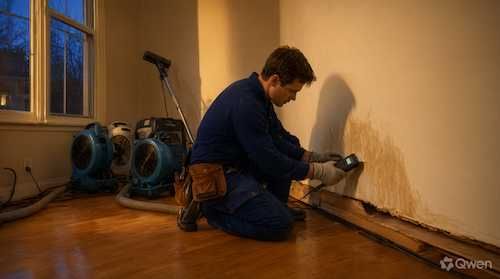
Portland gets 36.9 inches of rain, 5.03 of them in January and almost none in July, and the housing is older than average: 45.5% predates 1980, much of it with a crawlspace under the floor. Those two facts produce a different profile of loss from a storm-driven climate. Instead of a single dramatic event, the typical problem is chronic wetting — a gutter that has been blocked by moss since November, a window head that has leaked into the wall for two seasons, a crawlspace that never dries out. The damage is found late, usually when something else is being repaired.
The crawlspace under an older house
A vented crawlspace in a wet climate is designed to let ground moisture escape, and it works only if the ground is covered and the vents are open. Add a blocked vent, a downspout discharging beside the foundation, or years of stored belongings and the space stays damp, which then shows up as cupped floors, musty air inside the house and rot at the joist ends. Ask whether a vapor barrier is installed and sealed at the walls, whether the vents are clear, and how the moisture will be measured rather than judged by smell.
Gutters, moss and where the water lands
In a metro where moss is a roofing fact of life, gutters fill with growth and debris and then overflow — usually at the fascia and the wall below, not in the middle of the roof. A downspout that discharges against the foundation puts the water exactly where it does most damage. Ask whether the gutters and downspouts are part of the scope, where the discharge points are, and whether the grading sends water away from the building or back toward it.
The big winter storms
Most of the rain arrives in a handful of sustained events rather than in summer thunderstorms, and those events find the details that were marginal all year: a valley flashing, a skylight curb, the joint where a porch roof meets a wall. Water can also arrive from uphill, where saturated ground pushes into a basement or a low door. Ask how the property drains in a sustained storm, whether there is any history of water at a door or a stairwell, and which details on the building were last checked.
And then it freezes
A January mean of 41.9°F sounds mild, and it is — until a cold snap arrives and the housing stock, which is not built for hard freezes, produces the classic burst: a pipe in a crawlspace, an unheated garage wall or an exterior hose bib. The damage appears at the thaw. Ask whether the crawlspace plumbing is insulated, whether exterior faucets are frost-free or drained, and where the main shut-off is so a failure can be isolated quickly.
What the policy calls the loss
The difference between a covered loss and an argument usually comes down to how the event is classified: a sudden discharge from a pipe, a storm opening in the roof, or long-term seepage through a window that has leaked for years. Those are treated differently, and in a wet climate the third is common. Ask the insurer which perils are included, document the source as well as the damage, and keep a dated record from the first hour — because the timeline is often what decides it.
What to pin down before work starts
Where this page stops
No prices are quoted and no loss is assessed here. Insurance coverage depends on the individual policy and on whether the loss is treated as a sudden event or long-term seepage, and mold or structural questions require inspection.
Portland metro context
The 2024 ACS 5-year estimates describe about 2.52 million residents in 1,010,265 households and 1,062,495 housing units, with 61.7% owner-occupied and 60.2% single-family detached. About 45.5% of units predate 1980, which is where crawlspaces and original window details are most common. At the reference station annual precipitation is 36.9 inches, concentrated between autumn and spring.
Portland reference station and housing indicators
| Indicator | Value | Source |
|---|---|---|
| January mean temperature | 41.9°F | NOAA NCEI |
| July mean temperature | 70.2°F | NOAA NCEI |
| Annual precipitation | 36.9 in. | NOAA NCEI |
| Metro population | 2,520,987 | U.S. Census Bureau |
| Owner-occupied share | 61.7% | U.S. Census Bureau |
| Housing units built before 1980 | 45.5% | U.S. Census Bureau |
Station normals are historical averages for one location, not a forecast. Rainfall that continues for months is what turns a small defect into rot, and it is why moisture problems here are usually found late.
Frequently Asked Questions
Why does my house smell musty in winter?
Usually the crawlspace. Damp ground, a missing or torn vapor barrier and blocked vents keep the space wet, and the air moves upward into the house. It is a measurable problem, not just an odor.
Is a little water in the crawlspace normal?
Damp ground is common; standing water is not. If water is pooling, the source is either the grade, a downspout or a plumbing leak, and it should be identified rather than dried repeatedly.
How often should gutters be cleared here?
More often than in a dry climate, because moss and debris stay wet and compact. Once a year is rarely enough on a lot with trees.
Is long-term seepage covered by insurance?
Usually not — policies typically distinguish sudden discharge from repeated or gradual seepage. The timeline of when the problem started matters as much as the damage.
Do pipes freeze here?
Occasionally, and the housing is not built for it. The vulnerable runs are in crawlspaces, unheated garages and exterior walls, and the damage usually appears when temperatures rise.
Can a damp crawlspace be sealed instead of vented?
That is a design decision with real trade-offs, and it depends on the assembly and on how the space is used. It should be made on the basis of measurements rather than as a default fix.
Sources and review date
- American Community Survey 2024 5-year estimates (CBSA tables) — U.S. Census Bureau, 2024 ACS 5-year estimates.
- 1991–2020 station normals — PORTLAND INTL AP, OR US (USW00024229) — NOAA National Centers for Environmental Information, 1991–2020 climate normals.
Reviewed on 2026-11-18.