
Boston, MA-NH · metro guide
Window Cleaning in Boston: Triple-Deckers, Historic Rules and Sea Salt
Two-thirds of the housing predates 1980, and a good part of it comes with rules about how the exterior may be touched.
Metro snapshot
Boston in numbers
Sources named below each block
- Population
- 5.0M
- Households
- 1.9M
- Housing units
- 2.1M
- People / household
- 2.55
- population ÷ households
Owner-occupied homes 62%
The rest are rented. Owners are the ones who commission most exterior work.
Single-family detached 47%
Detached houses carry their own roof, gutters and exterior walls.
Built before 1980 66%
Older housing stock shapes what fails first: gutters, flashing, pipe material.
Season
The year in Boston
- Precipitation
- 43.6 in
- Snowfall
- 49.2 in
Average temperature by month, °F — the shape of the year is what decides when exterior work gets done.
Precipitation by month, inches.
Snowfall by month, inches.
| Month | Average temperature (°F) | Precipitation (in) | Snowfall (in) |
|---|---|---|---|
| January | 29.9°F | 3.39 in | 14.3 in |
| February | 31.8°F | 3.21 in | 14.4 in |
| March | 38.3°F | 4.17 in | 9.0 in |
| April | 48.6°F | 3.63 in | 1.6 in |
| May | 58.4°F | 3.25 in | 0.0 in |
| June | 68.0°F | 3.89 in | 0.0 in |
| July | 74.1°F | 3.27 in | 0.0 in |
| August | 72.7°F | 3.23 in | 0.0 in |
| September | 65.6°F | 3.56 in | 0.0 in |
| October | 54.8°F | 4.03 in | 0.2 in |
| November | 44.7°F | 3.66 in | 0.7 in |
| December | 35.7°F | 4.30 in | 9.0 in |
NOAA 1991–2020 climate normals, station BOSTON LOGAN INTL AP, MA US (USW00014739). Station observations, not a metro-wide average — a metro that spans a mountain range can differ by more than this record shows.
Population, households and housing shares: U.S. Census Bureau, American Community Survey 2024 5-year estimates, metropolitan statistical area.
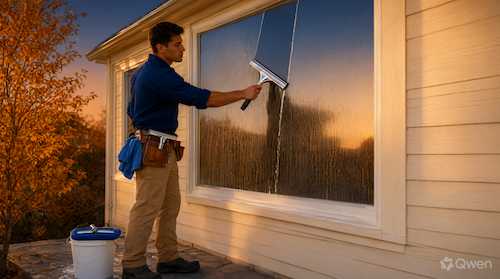
Boston gets 43.6 inches of rain and 49.2 inches of snow, with a January mean of 29.9°F, and 66.2% of its housing predates 1980. That combination means old wood sashes, storm windows and masonry that has been wet and salted for a century, plus a large share of attached housing — only 46.6% of units are detached — including the triple-deckers that define the region. Historic districts add a layer that has nothing to do with cleaning: some exterior work needs approval, and some equipment is not permitted on certain streets.
Triple-deckers and shared access
A three-storey flat-roof building with porches front and back is reached from the ground or from a porch roof, and the rear elevation often sits over a shared yard. Access may need a neighbor's permission, and the porch structure itself may not be safe to stand on. Ask how each elevation is reached and who is being asked for access.
Road salt and sea salt together
Winter puts salt on the street-facing glass and coastal neighborhoods get it from the air as well, so frames and hardware corrode while the glass carries a haze into spring. Aluminum storms and steel fixings are the parts that suffer first. Ask whether frames and hardware are rinsed, not just the glass.
Historic districts and what they require
In designated districts exterior work may need approval, and the requirements can cover equipment, access and hours as well as any physical change. A crew that has not worked the district before can lose a day. Ask what the district requires and whether the contractor has worked in yours.
Sashes, storms and lead paint
With two-thirds of the stock predating 1980, wood sashes with storm panels are standard, and the inner glass is only reachable with the storm removed. Some of that paint predates 1978. Ask whether storms come off and go back, and how painted surfaces are handled without disturbance.
The freeze and the working season
Water on glass, ladders and poles freezes, so exterior work stops in the cold months and resumes in a rush in spring when the salt is still on the glass. That is when schedules fill. Ask how a freeze mid-job is handled and how far ahead spring work is booked.
What to pin down in the estimate
Where this page stops
No prices are quoted and no property is assessed here. Lead paint, rot and district approvals are matters for a qualified contractor, an inspector or the district itself, not for this page.
Boston metro context
The 2024 ACS 5-year estimates describe about 4.95 million residents in 1,940,688 households and 2,059,059 housing units, with 61.6% owner-occupied and 46.6% single-family detached. About 66.2% of units predate 1980. At the Boston Logan Intl Ap reference station January averages 29.9°F and July 74.1°F, on 43.6 inches of annual precipitation.
Boston reference station and housing indicators
| Indicator | Value | Source |
|---|---|---|
| January mean temperature | 29.9°F | NOAA NCEI |
| July mean temperature | 74.1°F | NOAA NCEI |
| Annual precipitation | 43.6 in. | NOAA NCEI |
| Metro population | 4,953,354 | U.S. Census Bureau |
| Owner-occupied share | 61.6% | U.S. Census Bureau |
| Housing units built before 1980 | 66.2% | U.S. Census Bureau |
Station normals are historical averages for one location, not a forecast. Glass condition depends on how often the surface is wetted and what the water carries.
Frequently Asked Questions
Why does the glass haze over every spring?
Salt from the roads and, near the water, from the air. It holds moisture on the surface and survives until it is deliberately removed.
Do storm windows have to come off?
For the inner pane, yes. Confirm whether removal and refitting are in the scope and who puts them back.
Can windows be cleaned in winter here?
Exterior work stops when water freezes on glass or equipment. Interior work continues through the season.
Does a historic district affect window cleaning?
Sometimes, on equipment, access or hours rather than on the cleaning itself. Confirm before the visit rather than at the door.
What about lead paint on old sashes?
It is a lead-safety question. Cleaning that disturbs paint on pre-1978 windows needs the right practice, not just a careful hand.
Is sea salt worse than road salt?
Both corrode frames and fixings. Coastal properties get a continuous dose rather than a seasonal one.
Sources and review date
- American Community Survey 2024 5-year estimates (CBSA tables) — U.S. Census Bureau, 2024 ACS 5-year estimates.
- 1991–2020 station normals — BOSTON LOGAN INTL AP, MA US (USW00014739) — NOAA National Centers for Environmental Information, 1991–2020 climate normals.
Reviewed on 2026-11-18.