
Providence, RI-MA · metro guide
Window Cleaning in Providence: Sea Salt, Old Mill Housing and Triple-Deckers
Old, dense and close to the water, with the salt that comes with all three.
Metro snapshot
Providence in numbers
Sources named below each block
- Population
- 1.7M
- Households
- 675K
- Housing units
- 731K
- People / household
- 2.49
- population ÷ households
Owner-occupied homes 63%
The rest are rented. Owners are the ones who commission most exterior work.
Single-family detached 55%
Detached houses carry their own roof, gutters and exterior walls.
Built before 1980 70%
Older housing stock shapes what fails first: gutters, flashing, pipe material.
Season
The year in Providence
- Precipitation
- 47.5 in
- Snowfall
- 36.6 in
Average temperature by month, °F — the shape of the year is what decides when exterior work gets done.
Precipitation by month, inches.
Snowfall by month, inches.
| Month | Average temperature (°F) | Precipitation (in) | Snowfall (in) |
|---|---|---|---|
| January | 30.2°F | 3.96 in | 10.3 in |
| February | 32.0°F | 3.44 in | 10.5 in |
| March | 38.9°F | 4.90 in | 6.4 in |
| April | 49.3°F | 4.29 in | 0.6 in |
| May | 59.1°F | 3.37 in | 0.0 in |
| June | 68.2°F | 3.81 in | 0.0 in |
| July | 74.4°F | 2.91 in | 0.0 in |
| August | 73.0°F | 3.59 in | 0.0 in |
| September | 65.6°F | 4.17 in | 0.0 in |
| October | 54.4°F | 4.18 in | 0.2 in |
| November | 44.5°F | 4.27 in | 1.0 in |
| December | 35.5°F | 4.65 in | 7.6 in |
NOAA 1991–2020 climate normals, station PROVIDENCE T F GREEN AP, RI US (USW00014765). Station observations, not a metro-wide average — a metro that spans a mountain range can differ by more than this record shows.
Population, households and housing shares: U.S. Census Bureau, American Community Survey 2024 5-year estimates, metropolitan statistical area.
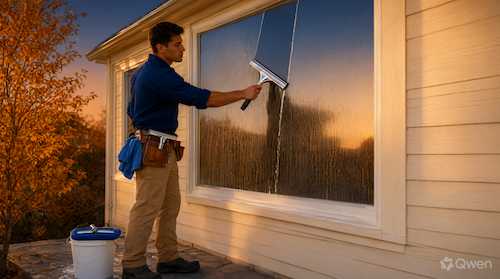
Providence has 70.0% of its housing built before 1980 and only 54.7% detached, so the stock is old and much of it is attached — triple-deckers, mill housing and two-family houses with shared walls and shared access. Being at the head of Narragansett Bay adds salt to the air on top of the road salt of winter, and the maritime air keeps shaded surfaces damp for long stretches. That combination is hard on wood frames, metal storms and hardware.
Sea salt and road salt together
Coastal air deposits salt continuously and winter adds it from the roads, so glass, frames, storms and hardware are all in contact with it. Metal corrodes, wood holds moisture and the glass carries a haze into spring. Ask whether frames and hardware are rinsed as well as the panes.
Triple-deckers and shared access
A three-storey building with a rear porch is reached from the ground or over the porch roof, and access often crosses a shared yard or a neighbor's entry. Whoever books the work may not be the one who grants access. Ask how each elevation is reached and whose permission is needed.
Mill-era woodwork and old sashes
The older stock includes sashes that have been painted many times, with putty that has been failing for years and storms that have to come off. Those frames do not tolerate soaking, and some of the paint predates 1978. Ask how both are handled.
Maritime damp and shaded growth
Bay air keeps shaded elevations damp, and tight streets keep much of the glass out of the sun. Growth establishes on frames and in tracks. Glass-only cleaning leaves it. Ask whether frames, sills and tracks are in scope.
Freeze and the season
Exterior work stops when water freezes on glass or equipment, and the spring that follows leaves salt on the glass that has been there all winter. Ask how the first spring visit is scheduled.
What to pin down in the estimate
Where this page stops
No prices are quoted and no property is assessed here. Rot, failed putty, lead paint and shared-building access are matters for an inspection or for the owners involved.
Providence metro context
The 2024 ACS 5-year estimates describe about 1.68 million residents in 675,395 households and 730,957 housing units, with 63.2% owner-occupied and 54.7% single-family detached. About 70.0% of units predate 1980. No climate station is reported for this metro in the site dataset, so no temperature or precipitation normals appear on this page.
Providence housing indicators
| Indicator | Value | Source |
|---|---|---|
| Housing units built before 1980 | 70.0% | U.S. Census Bureau |
| Single-family detached share | 54.7% | U.S. Census Bureau |
| Owner-occupied share | 63.2% | U.S. Census Bureau |
| Metro households | 675,395 | U.S. Census Bureau |
| Housing units | 730,957 | U.S. Census Bureau |
| Metro population | 1,684,071 | U.S. Census Bureau |
Station normals are historical averages for one location, not a forecast. Glass condition depends on how often the surface is wetted and what the water carries.
Frequently Asked Questions
Why does the glass look hazy every spring?
Salt from the air and the roads. It holds moisture on the surface and stays until it is deliberately removed.
Can you clean only one unit in a triple-decker?
Usually, but access is external and may cross shared space. Confirm who authorizes it and how the rear is reached.
Do storm windows have to come off?
For the inner pane, yes. Ask whether removal and refitting are included.
Is sea salt harder on frames than road salt?
It is continuous rather than seasonal, so metal corrodes year round on coastal properties.
Is lead paint a concern?
On pre-1978 windows it is, and cleaning that disturbs old paint needs lead-safe practice.
When should I book?
Early spring, once salting stops, and again in autumn before the first freeze.
Sources and review date
- American Community Survey 2024 5-year estimates (CBSA tables) — U.S. Census Bureau, 2024 ACS 5-year estimates.
Reviewed on 2026-11-18.