
Denver, CO · metro guide
Gutter Cleaning in Denver: Hail-Dented Runs, Wind and Very Little Rain
So little rain falls that a failing gutter can go unnoticed for years — until the one storm that matters.
Metro snapshot
Denver in numbers
Sources named below each block
- Population
- 3.0M
- Households
- 1.2M
- Housing units
- 1.3M
- People / household
- 2.46
- population ÷ households
Owner-occupied homes 64%
The rest are rented. Owners are the ones who commission most exterior work.
Single-family detached 57%
Detached houses carry their own roof, gutters and exterior walls.
Built before 1980 41%
Older housing stock shapes what fails first: gutters, flashing, pipe material.
Season
The year in Denver
- Precipitation
- 14.5 in
- Snowfall
- —
Average temperature by month, °F — the shape of the year is what decides when exterior work gets done.
Precipitation by month, inches.
| Month | Average temperature (°F) | Precipitation (in) | Snowfall (in) |
|---|---|---|---|
| January | 31.7°F | 0.38 in | — |
| February | 32.7°F | 0.41 in | — |
| March | 41.6°F | 0.86 in | — |
| April | 47.8°F | 1.68 in | — |
| May | 57.4°F | 2.16 in | — |
| June | 68.2°F | 1.94 in | — |
| July | 75.1°F | 2.14 in | — |
| August | 72.9°F | 1.58 in | — |
| September | 64.8°F | 1.35 in | — |
| October | 51.1°F | 0.99 in | — |
| November | 39.4°F | 0.64 in | — |
| December | 31.2°F | 0.35 in | — |
NOAA 1991–2020 climate normals, station DENVER INTL AP, CO US (USW00003017). Station observations, not a metro-wide average — a metro that spans a mountain range can differ by more than this record shows.
Population, households and housing shares: U.S. Census Bureau, American Community Survey 2024 5-year estimates, metropolitan statistical area.
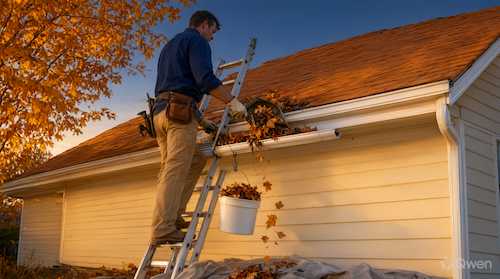
Denver gets 14.5 inches of precipitation a year, which is low enough that gutters are easy to ignore. That is the local problem: a run that leaks, sags or discharges against the foundation does its damage slowly and invisibly, and then a single convective storm delivers a month of rain in an hour. Hail is the other half of the story — the same storms that bring the water also dent aluminum and knock shingle granules into the channel.
Hail and what it leaves in the run
Hailstorms damage the roof covering, and the granules they knock loose wash into the gutter as a heavy grit that settles at the low points and in the outlets. Dents in the channel also create those low points. Ask whether the run is checked for grit and for the dents that trap it, not just for leaves.
Low rainfall hides failure
Fourteen inches a year is not enough to expose a slow leak or a sagging run, so problems sit for seasons without obvious symptoms and then show up as a wet basement after a storm. Ask how the contractor checks slope and joints rather than only clearing debris.
Wind-blown debris and exposed roofs
The metro is windy and much of the newer housing sits on open ground with few trees, so the debris load is small but the runs are exposed, and wind carries grit, seed and roofing material into them. Ask how often the property actually needs a visit, because a bare new build and an established neighborhood are different propositions.
Sun that degrades sealant and plastic
At this altitude the ultraviolet load is high, and sealant at joints and the plastic components of guards and outlets degrade faster than in a wetter climate. Ask whether joints and seals are inspected and reported.
Clay at the discharge point
The soil is clay and does not absorb quickly, so a downspout that ends at the wall sends roof water along the foundation. Ask where each downspout discharges and whether the ground falls away from the house.
What to pin down in the estimate
Where this page stops
No prices are quoted and no property is assessed here. Hail damage to roof coverings, foundation movement and grading are findings that need inspection, and roof claims belong to an insurer.
Denver metro context
The 2024 ACS 5-year estimates describe about 3.00 million residents in 1,221,636 households and 1,290,063 housing units, with 64.1% owner-occupied and 57.1% single-family detached. About 41.0% of units predate 1980. At the Denver Intl Ap reference station January averages 31.7°F and July 75.1°F, on 14.5 inches of annual precipitation.
Denver reference station and housing indicators
| Indicator | Value | Source |
|---|---|---|
| January mean temperature | 31.7°F | NOAA NCEI |
| July mean temperature | 75.1°F | NOAA NCEI |
| Annual precipitation | 14.5 in. | NOAA NCEI |
| Metro population | 3,002,721 | U.S. Census Bureau |
| Owner-occupied share | 64.1% | U.S. Census Bureau |
| Housing units built before 1980 | 41.0% | U.S. Census Bureau |
Station normals are historical averages for one location, not a forecast. What a gutter has to carry depends on roof area, pitch, the debris the surrounding trees drop and whether downspouts discharge where the water can leave.
Frequently Asked Questions
How often do gutters need clearing in a dry climate?
Often once a year is enough for debris, but the check for slope, dents and joints matters more here than the clearing.
Can hail damage a gutter?
It dents aluminum and creates low points where grit and water collect. The dents are part of the damage, not just cosmetic.
Why is there grit in my gutter?
Shingle granules washed off the roof, usually after hail. They settle at the low points and block the outlets.
Why does water still pool by the house?
Clay soil does not absorb quickly, so the discharge point matters. A downspout ending at the wall sends water along it.
Does low rainfall mean I can skip cleaning?
The debris load is lower, but a failing run goes unnoticed for longer, which is how the expensive damage happens.
What should I check after a hailstorm?
Dents in the channel, grit in the run and the state of the roof covering. All three are visible from the ground or from the roofline.
Sources and review date
- American Community Survey 2024 5-year estimates (CBSA tables) — U.S. Census Bureau, 2024 ACS 5-year estimates.
- 1991–2020 station normals — DENVER INTL AP, CO US (USW00003017) — NOAA National Centers for Environmental Information, 1991–2020 climate normals.
Reviewed on 2026-11-18.