
Detroit, MI · metro guide
Electrical in Detroit: Century-Old Bungalows and Sixty-Amp Services
Two thirds of the housing predates 1980, and in the inner ring a lot of it was wired for far less house than it now is.
Metro snapshot
Detroit in numbers
Sources named below each block
- Population
- 4.4M
- Households
- 1.8M
- Housing units
- 1.9M
- People / household
- 2.47
- population ÷ households
Owner-occupied homes 71%
The rest are rented. Owners are the ones who commission most exterior work.
Single-family detached 70%
Detached houses carry their own roof, gutters and exterior walls.
Built before 1980 66%
Older housing stock shapes what fails first: gutters, flashing, pipe material.
Season
The year in Detroit
- Precipitation
- 34.3 in
- Snowfall
- 45 in
Average temperature by month, °F — the shape of the year is what decides when exterior work gets done.
Precipitation by month, inches.
Snowfall by month, inches.
| Month | Average temperature (°F) | Precipitation (in) | Snowfall (in) |
|---|---|---|---|
| January | 25.8°F | 2.23 in | 14.0 in |
| February | 28.0°F | 2.08 in | 12.5 in |
| March | 37.2°F | 2.43 in | 6.2 in |
| April | 48.9°F | 3.26 in | 1.5 in |
| May | 60.3°F | 3.72 in | 0.0 in |
| June | 69.9°F | 3.26 in | 0.0 in |
| July | 74.1°F | 3.51 in | 0.0 in |
| August | 72.3°F | 3.26 in | 0.0 in |
| September | 64.9°F | 3.22 in | 0.0 in |
| October | 53.0°F | 2.53 in | 0.0 in |
| November | 41.2°F | 2.57 in | 1.9 in |
| December | 31.3°F | 2.25 in | 8.9 in |
NOAA 1991–2020 climate normals, station DETROIT METRO AP, MI US (USW00094847). Station observations, not a metro-wide average — a metro that spans a mountain range can differ by more than this record shows.
Population, households and housing shares: U.S. Census Bureau, American Community Survey 2024 5-year estimates, metropolitan statistical area.
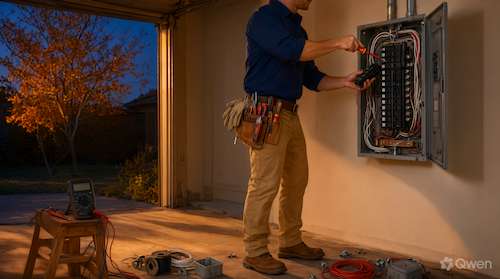
Detroit's electrical picture is dominated by age. ACS estimates put 66.3% of metro housing before 1980, and the inner ring contains a very large stock of 1920s bungalows and two-flats that were wired for lighting, a refrigerator and a gas range. Those houses have since acquired central air, a dryer, a second refrigerator and often an EV charger, and the panel is the same one that was installed when the street was new. The suburbs tell a different story — mostly 1950s to 1970s construction with 100-amp panels that are serviceable but full — but the same conclusion applies: the question is capacity and condition, not age alone.
Knob-and-tube and the sixty-amp service
Original services of 60 amps are still in service in parts of the city, sometimes with fuses rather than breakers, and knob-and-tube wiring remains in walls where nobody has opened them. The practical issues are the absence of an equipment ground, the condition of the insulation at fixtures, and what happens when a modern appliance is connected to a circuit that was never designed for it. Ask what the service rating is, which circuits are still on the old wiring, and whether the proposal is replacement or protection at the point of use. Insurers here often ask the same questions, so the answer is worth having in writing.
Aluminum branch circuits from the late 1960s
Some houses built between roughly 1965 and 1973 have aluminum branch wiring to receptacles and switches. It is not automatically dangerous and it is not automatically fine; the failure points are the connections at devices and in junction boxes. Ask whether the panel and a sample of devices were opened, what treatment is proposed for the connections, and whether the person doing the work has handled aluminum before. A blanket answer in either direction is a reason to get a second opinion.
Decades of work with no paperwork
A house that has been through vacancy, renovation and resale cycles often contains electrical work nobody documented — a basement finished in stages, a garage subpanel added, a kitchen rewired around an old circuit. Ask for the panel schedule to be verified against what is actually installed, and ask how the contract handles a finding outside the original scope. In this housing stock that is not an edge case; it is the normal condition, and a contractor who plans for it prices more honestly than one who does not.
Where the new loads land
Heating is the seasonal load here, whether from a furnace, a boiler or electric resistance, and central air now runs for a real summer as well. Add a dryer, an EV charger and a workshop, and a 100-amp panel can reach its limit. Ask for a load calculation that assumes the coldest week rather than an annual average, and ask whether the panel has physical space for the breakers even if it is adequate on paper. Those are two different constraints and both matter.
Permits, inspection and what they cover
Electrical work is licensed and inspected locally, and the requirements and the inspection process differ between the city and the surrounding counties. Ask who pulls the permit, what the inspection covers, and whether the permit covers the whole job or only the panel. A partial permit is a common problem at resale, when a buyer's inspector asks for documentation that does not exist.
What to settle before approving work
Where this page stops
No specific property is assessed here and no prices are published. Electrical hazards, service capacity and code compliance require on-site evaluation by a licensed electrician, and permit requirements belong to the local authority.
Detroit metro context
The 2024 ACS 5-year estimates count about 4.38 million residents in 1,768,816 households across 1,926,157 housing units. Owner occupancy is 71.2%, about 69.8% of units are single-family detached, and 66.3% were built before 1980 — one of the oldest stocks on this site, which is why service capacity and old wiring lead this page. A climate station is not reported for this metro in the site dataset, so no temperature figures are published here.
Detroit housing indicators
| Indicator | Value | Source |
|---|---|---|
| Metro population | 4,376,828 | U.S. Census Bureau |
| Metro households | 1,768,816 | U.S. Census Bureau |
| Housing units | 1,926,157 | U.S. Census Bureau |
| Housing units built before 1980 | 66.3% | U.S. Census Bureau |
| Single-family detached share | 69.8% | U.S. Census Bureau |
| Owner-occupied share | 71.2% | U.S. Census Bureau |
A climate station is not reported for this metro in the site dataset, so no temperature normals are shown. Census values describe the metro area, not an individual property.
Frequently Asked Questions
Is a 60-amp service enough for a modern house?
Rarely, if central air, a dryer, a dishwasher and an EV charger are all expected. The honest answer comes from a load calculation rather than a rule of thumb. In many cases the practical options are a service upgrade or a managed approach to what runs at the same time.
Does knob-and-tube wiring have to be replaced?
Not always immediately. What decides it is the condition of the wiring, whether circuits are appropriately protected, and how the insurer views it. Ask which circuits are involved and what the options are before agreeing to a whole-house rewiring.
What should I do about aluminum wiring?
Have it evaluated at the devices and junctions rather than condemned or ignored wholesale. The treatment for the connections is the substantive question, and it should be described in writing by someone who has done it before.
Why does my panel have no space left?
Because circuits were added one at a time over decades, often during renovations that were never documented. A panel can be electrically adequate and physically full, in which case the answer is consolidation, a subpanel, or a service upgrade.
Can I add an EV charger to an older home?
Often yes, sometimes with load management that prevents the charger and other large loads from drawing at once. What decides it is the service rating, the panel's spare capacity and the distance from the panel to where the car parks.
What if a previous owner did unpermitted work?
Ask the electrician to document what is present and what is not compliant, and how the contract will handle corrections. That is a common finding in a stock this old, and it is better priced into the project than discovered during an inspection.
Sources and review date
- American Community Survey 2024 5-year estimates (CBSA tables) — U.S. Census Bureau, 2024 ACS 5-year estimates.
Reviewed on 2026-11-18.