
Detroit, MI · metro guide
Gutter Cleaning in Detroit: Steel Gutters, Alley Outlets and Salt Rust
A metro where a lot of the gutters are made of steel that has been quietly rusting for decades.
Metro snapshot
Detroit in numbers
Sources named below each block
- Population
- 4.4M
- Households
- 1.8M
- Housing units
- 1.9M
- People / household
- 2.47
- population ÷ households
Owner-occupied homes 71%
The rest are rented. Owners are the ones who commission most exterior work.
Single-family detached 70%
Detached houses carry their own roof, gutters and exterior walls.
Built before 1980 66%
Older housing stock shapes what fails first: gutters, flashing, pipe material.
Season
The year in Detroit
- Precipitation
- 34.3 in
- Snowfall
- 45 in
Average temperature by month, °F — the shape of the year is what decides when exterior work gets done.
Precipitation by month, inches.
Snowfall by month, inches.
| Month | Average temperature (°F) | Precipitation (in) | Snowfall (in) |
|---|---|---|---|
| January | 25.8°F | 2.23 in | 14.0 in |
| February | 28.0°F | 2.08 in | 12.5 in |
| March | 37.2°F | 2.43 in | 6.2 in |
| April | 48.9°F | 3.26 in | 1.5 in |
| May | 60.3°F | 3.72 in | 0.0 in |
| June | 69.9°F | 3.26 in | 0.0 in |
| July | 74.1°F | 3.51 in | 0.0 in |
| August | 72.3°F | 3.26 in | 0.0 in |
| September | 64.9°F | 3.22 in | 0.0 in |
| October | 53.0°F | 2.53 in | 0.0 in |
| November | 41.2°F | 2.57 in | 1.9 in |
| December | 31.3°F | 2.25 in | 8.9 in |
NOAA 1991–2020 climate normals, station DETROIT METRO AP, MI US (USW00094847). Station observations, not a metro-wide average — a metro that spans a mountain range can differ by more than this record shows.
Population, households and housing shares: U.S. Census Bureau, American Community Survey 2024 5-year estimates, metropolitan statistical area.
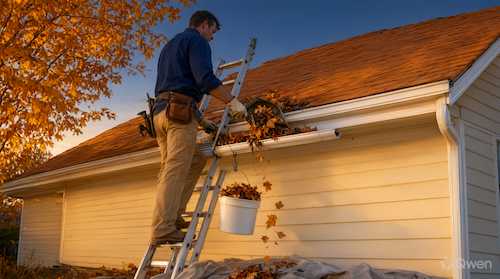
Detroit is 66.3% pre-1980 housing and 69.8% detached, and a great deal of it still carries galvanized steel or early aluminum runs rather than modern seamless aluminum. Steel that has held damp debris for years rusts from the inside, and the pinholes it develops are invisible until water starts running down the fascia. Add road salt, a long freeze and the alley-facing rear elevation, and the failures cluster at the back of the house.
Steel and galvanized runs that rust from inside
Debris held in a steel gutter keeps the base metal wet, and rust starts where it cannot be seen — often along the bottom seam. By the time water runs down the fascia the section is usually beyond patching. Ask whether the run's material and condition are assessed rather than only cleared.
Alley elevations and their outlets
On the classic Detroit lot the rear faces an alley used by vehicles and bins, and the downspout there discharges onto paving where water pools and refreezes. The alley elevation is also the one most often left out of a quote. Ask whether the rear is included and where it discharges.
Road salt and metal
Salt spray reaches the lower runs and the downspouts on the street side and holds moisture against metal through repeated freeze-thaw. Rust advances faster on that elevation than on the others. Ask whether the street side is checked for corrosion.
Outlets that freeze and stay frozen
A downspout holding debris or water freezes, and here that can last for weeks. Once it does, the run has no outlet and the ice backs up under the roof edge. Ask whether outlets are cleared as part of the visit.
Old hangers and sagging runs
Spike-and-ferrule hangers on old fascia loosen over decades, and a sagging run holds water even when it is clean. Ask whether the run is checked for slope and whether loose hangers are reported.
What to pin down in the estimate
Where this page stops
No prices are quoted and no property is assessed here. Rust perforation, fascia rot and hanger repair are findings that need inspection, and replacing a run is a separate job.
Detroit metro context
The 2024 ACS 5-year estimates describe about 4.38 million residents in 1,768,816 households and 1,926,157 housing units, with 71.2% owner-occupied and 69.8% single-family detached. About 66.3% of units predate 1980. No climate station is reported for this metro in the site dataset, so no temperature or precipitation normals appear on this page.
Detroit housing indicators
| Indicator | Value | Source |
|---|---|---|
| Housing units built before 1980 | 66.3% | U.S. Census Bureau |
| Single-family detached share | 69.8% | U.S. Census Bureau |
| Owner-occupied share | 71.2% | U.S. Census Bureau |
| Metro households | 1,768,816 | U.S. Census Bureau |
| Housing units | 1,926,157 | U.S. Census Bureau |
| Metro population | 4,376,828 | U.S. Census Bureau |
Station normals are historical averages for one location, not a forecast. What a gutter has to carry depends on roof area, pitch, the debris the surrounding trees drop and whether downspouts discharge where the water can leave.
Frequently Asked Questions
Why is water running down my fascia?
On an old steel run it is often a rust hole or a failed seam rather than a blockage. Both need to be looked at.
How old are galvanized gutters usually?
They can last decades, but they rust from the inside where damp debris sits, so condition matters more than age.
Does salt affect gutters?
It holds moisture against metal on the street side and speeds corrosion there compared with the rest of the house.
Is the back of the house included?
It should be. The alley elevation is the one most often left out of a quote and the one that fails first.
What happens if a downspout freezes?
The run loses its outlet and water backs up under the roof edge. Clearing the outlet matters as much as clearing the channel.
Can a sagging gutter be repaired?
Sometimes, if the run is sound. A sag that holds water is a hanger or pitch problem, and it needs fixing rather than clearing.
Sources and review date
- American Community Survey 2024 5-year estimates (CBSA tables) — U.S. Census Bureau, 2024 ACS 5-year estimates.
Reviewed on 2026-11-18.