
Detroit, MI · metro guide
Painting in Detroit: Brick Bungalows, Wood Trim, and Lead
The brick should usually be left alone. The wood trim around it is where the work actually is.
Metro snapshot
Detroit in numbers
Sources named below each block
- Population
- 4.4M
- Households
- 1.8M
- Housing units
- 1.9M
- People / household
- 2.47
- population ÷ households
Owner-occupied homes 71%
The rest are rented. Owners are the ones who commission most exterior work.
Single-family detached 70%
Detached houses carry their own roof, gutters and exterior walls.
Built before 1980 66%
Older housing stock shapes what fails first: gutters, flashing, pipe material.
Season
The year in Detroit
- Precipitation
- 34.3 in
- Snowfall
- 45 in
Average temperature by month, °F — the shape of the year is what decides when exterior work gets done.
Precipitation by month, inches.
Snowfall by month, inches.
| Month | Average temperature (°F) | Precipitation (in) | Snowfall (in) |
|---|---|---|---|
| January | 25.8°F | 2.23 in | 14.0 in |
| February | 28.0°F | 2.08 in | 12.5 in |
| March | 37.2°F | 2.43 in | 6.2 in |
| April | 48.9°F | 3.26 in | 1.5 in |
| May | 60.3°F | 3.72 in | 0.0 in |
| June | 69.9°F | 3.26 in | 0.0 in |
| July | 74.1°F | 3.51 in | 0.0 in |
| August | 72.3°F | 3.26 in | 0.0 in |
| September | 64.9°F | 3.22 in | 0.0 in |
| October | 53.0°F | 2.53 in | 0.0 in |
| November | 41.2°F | 2.57 in | 1.9 in |
| December | 31.3°F | 2.25 in | 8.9 in |
NOAA 1991–2020 climate normals, station DETROIT METRO AP, MI US (USW00094847). Station observations, not a metro-wide average — a metro that spans a mountain range can differ by more than this record shows.
Population, households and housing shares: U.S. Census Bureau, American Community Survey 2024 5-year estimates, metropolitan statistical area.
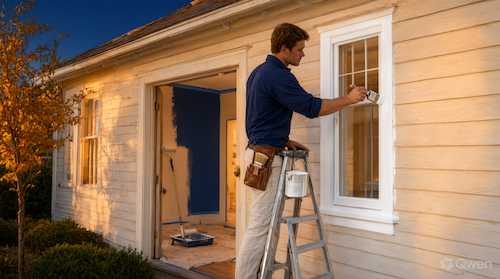
Detroit's inner-ring housing is largely brick — bungalows, two-flats and modest colonials with brick walls and a great deal of wood trim: window surrounds, fascia, porch columns, soffits and doors. That combination defines the painting job. The brick is meant to dry through its face and should usually not be coated, while the wood trim is exposed on every side and is where freeze-thaw, sun and water do their work. With 66.3% of metro housing built before 1980, most of the exteriors being repainted now carry multiple old coatings over original wood.
Brick and the coating question
Painting brick that has never been painted traps moisture in the wall, and in a climate with repeated freeze-thaw that shows up as spalling — the face of the brick coming away, which cannot be reversed. If the masonry is sound and unpainted, the usual advice is to leave it and address the mortar joints, the flashing and the staining instead. If it has already been painted, the goal becomes a breathable system and careful preparation rather than another heavy coat. Ask which surfaces are brick, whether a coating is actually appropriate, and what the source of any staining is.
The wood is where the job is decided
Trim on a 1925 house has probably been painted eight or nine times, and the failure patterns are predictable: alligatoring on the south and west faces where sun breaks the film, bare patches at the base of porch posts where snow sits, and open joints at window surrounds where water gets in. Scraping only the loose edges and painting over the rest is the fastest way to spend the same money twice. Ask what prep is included — hand scraping, sanding to feather edges, spot priming bare wood — and whether the joints will be re-caulked as part of the scope.
Freeze-thaw and the lower courses
Water that enters a joint or crack expands when it freezes, and the film above it lifts. That is why the bottom of the wall and the north elevations fail first here: snow sits against them, meltwater runs down, and the cycle repeats through the winter. Preparation is where the money goes, and a bid that prices per square foot without describing the prep is a bid for a coating that will look tired in three winters.
Lead paint is the norm in this stock
Two thirds of the housing predates 1978, so any preparation that involves sanding or scraping may generate lead dust. Ask whether surfaces will be tested, how the ground and landscaping are protected, how debris is contained and removed, and what documentation is supplied. This applies inside as well, and to the trim work that usually needs the heaviest preparation. In older rental property the applicable rules may be stricter, so confirm what standard applies before work starts.
A short season with hard edges
Exterior coatings need substrate and air temperatures within the product's range through curing, which here means late spring to early autumn. The shoulder weeks are where failures are created: paint applied on a cold October afternoon looks acceptable in November and peels in April. Ask how the contractor handles a job that runs into a cold snap, and whether they stop or push through. The answer says more about the company than the price does.
What to pin down in the estimate
Where this page stops
No prices are published and no assessment of a specific building is made here. Masonry deterioration, spalling and flashing failures should be evaluated by someone qualified to inspect the assembly, and lead requirements belong to the federal and state authorities.
Detroit metro context
The 2024 ACS 5-year estimates describe about 4.38 million residents in 1,768,816 households and 1,926,157 housing units, with 71.2% owner-occupied and 69.8% single-family detached. About 66.3% of units predate 1980, which is the share where original brick, original wood trim and multiple coatings are most likely. A climate station is not reported for this metro in the site dataset, so no temperature normals appear on this page.
Detroit housing indicators
| Indicator | Value | Source |
|---|---|---|
| Housing units built before 1980 | 66.3% | U.S. Census Bureau |
| Single-family detached share | 69.8% | U.S. Census Bureau |
| Owner-occupied share | 71.2% | U.S. Census Bureau |
| Housing units | 1,926,157 | U.S. Census Bureau |
| Metro households | 1,768,816 | U.S. Census Bureau |
| Metro population | 4,376,828 | U.S. Census Bureau |
No climate normals are shown because no station record is held for this metro in the site dataset. Housing age is a proxy for coating history and lead likelihood, not for condition.
Frequently Asked Questions
Should the brick on my house be painted?
Usually not. Brick is designed to dry through its face, and a coating traps moisture that freeze-thaw then damages from inside. If it is already painted, the practical goal is a breathable system and careful prep rather than another heavy film.
What is spalling and why does it matter?
The face of the brick coming away, usually because moisture froze behind it. It is irreversible on the affected units, so it is a reason to avoid trapping water in the wall in the first place and to fix the source rather than coat over it.
Why does the paint fail at the bottom of the wall first?
Because snow accumulates there and meltwater runs down, so that area stays wet longer and goes through more freeze-thaw cycles. It also takes splash from the ground, which carries dirt and salt.
Is lead paint likely in my house?
If it was built before 1978, possibly, and the likelihood rises with age. Any preparation involving sanding or scraping should include testing, containment and proper debris handling, with documentation at the end.
Can exterior painting be done in October?
Only if the product's minimum temperature holds through the curing window, which late-season weather rarely guarantees. A cold night shortly after application can prevent proper film formation and cause peeling the following spring.
Do I need to repaint all the woodwork at once?
Not necessarily. Exposed trim fails before shaded trim, so a phased approach can be sensible, provided a consistent product and color record is kept so later phases match.
Sources and review date
- American Community Survey 2024 5-year estimates (CBSA tables) — U.S. Census Bureau, 2024 ACS 5-year estimates.
Reviewed on 2026-11-18.