
Hartford, CT · metro guide
Water Damage Restoration in Hartford: Burst Pipe and the Spring Thaw
In a three-family building, the leak starts in one unit and the claim arrives in another.
Metro snapshot
Hartford in numbers
Sources named below each block
- Population
- 1.2M
- Households
- 465K
- Housing units
- 500K
- People / household
- 2.48
- population ÷ households
Owner-occupied homes 67%
The rest are rented. Owners are the ones who commission most exterior work.
Single-family detached 59%
Detached houses carry their own roof, gutters and exterior walls.
Built before 1980 67%
Older housing stock shapes what fails first: gutters, flashing, pipe material.
Season
The year in Hartford
- Precipitation
- 47 in
- Snowfall
- 51.7 in
Average temperature by month, °F — the shape of the year is what decides when exterior work gets done.
Precipitation by month, inches.
Snowfall by month, inches.
| Month | Average temperature (°F) | Precipitation (in) | Snowfall (in) |
|---|---|---|---|
| January | 27.1°F | 3.28 in | 14.2 in |
| February | 29.6°F | 3.13 in | 14.8 in |
| March | 37.8°F | 3.81 in | 9.4 in |
| April | 49.5°F | 3.88 in | 1.1 in |
| May | 60.0°F | 3.79 in | 0.0 in |
| June | 68.9°F | 4.28 in | 0.0 in |
| July | 74.3°F | 4.17 in | 0.0 in |
| August | 72.5°F | 4.21 in | 0.0 in |
| September | 64.8°F | 4.39 in | 0.0 in |
| October | 53.0°F | 4.52 in | 0.7 in |
| November | 42.3°F | 3.51 in | 1.4 in |
| December | 32.6°F | 4.08 in | 10.1 in |
NOAA 1991–2020 climate normals, station HARTFORD BRADLEY INTL AP, CT US (USW00014740). Station observations, not a metro-wide average — a metro that spans a mountain range can differ by more than this record shows.
Population, households and housing shares: U.S. Census Bureau, American Community Survey 2024 5-year estimates, metropolitan statistical area.
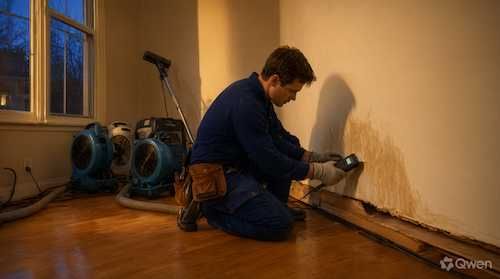
Hartford's water damage is winter-shaped. A hard freeze splits a supply line in an unheated porch or an exterior wall, and the water only starts running when it thaws. Snow accumulates on roofs with warm attics and forms ice dams at the eaves. In spring the melt releases over ground that cannot absorb it and finds foundations that were never waterproofed in the modern sense. And because only 59.3% of units are single-family detached, a great deal of this happens in buildings where one household's failure becomes another household's ceiling.
Frozen pipe, and damage at the thaw
The vulnerable runs are predictable: hose bibs left connected, lines in unheated porches and garages, rim joist cavities, and exterior walls in houses built before insulation standards changed. The split appears when the pipe thaws, which is why the supply should be shut off before thawing so the water does not run inside the wall. Ask how the leak was located, whether the wall is being opened to check for a second failure, and how much of the affected assembly needs to be removed rather than dried.
Ice dams and the ceiling below
Snow melts on a warm deck, refreezes at the cold eave, and pushes water back under the shingles until it shows up as a stain near an exterior wall. Removing icicles does nothing. Ask how the wet materials will be dried or removed, and what stops the next one — air sealing and insulation at the ceiling plane plus working ventilation. Those are the durable fixes; raking and heat cable treat symptoms.
The spring melt and old foundations
A brick or stone foundation built before the war has no modern drainage plane behind it, so water that reaches it comes through the mortar and the cove joint rather than around it. That changes what restoration means: the interior can be dried, but the wall will take water again unless the outside is addressed. Ask whether the contractor will recommend exterior work — grading, downspout extensions, a swale — alongside the interior drying.
When water crosses unit lines
In a two- or three-family building a supply failure on an upper floor reaches the ceiling below within minutes, and the lower household is involved whether or not they own the failed pipe. Ask who is documenting the loss, whose adjuster is involved, how the scope is divided between units, and whether common areas — hall ceilings, stairwells, shared basements — have been recorded. Those are the most frequently overlooked part of a multi-unit claim.
Drying plaster and old assemblies
Plaster and lath, solid masonry and multiple flooring layers hold water differently from modern drywall, and a plan built on standard assumptions will call a wall dry before it is. Ask for readings by material and location, a stated dry standard, and a recheck before the rebuild. Also ask who repairs plaster, because the finish repair is often a separate trade and a separate cost.
Questions to ask on the first visit
Where this page stops
This page does not assess a specific loss and publishes no prices. Sewage, mold and active intrusion require on-site assessment, and coverage questions belong to your insurer and the policy documents.
Hartford metro context
ACS 2024 5-year estimates report about 1.15 million residents in 465,181 households and 499,522 housing units, with 67.3% owner-occupied and 59.3% single-family detached. About 67.4% of units predate 1980, so most losses involve original pipe, older foundations and plaster finishes. A climate station is not reported for this metro in the site dataset, so no precipitation or snow figures are published on this page.
Hartford housing indicators
| Indicator | Value | Source |
|---|---|---|
| Housing units built before 1980 | 67.4% | U.S. Census Bureau |
| Single-family detached share | 59.3% | U.S. Census Bureau |
| Owner-occupied share | 67.3% | U.S. Census Bureau |
| Metro households | 465,181 | U.S. Census Bureau |
| Housing units | 499,522 | U.S. Census Bureau |
| Metro population | 1,153,112 | U.S. Census Bureau |
No climate normals are shown because no station record is held for this metro in the site dataset. Freeze and melt timing vary by year, which is why preparation matters more than averages.
Frequently Asked Questions
What should I do if a pipe freezes?
Shut off the supply before thawing so the leak at the split does not run inside the wall, then thaw carefully and check for a second failure. Knowing where the main shutoff is and that it turns has to be sorted out in advance.
My neighbor's pipe leaked into my unit. Whose insurance handles it?
It depends on the policies and the building's ownership structure, and the answer is rarely intuitive. Document your own loss independently, notify your insurer, and ask in writing how the carriers intend to divide the scope.
Why does my basement get wet in spring?
Because the melt releases over ground that cannot absorb it, and it reaches a foundation that was never built with a drainage plane. Grading, downspout extensions and window well covers are the first things to correct.
Why do ice dams form on my roof?
Warm attic air melts snow on the deck and it refreezes at the cold eave. The durable fix is air sealing and insulation at the ceiling plane plus working ventilation; the membrane under the covering is the backstop.
Can plaster be dried after a leak?
Often yes, but more slowly than drywall, and a plan built on standard assumptions will call it dry too early. Ask for readings by material and a recheck before the rebuild, and ask who does the plaster repair.
Should common areas be included in the documentation?
Yes. Hall ceilings, stairwells and shared basements are frequently missed because each household documents only its own unit. Record them at the same time as the unit interior.
Sources and review date
- American Community Survey 2024 5-year estimates (CBSA tables) — U.S. Census Bureau, 2024 ACS 5-year estimates.
Reviewed on 2026-11-18.
Other Home Services in Hartford–West Hartford–East Hartford
All guides for the Hartford–West Hartford–East Hartford metro area