
Hartford, CT · metro guide
Roofing in Hartford: Slate, Ice Dams, and Attics Without Ventilation
Some roofs here are a century old and worth repairing. The rest are on attics that were never ventilated.
Metro snapshot
Hartford in numbers
Sources named below each block
- Population
- 1.2M
- Households
- 465K
- Housing units
- 500K
- People / household
- 2.48
- population ÷ households
Owner-occupied homes 67%
The rest are rented. Owners are the ones who commission most exterior work.
Single-family detached 59%
Detached houses carry their own roof, gutters and exterior walls.
Built before 1980 67%
Older housing stock shapes what fails first: gutters, flashing, pipe material.
Season
The year in Hartford
- Precipitation
- 47 in
- Snowfall
- 51.7 in
Average temperature by month, °F — the shape of the year is what decides when exterior work gets done.
Precipitation by month, inches.
Snowfall by month, inches.
| Month | Average temperature (°F) | Precipitation (in) | Snowfall (in) |
|---|---|---|---|
| January | 27.1°F | 3.28 in | 14.2 in |
| February | 29.6°F | 3.13 in | 14.8 in |
| March | 37.8°F | 3.81 in | 9.4 in |
| April | 49.5°F | 3.88 in | 1.1 in |
| May | 60.0°F | 3.79 in | 0.0 in |
| June | 68.9°F | 4.28 in | 0.0 in |
| July | 74.3°F | 4.17 in | 0.0 in |
| August | 72.5°F | 4.21 in | 0.0 in |
| September | 64.8°F | 4.39 in | 0.0 in |
| October | 53.0°F | 4.52 in | 0.7 in |
| November | 42.3°F | 3.51 in | 1.4 in |
| December | 32.6°F | 4.08 in | 10.1 in |
NOAA 1991–2020 climate normals, station HARTFORD BRADLEY INTL AP, CT US (USW00014740). Station observations, not a metro-wide average — a metro that spans a mountain range can differ by more than this record shows.
Population, households and housing shares: U.S. Census Bureau, American Community Survey 2024 5-year estimates, metropolitan statistical area.
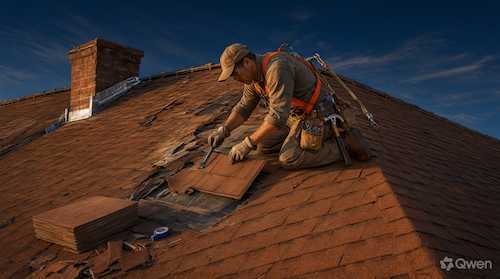
Hartford's roofing conversation has two branches, and which one applies depends on the age of the house. The older neighborhoods carry a significant number of slate roofs, some original and still serviceable with proper repair — and the first question there is whether the slate can be maintained rather than replaced. On the rest of the stock, where 67.4% of housing predates 1980, the familiar issues apply: ice dams at the eave in a New England winter, attics built before ventilation was a design requirement, and roofs already carrying a second layer.
Slate deserves a specializt
A slate roof that leaks in one place is often a flashing or fastener problem rather than a failed covering, and repairing it costs a fraction of replacement. Replacing slate with asphalt is a permanent downgrade of both lifespan and appearance. Ask whether the person quoting has actually worked on slate, what the repair would involve, and whether the flashings at chimneys, valleys and wall junctions are the source. A general roofer who proposes replacement without discussing repair has told you what they know.
Ice dams and the membrane under the covering
Snow on a warm deck melts, runs to the cold eave and refreezes, and the resulting dam pushes water back under the shingles and into the wall or ceiling. The backstop is a waterproof membrane under the covering at the eave. Ask how far up the slope it runs, whether valleys and penetrations are covered, and how junctions with walls and dormers are detailed. On a house with a history of ice dams that answer matters more than the shingle brand.
Ventilation, and the bath fan in the attic
Attics in this stock were built before modern ventilation practice, and many have insulation blown over the soffit intake or a bath fan discharging into the space. Both make ice dams more likely and shorten the life of the covering. Ask what the ventilation calculation is, whether baffles will protect the intake, and whether an attic fan will be corrected while the roof is open. That is the cheapest moment it will ever be fixed.
Layers, deck and the honest comparison
A house built in 1950 may carry two layers of shingles installed decades apart. A layover is cheaper up front and hides the deck, adds weight, and complicates the next replacement. If a bid assumes one, ask what happens if the deck is soft, whether repairs are priced per sheet, and whether a tear-off alternative is quoted. On a steep roof the staging and disposal costs are part of the comparison and easy to leave out.
Gutter ice and where the melt goes
Ice in a gutter is normal here; a gutter pulled away from the fascia is a fastening and pitch problem. Downspouts that discharge beside the foundation send the melt back to the basement wall, which in this region is already dealing with a spring thaw. Ask whether new hangers are included, whether downspout extensions carry water away, and where the discharge lands.
Questions to ask before signing
Where this page stops
This page does not inspect roofs and publishes no prices. Deck condition, slate condition and structural capacity require on-site assessment, and insurance questions belong to the carrier and the policy.
Hartford metro context
ACS 2024 5-year estimates put the metro at about 1.15 million residents in 465,181 households and 499,522 housing units, with 67.3% owner-occupied and 59.3% single-family detached. About 67.4% of units were built before 1980, which is why slate and original attic construction are live topics here. A climate station is not reported for this metro in the site dataset, so no snowfall normals are published on this page.
Hartford housing indicators
| Indicator | Value | Source |
|---|---|---|
| Housing units built before 1980 | 67.4% | U.S. Census Bureau |
| Single-family detached share | 59.3% | U.S. Census Bureau |
| Owner-occupied share | 67.3% | U.S. Census Bureau |
| Housing units | 499,522 | U.S. Census Bureau |
| Metro households | 465,181 | U.S. Census Bureau |
| Metro population | 1,153,112 | U.S. Census Bureau |
No NOAA climate normals are shown for this metro because no station record is held in the site dataset. Snow accumulation on a specific roof depends on pitch, drifting and how long it sits before a melt.
Frequently Asked Questions
Should I replace a slate roof?
Not without a specializt's assessment. A leak in slate is often a flashing or fastener problem rather than a failed covering, and replacement shortens the roof's life dramatically. Ask someone who actually works on slate.
How do I stop ice dams?
Keep the deck cold: seal air leaks at the ceiling plane, insulate to current standards, and make sure the soffit intake and ridge exhaust are clear. Heat cable and raking manage symptoms; the membrane under the covering is the backstop.
Can I put a second layer of shingles on?
It may be permitted depending on how many layers exist, but it hides the deck and adds weight. Ask for the layer count in writing and for the tear-off price including staging and disposal.
Why does my attic grow frost in winter?
Warm moist air is reaching a cold surface, usually from air leaks at the ceiling plane or a bath fan discharging into the attic. Air sealing and ventilation fix it; more insulation alone often does not.
Does the bath fan matter that much?
It does. A fan discharging into the attic adds moisture directly to the deck and works against every other measure taken to prevent ice dams. Correcting it during a roof replacement is far cheaper than later.
Why do my gutters pull away in winter?
Ice loading plus a fastening or pitch problem. Gutters full of ice are normal; gutters separating from the fascia mean the hangers or the slope are not adequate for the load.
Sources and review date
- American Community Survey 2024 5-year estimates (CBSA tables) — U.S. Census Bureau, 2024 ACS 5-year estimates.
Reviewed on 2026-11-18.
Other Home Services in Hartford–West Hartford–East Hartford
All guides for the Hartford–West Hartford–East Hartford metro area