
Hartford, CT · metro guide
HVAC in Hartford: Oil Boilers, Radiators, and Houses Without Ducts
Much of this stock is heated by oil through radiators, and cooling is something the house was never designed for.
Metro snapshot
Hartford in numbers
Sources named below each block
- Population
- 1.2M
- Households
- 465K
- Housing units
- 500K
- People / household
- 2.48
- population ÷ households
Owner-occupied homes 67%
The rest are rented. Owners are the ones who commission most exterior work.
Single-family detached 59%
Detached houses carry their own roof, gutters and exterior walls.
Built before 1980 67%
Older housing stock shapes what fails first: gutters, flashing, pipe material.
Season
The year in Hartford
- Precipitation
- 47 in
- Snowfall
- 51.7 in
Average temperature by month, °F — the shape of the year is what decides when exterior work gets done.
Precipitation by month, inches.
Snowfall by month, inches.
| Month | Average temperature (°F) | Precipitation (in) | Snowfall (in) |
|---|---|---|---|
| January | 27.1°F | 3.28 in | 14.2 in |
| February | 29.6°F | 3.13 in | 14.8 in |
| March | 37.8°F | 3.81 in | 9.4 in |
| April | 49.5°F | 3.88 in | 1.1 in |
| May | 60.0°F | 3.79 in | 0.0 in |
| June | 68.9°F | 4.28 in | 0.0 in |
| July | 74.3°F | 4.17 in | 0.0 in |
| August | 72.5°F | 4.21 in | 0.0 in |
| September | 64.8°F | 4.39 in | 0.0 in |
| October | 53.0°F | 4.52 in | 0.7 in |
| November | 42.3°F | 3.51 in | 1.4 in |
| December | 32.6°F | 4.08 in | 10.1 in |
NOAA 1991–2020 climate normals, station HARTFORD BRADLEY INTL AP, CT US (USW00014740). Station observations, not a metro-wide average — a metro that spans a mountain range can differ by more than this record shows.
Population, households and housing shares: U.S. Census Bureau, American Community Survey 2024 5-year estimates, metropolitan statistical area.
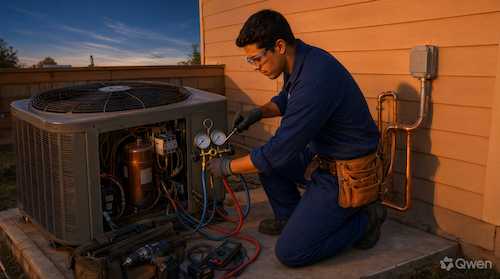
Connecticut has one of the higher shares of oil heating in the country, and Hartford's housing stock — 67.4% built before 1980 — means that oil is usually feeding a boiler with radiators rather than a ducted furnace. Those systems work well, and they were installed for a house that had no air conditioning and no expectation of it. So the local HVAC conversation runs on two tracks: what to do about an ageing oil boiler and the tank that feeds it, and how to add cooling to a house with no ductwork and no space to hide any.
The boiler, the tank and the chimney
An oil-fired boiler raises three questions that a gas furnace does not. The first is the tank: an older tank in a basement is a potential leak, and one buried outside or under a slab is a much larger problem when it fails. The second is the chimney, since oil flues need to be sound and correctly sized, and masonry chimneys in pre-war houses are often not. The third is combustion and efficiency. Ask when the boiler was last serviced, whether combustion testing was performed, what the condition of the tank and its lines is, and whether the chimney has been inspected.
Radiators are worth keeping
A working hydronic system is quiet, even and comfortable, and replacing it is expensive and disruptive. The important distinction is steam versus hot water: they are maintained differently and diagnosed differently. Ask which system the house has, whether the radiators will be balanced, what the boiler's condition is, and what the basement provides in combustion air. If replacement is proposed, ask why and what happens to the distribution system.
Cooling a house with no ducts
The realiztic routes are conventional ducts through chases and soffits — difficult in a pre-war house — a high-velocity small-duct system, or ductless mini-splits. Mini-splits have become the usual answer in this kind of stock: one or two heads can carry a floor, and they provide efficient heating in the shoulder seasons as well. Ask how many heads are proposed, which rooms they serve, what happens to the rooms left out, and where the outdoor units will sit on a lot where the neighbors are close.
Heat pumps alongside an oil boiler
A hybrid arrangement is common here: mini-split heat pumps for most of the year, with the boiler covering the coldest weeks. That can work well, and it needs a clear plan for when each system runs so they do not fight each other. Ask what the balance point is, how the changeover is controlled, whether the boiler will be retained for backup or domestic hot water, and what happens to the oil consumption in a mild winter.
Service before the first cold week
Oil equipment needs annual service, and the first sustained cold snap is the worst time to discover a failed nozzle, a clogged filter or a seized circulator — and the busiest week for every contractor. Book the service in late summer, keep the reports, and know where the emergency shutoff for the burner is. Ask what the visit includes: combustion analysis, a nozzle and filter change, a check of the expansion tank and relief valve, and a look at the tank and its lines.
What a proposal should answer
Where this page stops
No prices and no equipment recommendations are published here. Sizing, combustion safety, oil tank condition and refrigerant work require on-site assessment by a licensed professional, and tank and permit questions belong to the state and local authorities.
Hartford metro context
The 2024 ACS 5-year estimates describe about 1.15 million residents in 465,181 households and 499,522 housing units, with 67.3% owner-occupied and 59.3% single-family detached — a lower detached share than most metros on this site, reflecting the number of two- and three-family buildings. About 67.4% of units predate 1980. A climate station is not reported for this metro in the site dataset, so no temperature figures appear here.
Hartford housing indicators
| Indicator | Value | Source |
|---|---|---|
| Housing units built before 1980 | 67.4% | U.S. Census Bureau |
| Single-family detached share | 59.3% | U.S. Census Bureau |
| Owner-occupied share | 67.3% | U.S. Census Bureau |
| Metro households | 465,181 | U.S. Census Bureau |
| Housing units | 499,522 | U.S. Census Bureau |
| Metro population | 1,153,112 | U.S. Census Bureau |
No climate normals are shown because no station record is held for this metro in the site dataset. Design loads must be calculated for the specific building rather than taken from a regional average.
Frequently Asked Questions
Should I replace an oil boiler with a heat pump?
Sometimes, and often as a hybrid: minisplit heat pumps carrying most of the year with the boiler for the coldest weeks. What decides it is the heating load, the electrical capacity and how the distribution works. A single all-or-nothing answer is usually premature.
How do I know if my oil tank is a problem?
Age, material and location all matter, and an older tank — particularly one buried or beneath a slab — carries a much larger risk if it fails. Ask for an inspection and for the tank's age to be documented, and check what your insurance requires.
Do I need a new chimney for a new boiler?
Possibly. Oil flues need to be sound and correctly sized, and a high-efficiency replacement may vent differently altogether. Ask whether the chimney has been inspected and how the new appliance will vent.
Can I add central air to a pre-war house?
Often not without visible compromise. Mini-splits are the usual answer, with heads placed to serve the rooms that matter most. Conventional ducts through a plaster-and-lath house mean losing space somewhere.
How do I tell steam from hot water heat?
Steam systems have a boiler that boils water, radiators with a vent near the top, and pipes that may knock. Hot water systems run a circulator pump. The distinction changes maintenance and diagnosis.
Why does my upstairs overheat?
Rising heat plus a single thermostat. Zoning, a separate head for the upper rooms, or a second system addresses it; adding capacity to the existing system usually overcools the lower floors.
Sources and review date
- American Community Survey 2024 5-year estimates (CBSA tables) — U.S. Census Bureau, 2024 ACS 5-year estimates.
Reviewed on 2026-11-18.
Other Home Services in Hartford–West Hartford–East Hartford
All guides for the Hartford–West Hartford–East Hartford metro area