
Jacksonville, FL · metro guide
Gutter Cleaning in Jacksonville: Flat Ground, High Water Table and Oak Debris
Water has nowhere to go here, so the discharge point decides everything.
Metro snapshot
Jacksonville in numbers
Sources named below each block
- Population
- 1.7M
- Households
- 663K
- Housing units
- 732K
- People / household
- 2.54
- population ÷ households
Owner-occupied homes 67%
The rest are rented. Owners are the ones who commission most exterior work.
Single-family detached 64%
Detached houses carry their own roof, gutters and exterior walls.
Built before 1980 32%
Older housing stock shapes what fails first: gutters, flashing, pipe material.
Season
The year in Jacksonville
- Precipitation
- 53.4 in
- Snowfall
- 0 in
Average temperature by month, °F — the shape of the year is what decides when exterior work gets done.
Precipitation by month, inches.
| Month | Average temperature (°F) | Precipitation (in) | Snowfall (in) |
|---|---|---|---|
| January | 54.2°F | 3.28 in | 0.0 in |
| February | 57.5°F | 2.86 in | 0.0 in |
| March | 62.4°F | 3.29 in | 0.0 in |
| April | 68.1°F | 2.93 in | 0.0 in |
| May | 74.9°F | 3.42 in | 0.0 in |
| June | 80.3°F | 7.60 in | 0.0 in |
| July | 82.5°F | 6.77 in | 0.0 in |
| August | 82.1°F | 6.88 in | 0.0 in |
| September | 78.8°F | 7.56 in | 0.0 in |
| October | 71.2°F | 4.03 in | 0.0 in |
| November | 62.3°F | 2.00 in | 0.0 in |
| December | 56.7°F | 2.78 in | 0.0 in |
NOAA 1991–2020 climate normals, station JACKSONVILLE, FL US (USW00013889). Station observations, not a metro-wide average — a metro that spans a mountain range can differ by more than this record shows.
Population, households and housing shares: U.S. Census Bureau, American Community Survey 2024 5-year estimates, metropolitan statistical area.
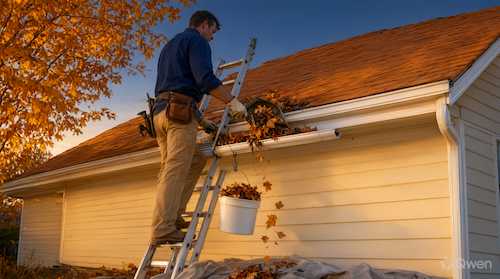
Jacksonville is flat, close to sea level and humid year round, and its oaks and pines drop material continuously rather than seasonally. The combination means a gutter spends most of its life damp and the water it releases has very little fall to work with. On ground this flat, a downspout that ends two feet from the wall is effectively feeding the foundation, because the water has nowhere else to go.
Flat ground and a high water table
With almost no fall away from the house and a water table that is often close to the surface, roof water does not disappear. It sits, and it sits against the wall. Ask where each downspout ends and whether there is a swale, a dry well or a defined path for it.
Continuous oak and pine debris
Live oaks drop leaves and twigs year round here, and pines add needles and cones, so there is no season in which the roof stops shedding. Ask how many visits the trees over the roof actually justify rather than accepting a fixed annual number.
A channel that never dries
Humidity keeps the run damp, which accelerates corrosion on metal, keeps the fascia wet and makes the channel a growing medium. Ask whether the run's condition and the fascia are assessed.
Storm season and capacity
Summer and autumn storms deliver heavy rain quickly, and a restricted run overflows at the fascia. Ask whether the outlets are confirmed to flow before the season rather than after it.
Screens, guards and pine needles
Guards are common here and they do reduce leaf load, but pine needles pass through and mat on top, which is worse than an open channel because it holds water against the edge. Ask whether guards are on the run and how they are cleared.
What to pin down in the estimate
Where this page stops
No prices are quoted and no property is assessed here. Grading, drainage systems and foundation repair belong to a contractor or an engineer, and nothing here is drainage design.
Jacksonville metro context
The 2024 ACS 5-year estimates describe about 1.68 million residents in 663,101 households and 732,419 housing units, with 66.5% owner-occupied and 63.7% single-family detached. About 31.6% of units predate 1980. No climate station is reported for this metro in the site dataset, so no temperature or precipitation normals appear on this page.
Jacksonville housing indicators
| Indicator | Value | Source |
|---|---|---|
| Housing units built before 1980 | 31.6% | U.S. Census Bureau |
| Single-family detached share | 63.7% | U.S. Census Bureau |
| Owner-occupied share | 66.5% | U.S. Census Bureau |
| Metro households | 663,101 | U.S. Census Bureau |
| Housing units | 732,419 | U.S. Census Bureau |
| Metro population | 1,683,960 | U.S. Census Bureau |
Station normals are historical averages for one location, not a forecast. What a gutter has to carry depends on roof area, pitch, the debris the surrounding trees drop and whether downspouts discharge where the water can leave.
Frequently Asked Questions
Why does water sit next to my house?
The ground is flat and the water table is high, so roof water does not drain away. The downspout discharge needs a defined path.
How often should gutters be cleared here?
At least twice a year under oaks, and more where pines are over the roof.
Do gutter guards help with pine needles?
Partly. Needles pass through and mat on top, which holds water against the edge.
Does humidity damage gutters?
It keeps the channel wet, which speeds corrosion and keeps the fascia damp.
When is the best time to clean?
Before storm season, so the run is clear when the heavy rain arrives.
Do I need to be home?
Exterior work can be done with agreed access. Nothing inside the house is involved.
Sources and review date
- American Community Survey 2024 5-year estimates (CBSA tables) — U.S. Census Bureau, 2024 ACS 5-year estimates.
Reviewed on 2026-11-18.