
Tampa, FL · metro guide
Gutter Cleaning in Tampa: Live Oaks, Salt and Seven Inches of July Rain
Mature live oaks over the roof, salt in the air, and the wettest month of the year arriving all at once.
Metro snapshot
Tampa in numbers
Sources named below each block
- Population
- 3.3M
- Households
- 1.3M
- Housing units
- 1.5M
- People / household
- 2.48
- population ÷ households
Owner-occupied homes 68%
The rest are rented. Owners are the ones who commission most exterior work.
Single-family detached 56%
Detached houses carry their own roof, gutters and exterior walls.
Built before 1980 39%
Older housing stock shapes what fails first: gutters, flashing, pipe material.
Season
The year in Tampa
- Precipitation
- 49.5 in
- Snowfall
- 0 in
Average temperature by month, °F — the shape of the year is what decides when exterior work gets done.
Precipitation by month, inches.
| Month | Average temperature (°F) | Precipitation (in) | Snowfall (in) |
|---|---|---|---|
| January | 62.0°F | 2.65 in | 0.0 in |
| February | 64.7°F | 2.62 in | 0.0 in |
| March | 68.6°F | 2.52 in | 0.0 in |
| April | 73.9°F | 2.55 in | 0.0 in |
| May | 79.5°F | 2.60 in | 0.0 in |
| June | 82.9°F | 7.37 in | 0.0 in |
| July | 83.8°F | 7.75 in | 0.0 in |
| August | 84.0°F | 9.03 in | 0.0 in |
| September | 82.7°F | 6.09 in | 0.0 in |
| October | 77.4°F | 2.34 in | 0.0 in |
| November | 69.8°F | 1.40 in | 0.0 in |
| December | 64.9°F | 2.56 in | 0.0 in |
NOAA 1991–2020 climate normals, station TAMPA INTL AP, FL US (USW00012842). Station observations, not a metro-wide average — a metro that spans a mountain range can differ by more than this record shows.
Population, households and housing shares: U.S. Census Bureau, American Community Survey 2024 5-year estimates, metropolitan statistical area.
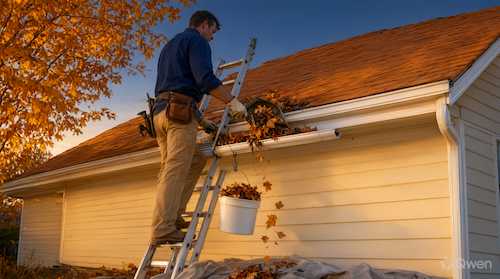
Tampa gets 49.5 inches of rain with 7.75 of it in July, and the city's live oaks are evergreen — they shed leaves, catkins and twigs continuously, so the run reloads between visits. Salt from the Gulf and the bay corrodes metal runs and hangers, and pool enclosures across the rear elevation complicate access to the runs that need the most attention.
Evergreen live oaks
There is no leaf-drop season here, so a single annual clean leaves the run loaded for months. Continuous debris also means the outlet blocks first, because that is where twigs collect. Ask how many visits the trees over the roof justify and whether the outlet is cleared separately.
July that arrives all at once
Seven and three-quarter inches in one month, usually in heavy afternoon bursts, will find any restriction in the run. Ask whether the visit is scheduled before the summer rather than after the first overflow.
Salt and metal
Salt holds moisture against the run and its fasteners, so corrosion starts at seams and fixings on coastal properties. Ask whether the run's condition is assessed.
Pool enclosures and rear access
A screen enclosure stands between the access point and the rear run, and it collects debris itself. Ask whether the enclosure is accounted for and who removes panels.
Storm-season preparation
June to November sets the calendar, and a pre-season clean of the runs and outlets is the practical preparation. Ask whether that can be scheduled deliberately rather than reactively.
What to pin down in the estimate
Where this page stops
No prices are quoted and no property is assessed here. Enclosure work, roof condition and structural repair belong to the right trade, and nothing here is a roof assessment.
Tampa metro context
The 2024 ACS 5-year estimates describe about 3.30 million residents in 1,330,303 households and 1,515,178 housing units, with 67.9% owner-occupied and 56.2% single-family detached. About 39.0% of units predate 1980. At the Tampa Intl Ap reference station January averages 62.0°F and July 83.8°F, on 49.5 inches of annual precipitation.
Tampa reference station and housing indicators
| Indicator | Value | Source |
|---|---|---|
| January mean temperature | 62.0°F | NOAA NCEI |
| July mean temperature | 83.8°F | NOAA NCEI |
| Annual precipitation | 49.5 in. | NOAA NCEI |
| Metro population | 3,304,691 | U.S. Census Bureau |
| Owner-occupied share | 67.9% | U.S. Census Bureau |
| Housing units built before 1980 | 39.0% | U.S. Census Bureau |
Station normals are historical averages for one location, not a forecast. What a gutter has to carry depends on roof area, pitch, the debris the surrounding trees drop and whether downspouts discharge where the water can leave.
Frequently Asked Questions
Why do my gutters need clearing more than once a year?
Live oaks are evergreen. There is no season in which the roof stops shedding, so the run reloads continuously.
What blocks first?
The outlet. Twigs and catkins collect there before the channel looks full.
Does salt damage gutters?
It holds moisture against metal and fasteners, so coastal runs corrode sooner than inland ones.
When should gutters be cleaned in Tampa?
Before the summer rains, and again after the heaviest part of the season if the run is loading quickly.
Can you clean behind a pool cage?
Usually, but panels may need to come out. Confirm the arrangement before the visit.
Do I need to be home?
Exterior work can be done with agreed access. Nothing inside the house is involved.
Sources and review date
- American Community Survey 2024 5-year estimates (CBSA tables) — U.S. Census Bureau, 2024 ACS 5-year estimates.
- 1991–2020 station normals — TAMPA INTL AP, FL US (USW00012842) — NOAA National Centers for Environmental Information, 1991–2020 climate normals.
Reviewed on 2026-11-18.
Other Home Services in Tampa–St. Petersburg–Clearwater
All guides for the Tampa–St. Petersburg–Clearwater metro area