
Orlando, FL · metro guide
Gutter Cleaning in Orlando: Pool Cages, Sand and Afternoon Storms
Half the rear elevations are behind a screen enclosure, and the rain arrives every afternoon.
Metro snapshot
Orlando in numbers
Sources named below each block
- Population
- 2.8M
- Households
- 1.0M
- Housing units
- 1.1M
- People / household
- 2.73
- population ÷ households
Owner-occupied homes 63%
The rest are rented. Owners are the ones who commission most exterior work.
Single-family detached 59%
Detached houses carry their own roof, gutters and exterior walls.
Built before 1980 24%
Older housing stock shapes what fails first: gutters, flashing, pipe material.
Season
The year in Orlando
- Precipitation
- 51.5 in
- Snowfall
- 0 in
Average temperature by month, °F — the shape of the year is what decides when exterior work gets done.
Precipitation by month, inches.
| Month | Average temperature (°F) | Precipitation (in) | Snowfall (in) |
|---|---|---|---|
| January | 60.6°F | 2.48 in | 0.0 in |
| February | 63.6°F | 2.04 in | 0.0 in |
| March | 67.3°F | 3.03 in | 0.0 in |
| April | 72.2°F | 2.58 in | 0.0 in |
| May | 77.3°F | 4.02 in | 0.0 in |
| June | 81.2°F | 8.05 in | 0.0 in |
| July | 82.6°F | 7.46 in | 0.0 in |
| August | 82.6°F | 7.69 in | 0.0 in |
| September | 81.0°F | 6.37 in | 0.0 in |
| October | 75.5°F | 3.46 in | 0.0 in |
| November | 68.2°F | 1.79 in | 0.0 in |
| December | 63.3°F | 2.48 in | 0.0 in |
NOAA 1991–2020 climate normals, station ORLANDO INTL AP, FL US (USW00012815). Station observations, not a metro-wide average — a metro that spans a mountain range can differ by more than this record shows.
Population, households and housing shares: U.S. Census Bureau, American Community Survey 2024 5-year estimates, metropolitan statistical area.
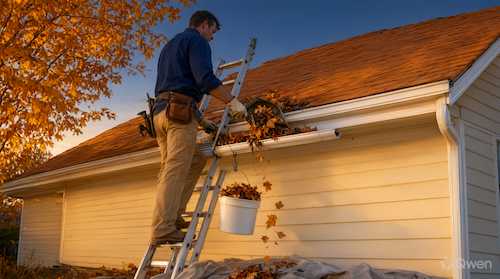
Orlando has the newest housing in this set — only 23.8% of units predate 1980 — and a great deal of it has a screened pool enclosure across the rear elevation. That enclosure changes the job: it shelters the gutter from leaves but catches pollen, dust and debris itself, and it restricts how the rear run can be reached. The rain is heavy and arrives most afternoons in summer, and the sandy soil takes it away quickly where it is not blocked.
Enclosures in the way of the rear run
A pool cage stands between the access point and the rear gutter, and panels may need to come out for the run to be reached properly. Ask whether the enclosure is accounted for in the visit and who removes and refits panels.
Sandy soil and fast drainage
Sandy ground absorbs roof water quickly, which is an advantage, but it also means the discharge can wash sand away from a footing or a slab edge. Ask where each downspout ends and whether the outlet is protected.
Afternoon storms and overflow
Summer storms arrive most afternoons, and a restricted run overflows repeatedly rather than once. That repeated wetting is what damages fascia and soffit. Ask whether the outlets are confirmed to flow.
Retention ponds and where water goes
Many subdivisions drain to retention ponds, and roof discharge that leaves the lot too fast contributes to the same system the streets use. Ask where the discharge ends up rather than only where the downspout ends.
Newer runs and fewer downspouts
On recent housing the run often wraps several roof planes with only a few downspouts, and the enclosure screens add debris the roof never sees. Ask how many downspouts serve each run.
What to pin down in the estimate
Where this page stops
No prices are quoted and no property is assessed here. Enclosure structure and screens, grading and retention systems are separate trades, and nothing here is drainage design.
Orlando metro context
The 2024 ACS 5-year estimates describe about 2.79 million residents in 1,022,315 households and 1,145,360 housing units, with 63.1% owner-occupied and 58.5% single-family detached. About 23.8% of units predate 1980. No climate station is reported for this metro in the site dataset, so no temperature or precipitation normals appear on this page.
Orlando housing indicators
| Indicator | Value | Source |
|---|---|---|
| Housing units built before 1980 | 23.8% | U.S. Census Bureau |
| Single-family detached share | 58.5% | U.S. Census Bureau |
| Owner-occupied share | 63.1% | U.S. Census Bureau |
| Metro households | 1,022,315 | U.S. Census Bureau |
| Housing units | 1,145,360 | U.S. Census Bureau |
| Metro population | 2,793,746 | U.S. Census Bureau |
Station normals are historical averages for one location, not a forecast. What a gutter has to carry depends on roof area, pitch, the debris the surrounding trees drop and whether downspouts discharge where the water can leave.
Frequently Asked Questions
Can you clean gutters behind a pool cage?
Usually, but the access has to be worked out and panels may need to come out. Confirm who removes and refits them.
Do the enclosure screens need cleaning too?
They collect pollen and dust themselves, and they are a separate item worth asking about.
Does sandy soil mean drainage is not a problem?
It absorbs faster, but a downspout can still wash sand from a slab edge or a footing.
When should gutters be cleaned here?
Before the summer storm season, so the run is clear for the months of afternoon storms.
Do I need HOA approval?
Often for vendor access. Confirm before the crew arrives.
Do I need to be home?
Exterior work can be done with agreed access, though enclosure access may need arranging.
Sources and review date
- American Community Survey 2024 5-year estimates (CBSA tables) — U.S. Census Bureau, 2024 ACS 5-year estimates.
Reviewed on 2026-11-18.