
Kansas City, MO-KS · metro guide
Gutter Cleaning in Kansas City: Hail-Dented Runs, Wind and Clay
Wind fills the run, hail dents it, and the clay will not take what comes out of it.
Metro snapshot
Kansas City in numbers
Sources named below each block
- Population
- 2.2M
- Households
- 895K
- Housing units
- 961K
- People / household
- 2.48
- population ÷ households
Owner-occupied homes 66%
The rest are rented. Owners are the ones who commission most exterior work.
Single-family detached 69%
Detached houses carry their own roof, gutters and exterior walls.
Built before 1980 51%
Older housing stock shapes what fails first: gutters, flashing, pipe material.
Season
The year in Kansas City
- Precipitation
- 38.1 in
- Snowfall
- 11 in
Average temperature by month, °F — the shape of the year is what decides when exterior work gets done.
Precipitation by month, inches.
Snowfall by month, inches.
| Month | Average temperature (°F) | Precipitation (in) | Snowfall (in) |
|---|---|---|---|
| January | 31.0°F | 1.02 in | 3.4 in |
| February | 35.8°F | 1.53 in | 3.2 in |
| March | 46.4°F | 2.08 in | 0.4 in |
| April | 56.5°F | 3.89 in | 0.1 in |
| May | 66.7°F | 5.10 in | 0.0 in |
| June | 76.5°F | 5.33 in | 0.0 in |
| July | 81.0°F | 4.38 in | 0.0 in |
| August | 79.2°F | 4.68 in | 0.0 in |
| September | 70.7°F | 3.78 in | 0.0 in |
| October | 58.4°F | 3.24 in | 0.3 in |
| November | 45.4°F | 1.80 in | 0.1 in |
| December | 35.3°F | 1.30 in | 3.5 in |
NOAA 1991–2020 climate normals, station KANSAS CITY DOWNTOWN AP, MO US (USW00013988). Station observations, not a metro-wide average — a metro that spans a mountain range can differ by more than this record shows.
Population, households and housing shares: U.S. Census Bureau, American Community Survey 2024 5-year estimates, metropolitan statistical area.
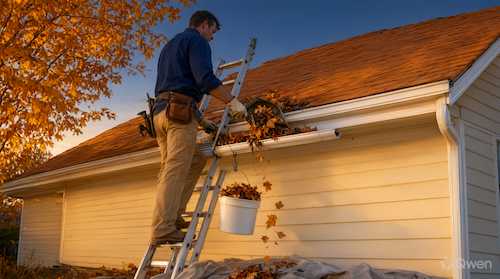
Kansas City's gutters take damage from above before they ever block. Wind drives debris and grit into the channel, hail dents aluminum and strips granules from shingles, and the clay soil means the discharge has nowhere to soak away. Half the housing predates 1980, so the metro has both narrow old runs and modern installations, and they fail for different reasons.
Hail dents and shingle grit
Hailstorms dent aluminum channels, and every dent becomes a low point where grit and water collect. The granules stripped off shingles wash in as heavy grit that blocks outlets. Ask whether dents and grit are part of what gets checked.
Wind-driven debris
The metro is windy and sits where open ground meets the city, so debris and soil are driven into runs rather than falling into them. Windward elevations load faster. Ask which runs are exposed and how that affects the frequency.
Clay at the discharge
Clay sheds rather than absorbs, so a downspout ending at the wall keeps the roof's water against the foundation. Ask where each downspout discharges and whether there is a defined path away.
Freeze-thaw and older runs
Winters cross the freezing point repeatedly, which works at joints and hangers, and older four-inch runs carry the strain less well than modern ones. Ask whether joints, pitch and hangers are checked.
Two housing stocks, two failures
Half the housing predates 1980 and half does not: older runs are narrower and often rusted, newer runs are wider but sometimes have too few downspouts. Ask which applies before deciding what the visit needs to cover.
What to pin down in the estimate
Where this page stops
No prices are quoted and no property is assessed here. Hail damage to roofs, foundation movement and grading need inspection by the right trade, and insurance questions belong to the insurer.
Kansas City metro context
The 2024 ACS 5-year estimates describe about 2.22 million residents in 895,368 households and 960,950 housing units, with 65.8% owner-occupied and 69.0% single-family detached. About 50.6% of units predate 1980. No climate station is reported for this metro in the site dataset, so no temperature or precipitation normals appear on this page.
Kansas City housing indicators
| Indicator | Value | Source |
|---|---|---|
| Housing units built before 1980 | 50.6% | U.S. Census Bureau |
| Single-family detached share | 69.0% | U.S. Census Bureau |
| Owner-occupied share | 65.8% | U.S. Census Bureau |
| Metro households | 895,368 | U.S. Census Bureau |
| Housing units | 960,950 | U.S. Census Bureau |
| Metro population | 2,218,142 | U.S. Census Bureau |
Station normals are historical averages for one location, not a forecast. What a gutter has to carry depends on roof area, pitch, the debris the surrounding trees drop and whether downspouts discharge where the water can leave.
Frequently Asked Questions
Can hail damage a gutter?
It dents aluminum and creates low points that trap grit and water. The dents matter functionally, not just visually.
What is the grit in my gutters?
Shingle granules, usually after a hail event. They block outlets because they are heavier than leaves.
Why does water pool by the foundation?
Clay will not absorb what a roof delivers, so the discharge point needs a path away from the wall.
How often should gutters be checked here?
Twice a year for debris, plus a check after a significant hailstorm because of the grit and dents.
Do old gutters fail differently?
They are narrower and corrode, so they overflow sooner and rust through. Newer runs usually fail on capacity.
Do I need to be home?
Exterior work can be done with agreed access. Nothing inside the house is involved.
Sources and review date
- American Community Survey 2024 5-year estimates (CBSA tables) — U.S. Census Bureau, 2024 ACS 5-year estimates.
Reviewed on 2026-11-18.