
Kansas City, MO-KS · metro guide
HVAC in Kansas City: Hot Summers, Cold Snaps
Kansas City asks one system to handle humid heat and hard cold, in a house that may have been built around a furnace.
Metro snapshot
Kansas City in numbers
Sources named below each block
- Population
- 2.2M
- Households
- 895K
- Housing units
- 961K
- People / household
- 2.48
- population ÷ households
Owner-occupied homes 66%
The rest are rented. Owners are the ones who commission most exterior work.
Single-family detached 69%
Detached houses carry their own roof, gutters and exterior walls.
Built before 1980 51%
Older housing stock shapes what fails first: gutters, flashing, pipe material.
Season
The year in Kansas City
- Precipitation
- 38.1 in
- Snowfall
- 11 in
Average temperature by month, °F — the shape of the year is what decides when exterior work gets done.
Precipitation by month, inches.
Snowfall by month, inches.
| Month | Average temperature (°F) | Precipitation (in) | Snowfall (in) |
|---|---|---|---|
| January | 31.0°F | 1.02 in | 3.4 in |
| February | 35.8°F | 1.53 in | 3.2 in |
| March | 46.4°F | 2.08 in | 0.4 in |
| April | 56.5°F | 3.89 in | 0.1 in |
| May | 66.7°F | 5.10 in | 0.0 in |
| June | 76.5°F | 5.33 in | 0.0 in |
| July | 81.0°F | 4.38 in | 0.0 in |
| August | 79.2°F | 4.68 in | 0.0 in |
| September | 70.7°F | 3.78 in | 0.0 in |
| October | 58.4°F | 3.24 in | 0.3 in |
| November | 45.4°F | 1.80 in | 0.1 in |
| December | 35.3°F | 1.30 in | 3.5 in |
NOAA 1991–2020 climate normals, station KANSAS CITY DOWNTOWN AP, MO US (USW00013988). Station observations, not a metro-wide average — a metro that spans a mountain range can differ by more than this record shows.
Population, households and housing shares: U.S. Census Bureau, American Community Survey 2024 5-year estimates, metropolitan statistical area.
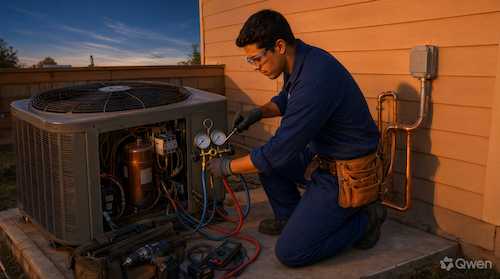
Kansas City sits where humid summer air meets cold continental air, and both arrive with force. A system here has to remove moisture in July and hold capacity during a January cold snap. About 50.6% of metro housing units were built before 1980, according to ACS estimates, so a large share of homes were built around a furnace and radiators and later retrofitted for cooling.
Sizing for both seasons
Ask whether a load calculation was performed and what it assumed about insulation, windows, and duct location. A system sized for the coldest night can be oversized for cooling, and an oversized unit cools quickly without removing enough humidity. The two seasons pull the design in different directions, which is why the calculation matters.
Distribution in retrofitted houses
Ask how the system delivers air to each room: new ducts, mini-split heads, or a high-velocity system. In older homes, duct runs may have to pass through closets, soffits, or a finished attic. Ask where equipment and lines will physically go before discussing efficiency ratings.
Basements and equipment location
Many homes here have furnaces and air handlers in a basement. Ask how equipment is protected from damp, whether the flue and combustion air arrangement is appropriate, and how condensate is routed. A damp basement shortens equipment life and can create venting problems.
Maintenance and measurements
Ask what a maintenance visit includes: filter, coil cleaning, drain check, combustion or refrigerant measurements, and a written record. Ask what measurements support any repair recommendation. A proposal that recommends replacement without readings is not a diagnosis.
Questions to ask before you decide
Where this page stops
This page does not diagnose an HVAC system remotely and does not publish local prices. Equipment selection, combustion safety, refrigerant handling, and permit requirements must be confirmed on site by a qualified professional and the responsible local authority.
Kansas City metro context
The 2024 ACS 5-year estimates put the metro at about 2.2 million residents and 895,000 households. About 65.8% of occupied homes are owner-occupied, and about 69.0% of housing units are single-family detached. About 50.6% of housing units were built before 1980, so many systems were retrofitted rather than designed in. This page reports Census indicators only; a NOAA station is not included for this metro in the site dataset.
Kansas City metro housing indicators
| Indicator | Value | Source |
|---|---|---|
| Metro population | 2,218,142 | U.S. Census Bureau |
| Households | 895,368 | U.S. Census Bureau |
| Owner-occupied share | 65.8% | U.S. Census Bureau |
| Single-family detached share | 69.0% | U.S. Census Bureau |
| Housing units built before 1980 | 50.6% | U.S. Census Bureau |
Census values describe the metro area, not an individual property. A climate station is not reported for this metro in the site dataset.
Frequently Asked Questions
How do I compare HVAC quotes in Kansas City?
Compare the load calculation, equipment models and capacities for both seasons, distribution method, duct or line routing, electrical work, permit handling, startup measurements, exclusions, and warranties.
Why does my house feel clammy in summer?
Oversizing, short runtime, low airflow, duct leakage, or a fan that runs continuously can all leave moisture in the air. Ask for measurements of indoor humidity and airflow before deciding on equipment changes.
Can an older Kansas City house get central air?
Often it can, but where the ducts run is the design problem. Some homes use a conventional system, others use mini-split heads or a high-velocity system.
Is a basement furnace a problem?
It can be, if the space is damp or the venting is not appropriate. Ask how the equipment is protected and whether the flue and combustion air were evaluated.
Does a new system require a permit?
Requirements depend on the work and the jurisdiction. Confirm with the authority responsible for the address and ask whether permit handling and inspection are included.
What is the population of the Kansas City metro area?
The U.S. Census Bureau's 2024 ACS 5-year estimates report about 2.2 million residents in the metro area. The figure describes regional scale, not the number of homes or providers.
Sources and review date
- American Community Survey 2024 5-year estimates (CBSA tables) — U.S. Census Bureau, 2024 ACS 5-year estimates.
Reviewed on 2026-11-18.