
Kansas City, MO-KS · metro guide
Roofing in Kansas City: Hail, Wind, and Layers
Kansas City roofs face hail and wind on a housing stock where half the roofs have already been replaced once.
Metro snapshot
Kansas City in numbers
Sources named below each block
- Population
- 2.2M
- Households
- 895K
- Housing units
- 961K
- People / household
- 2.48
- population ÷ households
Owner-occupied homes 66%
The rest are rented. Owners are the ones who commission most exterior work.
Single-family detached 69%
Detached houses carry their own roof, gutters and exterior walls.
Built before 1980 51%
Older housing stock shapes what fails first: gutters, flashing, pipe material.
Season
The year in Kansas City
- Precipitation
- 38.1 in
- Snowfall
- 11 in
Average temperature by month, °F — the shape of the year is what decides when exterior work gets done.
Precipitation by month, inches.
Snowfall by month, inches.
| Month | Average temperature (°F) | Precipitation (in) | Snowfall (in) |
|---|---|---|---|
| January | 31.0°F | 1.02 in | 3.4 in |
| February | 35.8°F | 1.53 in | 3.2 in |
| March | 46.4°F | 2.08 in | 0.4 in |
| April | 56.5°F | 3.89 in | 0.1 in |
| May | 66.7°F | 5.10 in | 0.0 in |
| June | 76.5°F | 5.33 in | 0.0 in |
| July | 81.0°F | 4.38 in | 0.0 in |
| August | 79.2°F | 4.68 in | 0.0 in |
| September | 70.7°F | 3.78 in | 0.0 in |
| October | 58.4°F | 3.24 in | 0.3 in |
| November | 45.4°F | 1.80 in | 0.1 in |
| December | 35.3°F | 1.30 in | 3.5 in |
NOAA 1991–2020 climate normals, station KANSAS CITY DOWNTOWN AP, MO US (USW00013988). Station observations, not a metro-wide average — a metro that spans a mountain range can differ by more than this record shows.
Population, households and housing shares: U.S. Census Bureau, American Community Survey 2024 5-year estimates, metropolitan statistical area.
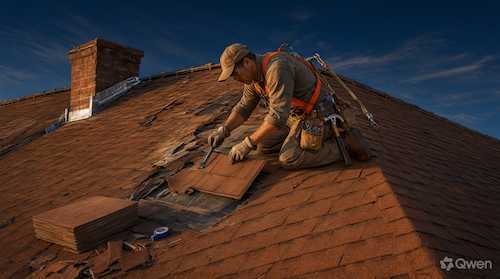
About 50.6% of Kansas City metro housing units were built before 1980, according to ACS estimates, so many roofs have been replaced at least once and some carry more than one layer. The region sits where central-plains storms arrive with hail and straight-line wind, which means the covering and the attachment details get tested regularly rather than occasionally.
Hail and wind documentation
Ask what impact rating the proposed covering carries and what documentation supports it. Ask how the contractor documents storm damage for an insurer: photographs, test squares, and a written scope that separates damage from wear. Ask whether they will meet the adjuster on site, because a claim is easier when evidence is collected before anything is removed.
Layers, tear-off, and decking
Ask whether the quote is for a full tear-off or an overlay, and how many existing layers are present. Layering saves money up front and hides the deck, which is where soft spots and rot live. Ask how decking damage will be priced and approved if it is found after removal.
Ice at the eaves
Ask where ice-and-water protection is installed and how the attic is ventilated. When snow melts on a warm roof deck and refreezes at the colder edge, water backs up under the covering. Edge protection and balanced ventilation address the mechanism; a new roof over the same conditions repeats the problem.
Flashing and penetrations
Ask how chimneys, valleys, skylights, and wall junctions are flashed, and whether old flashing is replaced or reused. These are the details most likely to leak and the ones most often left out of a written scope. Get them itemized rather than covered by a general promise.
Questions to ask before signing
Where this page stops
This page does not inspect a roof, estimate cost, or interpret an insurance policy. Coverage and claim requirements depend on the policy and the insurer, and code requirements vary by jurisdiction and should be confirmed with the responsible local authority.
Kansas City metro context
The 2024 ACS 5-year estimates put the metro at about 2.2 million residents and 895,000 households. About 65.8% of occupied homes are owner-occupied, and about 69.0% of housing units are single-family detached, so most roof work happens on owner-occupied houses. About 50.6% of housing units were built before 1980. This page reports Census indicators only; a NOAA station is not included for this metro in the site dataset.
Kansas City metro housing indicators
| Indicator | Value | Source |
|---|---|---|
| Metro population | 2,218,142 | U.S. Census Bureau |
| Households | 895,368 | U.S. Census Bureau |
| Owner-occupied share | 65.8% | U.S. Census Bureau |
| Single-family detached share | 69.0% | U.S. Census Bureau |
| Housing units built before 1980 | 50.6% | U.S. Census Bureau |
Census values describe the metro area, not an individual property. A climate station is not reported for this metro in the site dataset.
Frequently Asked Questions
How do I compare roofing estimates in Kansas City?
Compare the specified covering and impact rating, underlayment and ice protection, flashing details, decking allowances, ventilation, tear-off versus overlay, permit handling, disposal, exclusions, and warranties.
Should I choose impact-resistant shingles?
It depends on the cost difference, how your insurer treats ratings, and how long you plan to stay. Ask for documentation behind each class and what your insurer does with it.
How is hail damage documented?
Typically with photographs, test squares, and a written scope separating storm damage from normal wear. Ask whether the contractor will meet the adjuster on site.
Should I tear off existing layers?
A tear-off lets the deck be inspected and usually produces a flatter, better-attached roof. Ask how many layers exist and what the difference in cost and warranty is.
Does a roof replacement require a permit?
Requirements depend on the jurisdiction and the scope. Confirm with the authority responsible for the address and ask whether permit handling and inspection are included.
What is the population of the Kansas City metro area?
The U.S. Census Bureau's 2024 ACS 5-year estimates report about 2.2 million residents in the metro area. The figure describes regional scale, not the number of homes or providers.
Sources and review date
- American Community Survey 2024 5-year estimates (CBSA tables) — U.S. Census Bureau, 2024 ACS 5-year estimates.
Reviewed on 2026-11-18.