
Kansas City, MO-KS · metro guide
Landscaping in Kansas City: Clay, Slope, and Four Seasons
Kansas City planting has to survive a wet spring, a hot summer, and a freezing winter in the same heavy soil.
Metro snapshot
Kansas City in numbers
Sources named below each block
- Population
- 2.2M
- Households
- 895K
- Housing units
- 961K
- People / household
- 2.48
- population ÷ households
Owner-occupied homes 66%
The rest are rented. Owners are the ones who commission most exterior work.
Single-family detached 69%
Detached houses carry their own roof, gutters and exterior walls.
Built before 1980 51%
Older housing stock shapes what fails first: gutters, flashing, pipe material.
Season
The year in Kansas City
- Precipitation
- 38.1 in
- Snowfall
- 11 in
Average temperature by month, °F — the shape of the year is what decides when exterior work gets done.
Precipitation by month, inches.
Snowfall by month, inches.
| Month | Average temperature (°F) | Precipitation (in) | Snowfall (in) |
|---|---|---|---|
| January | 31.0°F | 1.02 in | 3.4 in |
| February | 35.8°F | 1.53 in | 3.2 in |
| March | 46.4°F | 2.08 in | 0.4 in |
| April | 56.5°F | 3.89 in | 0.1 in |
| May | 66.7°F | 5.10 in | 0.0 in |
| June | 76.5°F | 5.33 in | 0.0 in |
| July | 81.0°F | 4.38 in | 0.0 in |
| August | 79.2°F | 4.68 in | 0.0 in |
| September | 70.7°F | 3.78 in | 0.0 in |
| October | 58.4°F | 3.24 in | 0.3 in |
| November | 45.4°F | 1.80 in | 0.1 in |
| December | 35.3°F | 1.30 in | 3.5 in |
NOAA 1991–2020 climate normals, station KANSAS CITY DOWNTOWN AP, MO US (USW00013988). Station observations, not a metro-wide average — a metro that spans a mountain range can differ by more than this record shows.
Population, households and housing shares: U.S. Census Bureau, American Community Survey 2024 5-year estimates, metropolitan statistical area.
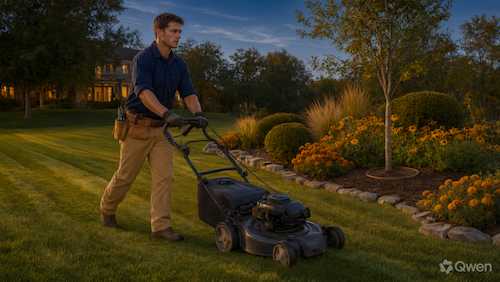
Kansas City's growing conditions are not gentle. Springs are wet, summers are hot and humid, and winters freeze deeply enough to heave anything planted shallow. Underneath, much of the metro sits on heavy clay that holds water and then cracks as it dries. A plan that works in one season can fail in the next, which is why soil and drainage come first.
Clay and drainage
Ask how the soil was assessed and what amendment or drainage is included. Clay absorbs slowly, so planting holes can fill and roots can rot after a wet spring. Ask whether the plan accounts for that with amendment, mounding, raised beds, or species that tolerate wet feet.
Slope and runoff
Ask how the design moves water away from the foundation and where it goes on a sloped lot. Terracing, swales, and retaining walls change cost and engineering. Ask whether any structural work is included and who permits it.
Plants for both extremes
Ask which plants are proposed and why they suit the site: sun exposure, soil moisture, and winter hardiness. A species that thrives in July may not survive January, and one that handles winter may struggle in humid heat. Ask how the plan accounts for both ends of the year.
The first year and after
Ask who waters and maintains the planting through establishment, what the schedule is, and whether replacement of failed plants is included. Ask about pruning expectations and whether the contract continues after installation.
Questions to ask before approving a plan
Where this page stops
This page does not design a landscape or estimate cost for a specific property. Plant suitability, drainage requirements, and municipal or association rules vary by address and should be confirmed locally.
Kansas City metro context
The 2024 ACS 5-year estimates put the metro at about 2.2 million residents and 895,000 households. About 65.8% of occupied homes are owner-occupied, and about 69.0% of housing units are single-family detached, so most landscaping work happens on private lots. About 50.6% of housing units were built before 1980. This page reports Census indicators only; a NOAA station is not included for this metro in the site dataset.
Kansas City metro housing indicators
| Indicator | Value | Source |
|---|---|---|
| Metro population | 2,218,142 | U.S. Census Bureau |
| Households | 895,368 | U.S. Census Bureau |
| Owner-occupied share | 65.8% | U.S. Census Bureau |
| Single-family detached share | 69.0% | U.S. Census Bureau |
| Housing units built before 1980 | 50.6% | U.S. Census Bureau |
Census values describe the metro area, not an individual property. A climate station is not reported for this metro in the site dataset.
Frequently Asked Questions
What should a Kansas City landscaping estimate include?
Ask for the plan drawing, plant list with sizes, soil amendment, mulch, grading and drainage work, hardscape, irrigation if any, disposal, a schedule, exclusions, and the establishment terms.
Why do plants struggle in clay soil?
Clay holds water, and a planting hole can fill like a bucket, drowning roots. Amendment, raised beds, and species choice all affect whether plants establish.
How should a sloped yard be handled?
Slopes need grading, terracing, or drainage to control runoff. Ask where water goes at the bottom of the slope and whether structural work is included.
Is winter hardiness a problem here?
Winters freeze deeply enough to damage marginally hardy plants, so species selection matters. Ask why each plant was chosen and whether it is reliably hardy in this area.
Who replaces plants that die in the first year?
It depends on the contract. Ask whether replacement is included, for how long, and under what conditions, such as proper watering or maintenance by the owner.
What is the population of the Kansas City metro area?
The U.S. Census Bureau's 2024 ACS 5-year estimates report about 2.2 million residents in the metro area. The figure describes regional scale, not the number of homes or providers.
Sources and review date
- American Community Survey 2024 5-year estimates (CBSA tables) — U.S. Census Bureau, 2024 ACS 5-year estimates.
Reviewed on 2026-11-18.