
Las Vegas, NV · metro guide
Painting in Las Vegas: Sun, Stucco, and Constant Movement
Nothing rots here. Everything fades, chalks, and cracks — and the sun does it faster than the calendar suggests.
Metro snapshot
Las Vegas in numbers
Sources named below each block
- Population
- 2.3M
- Households
- 863K
- Housing units
- 949K
- People / household
- 2.70
- population ÷ households
Owner-occupied homes 58%
The rest are rented. Owners are the ones who commission most exterior work.
Single-family detached 60%
Detached houses carry their own roof, gutters and exterior walls.
Built before 1980 18%
Older housing stock shapes what fails first: gutters, flashing, pipe material.
Season
The year in Las Vegas
- Precipitation
- 4.2 in
- Snowfall
- 0.2 in
Average temperature by month, °F — the shape of the year is what decides when exterior work gets done.
Precipitation by month, inches.
Snowfall by month, inches.
| Month | Average temperature (°F) | Precipitation (in) | Snowfall (in) |
|---|---|---|---|
| January | 49.5°F | 0.56 in | 0.0 in |
| February | 53.5°F | 0.80 in | 0.0 in |
| March | 60.8°F | 0.42 in | 0.0 in |
| April | 67.7°F | 0.20 in | 0.0 in |
| May | 77.3°F | 0.07 in | 0.0 in |
| June | 87.6°F | 0.04 in | 0.0 in |
| July | 93.2°F | 0.38 in | 0.0 in |
| August | 91.7°F | 0.32 in | 0.0 in |
| September | 83.6°F | 0.32 in | 0.0 in |
| October | 70.4°F | 0.32 in | 0.0 in |
| November | 57.2°F | 0.30 in | 0.0 in |
| December | 48.2°F | 0.45 in | 0.2 in |
NOAA 1991–2020 climate normals, station LAS VEGAS MCCARRAN AP, NV US (USW00023169). Station observations, not a metro-wide average — a metro that spans a mountain range can differ by more than this record shows.
Population, households and housing shares: U.S. Census Bureau, American Community Survey 2024 5-year estimates, metropolitan statistical area.
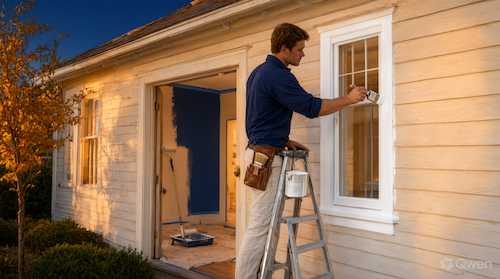
The failure modes that dominate painting in a wet climate — rot, blistering from trapped moisture, peeling from freeze-thaw — barely apply here. What replaces them is solar damage. Ultraviolet light breaks down the resin in the coating, the surface chalks, the color fades, and the film eventually loses its ability to flex with the wall behind it. Because almost the entire housing stock is recent (17.5% predates 1980), most exteriors in this metro are on their second or third repaint, and the question homeowners face is not whether the paint is failing but which elevation is failing first and why.
South and west walls carry the cost
An elevation that takes direct afternoon sun will chalk and fade years before a shaded one, and the same building can show dramatically different wear on different sides. That is why a single product and a single coat count for the whole house is usually a false economy. Ask whether the specification differs by elevation, whether a higher-performance coating is proposed for the exposed sides, and what the colorfastness of the chosen product is. Lighter colors also reduce surface temperature, which is a real consideration on a wall that radiates heat into the house in the evening.
Stucco moves, and the cracks are the job
Stucco over frame expands and contracts with daily temperature swings, and hairline cracks are normal rather than alarming. The painting question is how they are treated: filling with an appropriate patching material, allowing it to cure, and then coating so the repair does not telegraph through. On a large wall, ask whether the contractor will bridge cracks with an elastomeric coating and whether that coating is appropriate for the substrate. Painting over a crack with ordinary acrylic hides it for one season and shows it again the next.
Block walls and metal are their own projects
Perimeter walls, planters and screen walls in block are extremely common here, and they present a different problem from a house wall: porous, often unpainted, and exposed on both sides. Ask whether the block will be sealed or coated, which side is being treated, and how the top course is capped so water does not sit in the wall. Metal is the other frequent item — gates, railings, security doors and garage doors — and it fails by rust at the fixings and edges rather than across the panel, so preparation at those points is what determines how long the finish lasts.
The working window is about temperature, not rain
Here the constraint is heat rather than precipitation. Coatings have a maximum substrate temperature for application, and a stucco wall in direct afternoon sun can be far hotter than the air, so a crew that starts at noon on an exposed elevation may be applying product outside its specified range without noticing. Ask how the schedule avoids that — early starts, working the shaded elevations first, or waiting for a cooler period — and whether the contractor will stop rather than push through. The same heat also affects cure, so a job done too fast in the wrong conditions can look fine and fail early.
Inside, dry air and fast cure
Interior painting in this climate is comparatively straightforward, but two local details are worth raising. First, very dry air makes some products cure faster than expected, which shortens the recoat window and can leave lap marks if a wall is cut in and rolled too slowly. Second, if the house is being painted while occupied in summer, ventilation and product choice matter more than usual because the air conditioning is running and the house is closed. Low-odor and fast-drying products are the practical answer, and they should be specified rather than assumed.
What to pin down in the estimate
Where this page stops
No prices are published and no assessment of a specific building is made here. Stucco and structural cracking should be evaluated by someone qualified to inspect the assembly, since a crack that indicates movement is a different problem from a crack that indicates curing.
Las Vegas metro context
ACS 2024 5-year estimates describe about 2.3 million residents in 862,518 households and 948,995 housing units, with 57.8% owner-occupied and 60.2% single-family detached. Only 17.5% of units were built before 1980, so most exteriors here are relatively young and the wear being addressed is solar rather than age. A climate station is not reported for this metro in the site dataset, so no temperature normals are published on this page.
Las Vegas housing age and ownership
| Indicator | Value | Source |
|---|---|---|
| Housing units built before 1980 | 17.5% | U.S. Census Bureau |
| Single-family detached share | 60.2% | U.S. Census Bureau |
| Owner-occupied share | 57.8% | U.S. Census Bureau |
| Housing units | 948,995 | U.S. Census Bureau |
| Metro households | 862,518 | U.S. Census Bureau |
| Metro population | 2,329,548 | U.S. Census Bureau |
No climate normals are shown because no station record is held for this metro in the site dataset. Housing age indicates how many repaint cycles an exterior has likely seen, not its condition.
Frequently Asked Questions
How often does a Las Vegas exterior need repainting?
There is no fixed interval, but exposed elevations usually need attention before shaded ones. Chalking, fading and a powdery residue that rubs off on your hand are the early signals that the film is breaking down, and they appear on the sunny sides first.
Are stucco cracks something to worry about?
Hairline cracking is normal movement in stucco over frame. Wider or continuing cracks, or cracks that follow a pattern around openings, may indicate a structural or water issue and should be evaluated before painting. Filling and bridging is a paint task; diagnosis is not.
What is elastomeric coating and do I need it?
A thicker, more flexible coating that bridges small cracks and resists water. It is useful on stucco and block, but it is not right for every substrate and it needs to be applied at the specified thickness to perform. Ask why it is being proposed rather than accepting it as a default upgrade.
Should block walls be painted or sealed?
Either can work, and the choice depends on appearance and on how the wall handles water. What matters is whether both faces and the cap are addressed, since an unpainted top course lets water into the wall and a coating on one side only can trap it.
Does color affect how hot the house gets?
Lighter colors reflect more solar energy and stay cooler, which reduces heat gain through the wall. In a climate where cooling dominates, that is a small but real effect, and it is worth discussing with the contractor rather than choosing purely on appearance.
Can exterior painting be done in summer?
Yes, with scheduling that avoids applying product to surfaces heated beyond the manufacturer's limit. Early starts and working shaded elevations first are the usual methods. A contractor who plans to spray a west wall at midday in peak summer is a contractor to question.
Sources and review date
- American Community Survey 2024 5-year estimates (CBSA tables) — U.S. Census Bureau, 2024 ACS 5-year estimates.
Reviewed on 2026-11-18.
Other Home Services in Las Vegas–Henderson–North Las Vegas
All guides for the Las Vegas–Henderson–North Las Vegas metro area