
Memphis, TN-MS-AR · metro guide
Water Damage Restoration in Memphis: Crawl Spaces, Condensate, and Storm Rain
The most common call here is not a burst pipe. It is a crawl space that has been damp for years.
Metro snapshot
Memphis in numbers
Sources named below each block
- Population
- 1.3M
- Households
- 523K
- Housing units
- 580K
- People / household
- 2.57
- population ÷ households
Owner-occupied homes 61%
The rest are rented. Owners are the ones who commission most exterior work.
Single-family detached 70%
Detached houses carry their own roof, gutters and exterior walls.
Built before 1980 46%
Older housing stock shapes what fails first: gutters, flashing, pipe material.
Season
The year in Memphis
- Precipitation
- 54.9 in
- Snowfall
- 2.7 in
Average temperature by month, °F — the shape of the year is what decides when exterior work gets done.
Precipitation by month, inches.
Snowfall by month, inches.
| Month | Average temperature (°F) | Precipitation (in) | Snowfall (in) |
|---|---|---|---|
| January | 42.1°F | 4.14 in | 0.9 in |
| February | 46.1°F | 4.55 in | 1.0 in |
| March | 54.2°F | 5.74 in | 0.5 in |
| April | 63.2°F | 5.87 in | 0.0 in |
| May | 72.1°F | 5.27 in | 0.0 in |
| June | 79.9°F | 3.99 in | 0.0 in |
| July | 82.8°F | 4.82 in | 0.0 in |
| August | 82.1°F | 3.37 in | 0.0 in |
| September | 76.0°F | 3.03 in | 0.0 in |
| October | 64.6°F | 3.98 in | 0.0 in |
| November | 52.7°F | 4.69 in | 0.1 in |
| December | 44.8°F | 5.49 in | 0.2 in |
NOAA 1991–2020 climate normals, station MEMPHIS INTL AP, TN US (USW00013893). Station observations, not a metro-wide average — a metro that spans a mountain range can differ by more than this record shows.
Population, households and housing shares: U.S. Census Bureau, American Community Survey 2024 5-year estimates, metropolitan statistical area.
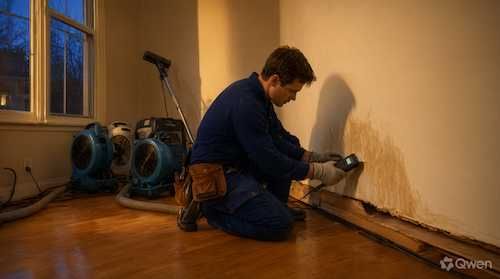
Water damage in Memphis has two very different tempos. The fast kind is an attic air handler overflowing its pan, a supply line letting go, or a storm driving rain under a flashing. The slow kind is more common and more expensive over time: a vented crawl space under the house that stays humid all summer, so floor joists, subfloor and insulation absorb moisture for months without producing a puddle anyone notices. In a climate where mold can establish quickly, the slow version is the one that turns a plumbing repair into a structural one.
The crawl space is the quiet problem
Vented crawl spaces were designed to dry out through outside air, and in a humid climate that logic works badly: on a warm damp day, opening the vents lets more moisture in than it lets out. The signs are a musty smell on the first floor, floors that feel soft near an outside wall, and insulation that has fallen or is hanging dark. Ask whether the crawl space has been inspected, what the moisture readings are, and what the proposal is — correcting grade and downspouts, repairing a plumbing leak, improving ventilation, or installing a vapor barrier and dehumidification. Each is a different job and only one of them is drying equipment.
The air handler above the ceiling
Where cooling equipment sits in the attic, condensate is produced for months of the year and the drain line is the component that decides whether it reaches the outside. A blocked line overflows the pan and the water comes through the ceiling below, often in a room that has been dry for years. Ask whether the pan has a float switch, where the secondary drain discharges, and when the line was last cleared. If a ceiling stain appears during the cooling season, this is the first thing to check — before the roof.
Storm rain finds the details
Heavy rain driven at an angle tests flashing, not shingles. The failures cluster at chimney and vent penetrations, at the joint where a porch roof meets the wall, at window heads, and at gutters that overflow because a downspout is blocked. Water enters high and travels along framing, so the ceiling stain can be several feet from the actual opening. Ask how the entry point was identified, whether the repair addresses the flashing or only the interior finish, and whether gutters and downspouts will be checked while the wall is open.
When the drain line fails, the damage is not clean water
Cast iron waste lines in older houses rust from the inside, and when they fail the water in the ceiling is not the same category as a supply leak. Cleanup requirements differ, materials are often removed rather than dried, and the insurance treatment can differ too. Ask what category of water is involved, what will be removed versus dried, and how the space will be verified clean before the rebuild. In a house with a crawl space, sewage can also pool under the floor where it is invisible from inside.
Drying in a humid climate takes the right equipment
Evaporation here is slow because the air is already loaded with moisture, which is exactly why dehumidification matters more than fans. A drying plan built on the assumption that open windows will do the work will run for weeks. Ask for readings by material and location, a stated dry standard, and a recheck before the rebuild is scheduled. Also ask what happens to the crawl space, since drying a floor without drying what is underneath it leaves the joists wet and the mold problem in place.
Questions to ask on the first visit
Where this page stops
This page does not assess a specific loss and publishes no prices. Sewage, mold and any active intrusion require on-site assessment, and coverage questions belong to your insurer and the policy documents.
Memphis metro context
ACS 2024 5-year estimates report about 1.34 million residents in 522,879 households and 580,185 housing units, with 60.5% owner-occupied and 69.9% single-family detached. About 46.1% of units predate 1980, which is the share most likely to have vented crawl spaces, cast iron drains and original attic ductwork. A climate station is not reported for this metro in the site dataset, so no precipitation figures are published on this page.
Memphis housing and ownership indicators
| Indicator | Value | Source |
|---|---|---|
| Housing units built before 1980 | 46.1% | U.S. Census Bureau |
| Single-family detached share | 69.9% | U.S. Census Bureau |
| Owner-occupied share | 60.5% | U.S. Census Bureau |
| Metro households | 522,879 | U.S. Census Bureau |
| Housing units | 580,185 | U.S. Census Bureau |
| Metro population | 1,341,924 | U.S. Census Bureau |
No climate normals are shown because no station record is held for this metro in the site dataset. Crawl space humidity depends on drainage, shading and ventilation on the specific lot.
Frequently Asked Questions
Why does my house smell musty when there is no visible leak?
The likely source is a damp crawl space, where humidity accumulates under the floor and works into the framing and insulation. It is worth inspecting with readings rather than guessing, because the fix may be drainage and vapor control rather than drying equipment.
Should I close the crawl space vents?
In a humid climate, open vents can admit more moisture than they remove, which is why many crawl spaces are now sealed and conditioned instead. That is a design decision for the specific house, and it should follow an inspection and moisture readings rather than a general rule.
Why does the ceiling stain appear in summer rather than during rain?
If it appears during the cooling season, the air handler condensate drain is the likely cause. If it appears during storms, suspect flashing at a penetration. The timing is the most useful diagnostic clue you have.
Is a sewage backup handled the same way as a supply leak?
No. Water containing sewage is a different category, cleanup requirements are stricter, and porous materials are generally removed rather than dried. Ask what category is involved and how the space will be verified clean.
How long should drying take here?
Longer than in a dry climate, because the air is already humid and evaporation is slower. That makes dehumidification essential and means the schedule should be driven by readings rather than by a fixed number of days.
What should I document first?
The water line on walls and stored items, the visible source, damaged flooring and furniture, and any readings taken. Insurers rely on documentation made before cleanup, and it cannot be recreated afterwards.
Sources and review date
- American Community Survey 2024 5-year estimates (CBSA tables) — U.S. Census Bureau, 2024 ACS 5-year estimates.
Reviewed on 2026-11-18.