
Miami, FL · metro guide
Electrical in Miami: Storm Code, Corrosion, and What to Compare
Miami electrical work has to answer two questions the rest of the country does not ask: what happens in a storm, and what salt air does to it.
Metro snapshot
Miami in numbers
Sources named below each block
- Population
- 6.2M
- Households
- 2.3M
- Housing units
- 2.7M
- People / household
- 2.68
- population ÷ households
Owner-occupied homes 61%
The rest are rented. Owners are the ones who commission most exterior work.
Single-family detached 41%
Detached houses carry their own roof, gutters and exterior walls.
Built before 1980 45%
Older housing stock shapes what fails first: gutters, flashing, pipe material.
Season
The year in Miami
- Precipitation
- 67.4 in
- Snowfall
- 0 in
Average temperature by month, °F — the shape of the year is what decides when exterior work gets done.
Precipitation by month, inches.
| Month | Average temperature (°F) | Precipitation (in) | Snowfall (in) |
|---|---|---|---|
| January | 68.6°F | 1.83 in | 0.0 in |
| February | 70.7°F | 2.15 in | 0.0 in |
| March | 73.1°F | 2.46 in | 0.0 in |
| April | 76.7°F | 3.36 in | 0.0 in |
| May | 80.1°F | 6.32 in | 0.0 in |
| June | 82.8°F | 10.51 in | 0.0 in |
| July | 84.1°F | 7.36 in | 0.0 in |
| August | 84.2°F | 9.58 in | 0.0 in |
| September | 83.0°F | 10.22 in | 0.0 in |
| October | 80.1°F | 7.65 in | 0.0 in |
| November | 74.8°F | 3.53 in | 0.0 in |
| December | 71.2°F | 2.44 in | 0.0 in |
NOAA 1991–2020 climate normals, station MIAMI INTL AP, FL US (USW00012839). Station observations, not a metro-wide average — a metro that spans a mountain range can differ by more than this record shows.
Population, households and housing shares: U.S. Census Bureau, American Community Survey 2024 5-year estimates, metropolitan statistical area.
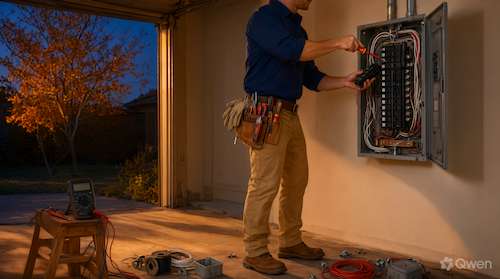
Electrical work in South Florida is shaped by weather. About 45.4% of metro housing units were built before 1980, according to ACS estimates, so a large share of panels and service equipment predate the code changes that followed later storms. Add salt air and a long humid season, and the failure modes look different from a dry inland metro.
Corrosion changes the failure mode
Ask how exterior panels, meter enclosures, and connections are evaluated where salt air reaches them. Corroded terminals and rusted enclosures cause intermittent faults that are hard to reproduce. If a property has had water intrusion, ask whether the affected circuits were inspected before being re-energized.
Capacity before equipment
Ask what the existing service rating is and whether a load calculation was done for the proposed change. A larger air conditioner, a pool, a generator, or an EV charger can each push a service past its practical limit. The answer may be a dedicated circuit, a panel change, a service upgrade, or a different equipment choice.
Surge, generators, and storm readiness
Ask what the proposal does about surge protection and how a generator would be connected, if that is part of the plan. A portable generator connected through a transfer switch is a different scope from a standby unit, and both are different from a battery. Ask what runs during an outage and for how long.
Permits, inspection, and restoration
Ask who files the permit, who schedules the inspection, and what restoration is included after walls or ceilings are opened. In older buildings, work often involves concrete block and plaster, which repair differently from drywall. Get the restoration scope in writing.
Questions to ask before approving work
Where this page stops
This page does not assess electrical safety remotely and does not publish local prices. Electrical hazards should be handled by a qualified professional, and permit and inspection requirements must be confirmed with the authority responsible for the address.
Miami metro context
The 2024 ACS 5-year estimates put the metro at about 6.2 million residents and 2.3 million households. About 60.5% of occupied homes are owner-occupied, and about 41.0% of housing units are single-family detached, so many systems serve shared buildings. About 45.4% of housing units were built before 1980. NOAA's Miami station records January averaging 68.6°F, July 84.1°F, and about 67.4 inches of precipitation a year.
Miami reference station and housing indicators
| Indicator | Value | Source |
|---|---|---|
| January mean temperature | 68.6°F | NOAA NCEI |
| July mean temperature | 84.1°F | NOAA NCEI |
| Annual precipitation | 67.4 in. | NOAA NCEI |
| Metro population | 6,249,291 | U.S. Census Bureau |
| Owner-occupied share | 60.5% | U.S. Census Bureau |
| Housing units built before 1980 | 45.4% | U.S. Census Bureau |
Station normals are historical averages for one location, not a forecast. Census values describe the metro area, not an individual property.
Frequently Asked Questions
How do I know if my Miami home needs a panel upgrade?
The decision should follow an assessment of the service rating, panel and enclosure condition, and the proposed load. Ask whether a load calculation was performed and which findings support the upgrade.
What should be checked after water intrusion?
Circuits and equipment that were wet should be inspected before being re-energized. Ask what was tested, what was replaced, and whether the inspection is documented.
Do I need a transfer switch for a generator?
A generator connected to house wiring needs a safe connection method, typically a transfer switch, to prevent backfeeding. Ask what the proposal includes and who will install and inspect it.
Why do exterior panels fail faster here?
Salt air and humidity corrode metal enclosures and connections. Ask how exterior equipment is evaluated and whether replacement materials are suited to coastal exposure.
What should an electrical estimate include?
The tested condition, work area, materials, labor, permit assumptions, inspection responsibilities, restoration, exclusions, and warranty. Ask for the test results that support the recommendation.
What is the population of the Miami metro area?
The U.S. Census Bureau's 2024 ACS 5-year estimates report about 6.2 million residents in the metro area. The figure describes regional scale, not the number of homes or providers.
Sources and review date
- American Community Survey 2024 5-year estimates (CBSA tables) — U.S. Census Bureau, 2024 ACS 5-year estimates.
- 1991–2020 station normals — MIAMI INTL AP, FL US (USW00012839) — NOAA National Centers for Environmental Information, 1991–2020 climate normals.
Reviewed on 2026-11-17.
Other Home Services in Miami–Fort Lauderdale–West Palm Beach
All guides for the Miami–Fort Lauderdale–West Palm Beach metro area