
Orlando, FL · metro guide
Electrical Work in Orlando: Panels, Pools and Storm Outages
A young stock does not mean a modern service — and a pool plus a generator inlet can exhaust one quickly.
Metro snapshot
Orlando in numbers
Sources named below each block
- Population
- 2.8M
- Households
- 1.0M
- Housing units
- 1.1M
- People / household
- 2.73
- population ÷ households
Owner-occupied homes 63%
The rest are rented. Owners are the ones who commission most exterior work.
Single-family detached 59%
Detached houses carry their own roof, gutters and exterior walls.
Built before 1980 24%
Older housing stock shapes what fails first: gutters, flashing, pipe material.
Season
The year in Orlando
- Precipitation
- 51.5 in
- Snowfall
- 0 in
Average temperature by month, °F — the shape of the year is what decides when exterior work gets done.
Precipitation by month, inches.
| Month | Average temperature (°F) | Precipitation (in) | Snowfall (in) |
|---|---|---|---|
| January | 60.6°F | 2.48 in | 0.0 in |
| February | 63.6°F | 2.04 in | 0.0 in |
| March | 67.3°F | 3.03 in | 0.0 in |
| April | 72.2°F | 2.58 in | 0.0 in |
| May | 77.3°F | 4.02 in | 0.0 in |
| June | 81.2°F | 8.05 in | 0.0 in |
| July | 82.6°F | 7.46 in | 0.0 in |
| August | 82.6°F | 7.69 in | 0.0 in |
| September | 81.0°F | 6.37 in | 0.0 in |
| October | 75.5°F | 3.46 in | 0.0 in |
| November | 68.2°F | 1.79 in | 0.0 in |
| December | 63.3°F | 2.48 in | 0.0 in |
NOAA 1991–2020 climate normals, station ORLANDO INTL AP, FL US (USW00012815). Station observations, not a metro-wide average — a metro that spans a mountain range can differ by more than this record shows.
Population, households and housing shares: U.S. Census Bureau, American Community Survey 2024 5-year estimates, metropolitan statistical area.
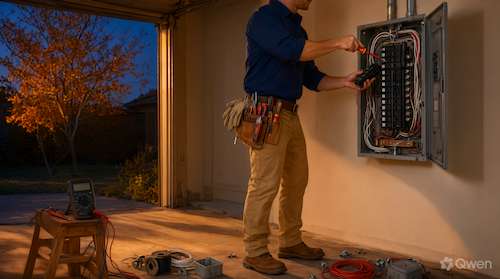
Only 23.8% of the housing here predates 1980, so most of the electrical work is in houses from the boom decades rather than in pre-war properties. That shifts the problems: fewer knob-and-tube situations, more 150-amp and 100-amp panels from the 1980s and 1990s that are now being asked to carry central cooling, a pool pump, an EV charger and a generator inlet. Because 58.5% of the stock is single-family detached and pools are common, the outdoor electrical work here is a bigger share of the total than in most metros.
The load list grows faster than the service
A panel that was specified for a house with a range and a dryer does not necessarily have room for the additions a household makes over thirty years, and the answer is a load calculation rather than an assumption. Replacing a panel on an undersized service is the classic false economy, and it is worth deciding early whether the project is a panel swap or a service upgrade, because the utility coordination and the permit differ. Ask for the calculated load, whether the service entrance equipment is included, and how grounding is being brought up to current requirements.
Pools, bonding and wet locations
Pool equipment is an electrical installation as much as a plumbing one: the metal parts have to be bonded together so that a fault cannot create a difference in potential, and the circuits serving the equipment need the protection appropriate to a wet location. Outdoor receptacles and lighting around a lanai or a dock raise the same questions. Ask whether the existing pool is bonded, what protection the outdoor circuits have, and whether the work requires a separate permit and inspection.
Generator inlets after a storm season
A hurricane season that takes the power out for days makes backup power a practical request, and the safe method is a transfer switch or an interlock kit that prevents backfeeding the utility lines. The circuits that can run on a portable generator are a small, deliberate subset, and the installation has to account for where the inlet sits, how the cord reaches it and how the exhaust is kept out of the house. Ask what the connection method is, which circuits are being transferred, and whether the work is permitted and inspected.
Aluminum, garages and the tropical details
Houses of the late 1960s and 1970s may have aluminum branch circuits that need proper remediation at the connections, and panels in a garage — the usual location here — sit in a hot, humid space that ages everything faster. Damp and heat also make the condition of the panel enclosure and the torque on the terminations worth checking. Ask what the inspection found at the panel and the devices, whether any aluminum connections will be remediated, and whether the panel location has any moisture problem.
Upgrades and the utility's schedule
When the answer is a service upgrade rather than a panel swap, the project stops being entirely a contractor's job: the utility has to disconnect, the new service and meter socket go in, the inspection has to pass, and the utility reconnects. That sequence drives the schedule and the cost of being without power. Ask who books the disconnect, how long the house will be without power, and whether any of that is included in the price.
What to pin down in the estimate
Where this page stops
No prices are quoted and no property is assessed here. Panel condition, bonding and service capacity have to be judged on site by a licensed electrician, and code questions belong to the authority having jurisdiction.
Orlando metro context
The 2024 ACS 5-year estimates describe about 2.79 million residents in 1,022,315 households and 1,145,360 housing units, with 63.1% owner-occupied and 58.5% single-family detached. Only 23.8% of units predate 1980 — the youngest stock in this dataset — so most panels here are of the boom decades rather than pre-war. No climate station is reported for this metro in the site dataset, so no temperature or precipitation normals appear on this page.
Orlando housing indicators
| Indicator | Value | Source |
|---|---|---|
| Housing units built before 1980 | 23.8% | U.S. Census Bureau |
| Single-family detached share | 58.5% | U.S. Census Bureau |
| Owner-occupied share | 63.1% | U.S. Census Bureau |
| Metro households | 1,022,315 | U.S. Census Bureau |
| Housing units | 1,145,360 | U.S. Census Bureau |
| Metro population | 2,793,746 | U.S. Census Bureau |
No climate normals are shown because no station record is held for this metro in the site dataset. The young stock moves the work toward capacity upgrades and outdoor circuits rather than toward replacing knob-and-tube.
Frequently Asked Questions
Do I need a service upgrade for a pool?
The existing load plus the pool equipment has to be calculated. Sometimes there is capacity; often the pool is the addition that tips a marginal service over, and that should be established before the equipment is ordered.
Why does pool bonding matter?
Bonding ties the metal parts together so a fault cannot create a voltage difference between them. Without it, a fault in one component can make another — a ladder, a handrail — hazardous to touch.
Can I use a portable generator with an interlock?
Yes, and a transfer switch or interlock is the correct method because it prevents backfeeding the utility lines. The circuits that can run are a deliberate, limited set.
Is a 1980s panel a problem?
Not by age alone. What matters is the brand and model, the condition of the terminations and the calculated load. An electrician inspecting it will tell you whether it is worth extending or replacing.
Why is the panel in the garage a concern?
Because a garage in this climate is hot and humid, which ages enclosures and terminations faster. The condition of the panel and its surroundings is part of the inspection, not a separate concern.
Do outdoor outlets need special protection?
Outdoor and wet-location circuits need protection appropriate to the exposure, and the enclosures have to be rated for it. A lanai or pool area concentrates those requirements.
Sources and review date
- American Community Survey 2024 5-year estimates (CBSA tables) — U.S. Census Bureau, 2024 ACS 5-year estimates.
Reviewed on 2026-11-18.