
New Orleans, LA · metro guide
Painting in New Orleans: Humidity, Wood Rot, and a Regulated Palette
Paint here is a moisture barrier over wood that wants to stay wet, and the color may not be entirely your decision.
Metro snapshot
New Orleans in numbers
Sources named below each block
- Population
- 982K
- Households
- 399K
- Housing units
- 465K
- People / household
- 2.46
- population ÷ households
Owner-occupied homes 61%
The rest are rented. Owners are the ones who commission most exterior work.
Single-family detached 58%
Detached houses carry their own roof, gutters and exterior walls.
Built before 1980 64%
Older housing stock shapes what fails first: gutters, flashing, pipe material.
Season
The year in New Orleans
- Precipitation
- 63.4 in
- Snowfall
- 0 in
Average temperature by month, °F — the shape of the year is what decides when exterior work gets done.
Precipitation by month, inches.
| Month | Average temperature (°F) | Precipitation (in) | Snowfall (in) |
|---|---|---|---|
| January | 54.3°F | 5.18 in | 0.0 in |
| February | 58.0°F | 4.13 in | 0.0 in |
| March | 63.8°F | 4.36 in | 0.0 in |
| April | 70.1°F | 5.22 in | 0.0 in |
| May | 77.1°F | 5.64 in | 0.0 in |
| June | 82.4°F | 7.62 in | 0.0 in |
| July | 83.9°F | 6.79 in | 0.0 in |
| August | 84.0°F | 6.91 in | 0.0 in |
| September | 80.8°F | 5.11 in | 0.0 in |
| October | 72.5°F | 3.70 in | 0.0 in |
| November | 62.4°F | 3.87 in | 0.0 in |
| December | 56.6°F | 4.82 in | 0.0 in |
NOAA 1991–2020 climate normals, station NEW ORLEANS INTL AP, LA US (USW00012916). Station observations, not a metro-wide average — a metro that spans a mountain range can differ by more than this record shows.
Population, households and housing shares: U.S. Census Bureau, American Community Survey 2024 5-year estimates, metropolitan statistical area.
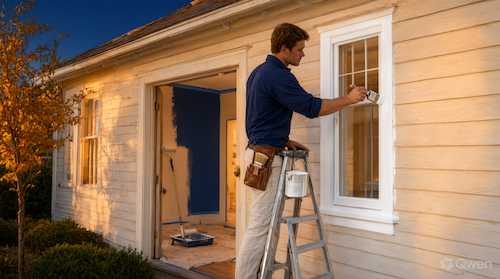
The local painting problem is not sun and it is not frost. It is water that arrives as humidity and stays. Wood trim, siding, porch columns and the exposed structure under a raised house all absorb moisture from air that is damp most of the year, and paint that seals the surface without letting that moisture escape will blister from behind. Because 63.5% of the metro's housing predates 1980 and much of it is wood construction with original trim, most of the exteriors being painted now are working on their sixth or seventh coating over wood that has been wet and dry for a century.
Find the rot before the brush
Sills, the bottom courses of siding, porch steps and the ends of fascia hold water longest and fail first. Soft wood cannot be painted back into service, and coating it hides the problem for a season while it spreads. The question worth settling at the estimate stage is who handles carpentry: whether repairs are included, priced as a contingency, or excluded. On a raised house, the structure underneath is also exposed and is often the last thing anyone inspects. Ask whether the scope includes the underside and what the standard is for calling a board sound.
Dry time is the constraint that schedules ignore
Coatings specify a maximum moisture content for the substrate, and in this climate that number is exceeded easily, particularly on a shaded wall or after a week of rain. A crew working to a calendar rather than to conditions will paint damp wood, and the failure appears later as blistering that looks like a product problem and is not. Ask how moisture is checked, what happens if the wall is not ready, and whether the schedule has weather contingency. On a house with deep overhangs and shaded elevations, the drying difference between walls can be days.
Stucco over brick, and what that means
Some of the older buildings in the metro are brick with a stucco coat, and the relationship between those layers decides how the wall should be treated. A coating that seals the surface can trap moisture behind the stucco and cause it to detach, and repair then becomes a plastering job rather than a painting one. Ask whether cracks will be filled and with what, whether the proposed coating is breathable, and whether any hollow or drummy areas were sounded out before the estimate. Painting over failed stucco is the most expensive way to postpone a repair.
Color may be a reviewed decision
Large parts of the metro fall inside historic districts where exterior changes, and in some cases color, are reviewed by a commission. This is not a formality to discover after the paint is ordered. Ask whether the address is in a district, what the review process covers, and whether the contractor has worked under it before. It also helps to record the products and colors used, since matching an approved palette later is easier with a specification than with a photograph of a faded wall.
Lead paint in a stock this old
With two thirds of the housing built before 1980, lead paint is likely to be present on at least some surfaces, and any preparation involving sanding or scraping generates dust and chips. Ask whether surfaces will be tested, how debris is contained and removed, and what documentation is provided. This applies to interiors as well, and to the trim work that most often needs the heaviest preparation. A vague answer is a reason to keep looking.
What to pin down in the estimate
Where this page stops
No prices are published and no judgement is made about a specific building. Rot, failed stucco and structural moisture should be identified by someone who inspects the assembly, and historic district and lead requirements belong to the local authority.
New Orleans metro context
ACS 2024 5-year estimates describe about 982,000 residents in 398,564 households and 465,148 housing units, with 60.6% owner-occupied and 58.4% single-family detached — the latter reflecting the number of doubles and multi-unit buildings in the stock. About 63.5% of units predate 1980, which is why original wood trim and multiple old coatings are the normal starting point. A climate station is not reported for this metro in the site dataset, so no temperature or precipitation normals appear here.
New Orleans housing and ownership indicators
| Indicator | Value | Source |
|---|---|---|
| Housing units built before 1980 | 63.5% | U.S. Census Bureau |
| Single-family detached share | 58.4% | U.S. Census Bureau |
| Owner-occupied share | 60.6% | U.S. Census Bureau |
| Housing units | 465,148 | U.S. Census Bureau |
| Metro households | 398,564 | U.S. Census Bureau |
| Metro population | 981,662 | U.S. Census Bureau |
No climate normals are shown because no station record is held for this metro in the site dataset. Housing age is a proxy for the number of existing coatings and for the likelihood of lead paint, not for condition.
Frequently Asked Questions
Why does paint peel off in sheets here?
Usually because moisture is trapped behind the film, often from wood that was painted while damp or from water entering at a joint. Preparation, drying and joint repair matter more than the coating brand, and repainting without addressing them repeats the cycle.
How do I know whether my wood trim is rotted?
Probe it with a tool rather than pressing with a finger. Soft, crumbly wood at sills, the bottom of siding and the ends of fascia is failing, and it has to be repaired or replaced rather than painted. That work is often carpentry outside the painter's scope.
Do I need approval for my exterior colors?
Possibly, if the building is in a historic district with design review. Ask the local commission for the address before ordering paint. Even where color is not reviewed, other exterior changes may be, so it is worth checking the whole scope at once.
Can painted stucco just be repainted?
Only if the stucco is sound and the coating is compatible. Hollow or drummy areas, and cracks that are not repaired properly, will cause the new coating to fail. Sounding the wall before estimating is how those areas get found.
What is the best season for exterior painting?
A stretch of several dry days with moderate humidity, which here is more likely in spring or autumn than in midsummer. Substrate moisture is the deciding factor rather than air temperature alone.
Is lead paint a concern in older New Orleans houses?
Yes, in pre-1978 housing, particularly where sanding or scraping is involved. Ask about testing, containment and debris removal, and expect the contractor to describe the process rather than dismiss the question.
Sources and review date
- American Community Survey 2024 5-year estimates (CBSA tables) — U.S. Census Bureau, 2024 ACS 5-year estimates.
Reviewed on 2026-11-18.