
Oklahoma City, OK · metro guide
Gutter Cleaning in Oklahoma City: Red Dirt, Wind and Hail
The run fills from the air rather than from the trees.
Metro snapshot
Oklahoma City in numbers
Sources named below each block
- Population
- 1.5M
- Households
- 571K
- Housing units
- 622K
- People / household
- 2.56
- population ÷ households
Owner-occupied homes 64%
The rest are rented. Owners are the ones who commission most exterior work.
Single-family detached 72%
Detached houses carry their own roof, gutters and exterior walls.
Built before 1980 45%
Older housing stock shapes what fails first: gutters, flashing, pipe material.
Season
The year in Oklahoma City
- Precipitation
- 36.4 in
- Snowfall
- 6.7 in
Average temperature by month, °F — the shape of the year is what decides when exterior work gets done.
Precipitation by month, inches.
Snowfall by month, inches.
| Month | Average temperature (°F) | Precipitation (in) | Snowfall (in) |
|---|---|---|---|
| January | 38.2°F | 1.32 in | 1.8 in |
| February | 42.3°F | 1.42 in | 1.8 in |
| March | 51.2°F | 2.55 in | 0.8 in |
| April | 59.3°F | 3.60 in | 0.0 in |
| May | 68.2°F | 5.31 in | 0.0 in |
| June | 76.9°F | 4.49 in | 0.0 in |
| July | 81.7°F | 3.59 in | 0.0 in |
| August | 80.7°F | 3.60 in | 0.0 in |
| September | 72.7°F | 3.72 in | 0.0 in |
| October | 61.1°F | 3.32 in | 0.0 in |
| November | 49.2°F | 1.68 in | 0.5 in |
| December | 40.0°F | 1.79 in | 1.8 in |
NOAA 1991–2020 climate normals, station OKLAHOMA CITY WILL ROGERS AP, OK US (USW00013967). Station observations, not a metro-wide average — a metro that spans a mountain range can differ by more than this record shows.
Population, households and housing shares: U.S. Census Bureau, American Community Survey 2024 5-year estimates, metropolitan statistical area.
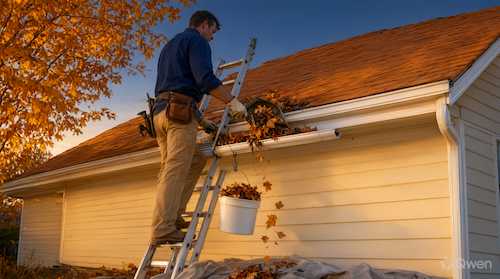
Oklahoma City sits on red soil in one of the windier parts of the country, and the gutters here fill with what the wind carries rather than with leaves. That makes the load uneven: the windward elevations accumulate a fine red silt that sets at the low points, while the sheltered side may stay almost clean. Hail arrives with the same storm systems, denting channels and stripping granules off roofs.
Wind-driven red silt
The soil is fine and red, and the wind moves it in quantity, so it lands in runs as an even layer that turns to slurry when wetted and sets when it dries. Ask which runs are exposed and whether the outlets are cleared of silt.
Hail dents and shingle grit
Hail dents aluminum and knocks granules off shingles, and the grit washes into the run and collects at the low points. Ask whether dents and grit are reported.
Flat lots and clay
The terrain is flat and the soil is clay, so discharged water stays near the wall. Ask where each downspout ends and whether there is a defined path away from the foundation.
One side fills, the other does not
Because the load arrives on the wind, the elevations do not need the same treatment, and a quote that assumes a uniform job will either overcharge one side or under-clean the other. Ask whether the windward runs are identified.
Storm season and timing
Spring brings the hail and the wind together, so the useful visit is the one before the season rather than after the first damaging storm. Ask when it is scheduled.
What to pin down in the estimate
Where this page stops
No prices are quoted and no property is assessed here. Hail damage to roofs, grading and foundation movement need inspection by the right trade, and insurance questions belong to the insurer.
Oklahoma City metro context
The 2024 ACS 5-year estimates describe about 1.46 million residents in 571,211 households and 622,187 housing units, with 63.6% owner-occupied and 71.8% single-family detached. About 45.1% of units predate 1980. No climate station is reported for this metro in the site dataset, so no temperature or precipitation normals appear on this page.
Oklahoma City housing indicators
| Indicator | Value | Source |
|---|---|---|
| Housing units built before 1980 | 45.1% | U.S. Census Bureau |
| Single-family detached share | 71.8% | U.S. Census Bureau |
| Owner-occupied share | 63.6% | U.S. Census Bureau |
| Metro households | 571,211 | U.S. Census Bureau |
| Housing units | 622,187 | U.S. Census Bureau |
| Metro population | 1,463,267 | U.S. Census Bureau |
Station normals are historical averages for one location, not a forecast. What a gutter has to carry depends on roof area, pitch, the debris the surrounding trees drop and whether downspouts discharge where the water can leave.
Frequently Asked Questions
Why is there red silt in my gutters?
Wind-driven soil. It settles as a layer, turns to slurry when wet and sets at the low points.
Do all the gutters need cleaning at once?
Not necessarily. The windward runs fill far faster, and a good visit distinguishes between them.
Can hail damage a gutter?
It dents aluminum and creates low points that trap grit. The dents are a functional problem.
Where should the downspout end?
Away from the foundation with a path, because the clay will not absorb what the roof delivers.
When should gutters be cleaned here?
Before the spring storm season, and again in autumn if the wind has loaded them.
Do I need to be home?
Exterior work can be done with agreed access. Nothing inside the house is involved.
Sources and review date
- American Community Survey 2024 5-year estimates (CBSA tables) — U.S. Census Bureau, 2024 ACS 5-year estimates.
Reviewed on 2026-11-18.