
Phoenix, AZ · metro guide
Gutter Cleaning in Phoenix: Desert Roofs, Monsoon Bursts and Dust in the Channel
Seven inches of rain a year, most of it in a few weeks, on houses that were often built without gutters.
Metro snapshot
Phoenix in numbers
Sources named below each block
- Population
- 5.0M
- Households
- 1.9M
- Housing units
- 2.1M
- People / household
- 2.66
- population ÷ households
Owner-occupied homes 67%
The rest are rented. Owners are the ones who commission most exterior work.
Single-family detached 65%
Detached houses carry their own roof, gutters and exterior walls.
Built before 1980 27%
Older housing stock shapes what fails first: gutters, flashing, pipe material.
Season
The year in Phoenix
- Precipitation
- 7.2 in
- Snowfall
- —
Average temperature by month, °F — the shape of the year is what decides when exterior work gets done.
Precipitation by month, inches.
| Month | Average temperature (°F) | Precipitation (in) | Snowfall (in) |
|---|---|---|---|
| January | 56.8°F | 0.87 in | — |
| February | 59.9°F | 0.87 in | — |
| March | 66.3°F | 0.83 in | — |
| April | 73.2°F | 0.22 in | — |
| May | 82.0°F | 0.13 in | — |
| June | 91.4°F | 0.02 in | — |
| July | 95.5°F | 0.91 in | — |
| August | 94.4°F | 0.93 in | — |
| September | 89.2°F | 0.57 in | — |
| October | 77.4°F | 0.56 in | — |
| November | 65.1°F | 0.57 in | — |
| December | 55.8°F | 0.74 in | — |
NOAA 1991–2020 climate normals, station PHOENIX SKY HARBOR INTL AP, AZ US (USW00023183). Station observations, not a metro-wide average — a metro that spans a mountain range can differ by more than this record shows.
Population, households and housing shares: U.S. Census Bureau, American Community Survey 2024 5-year estimates, metropolitan statistical area.
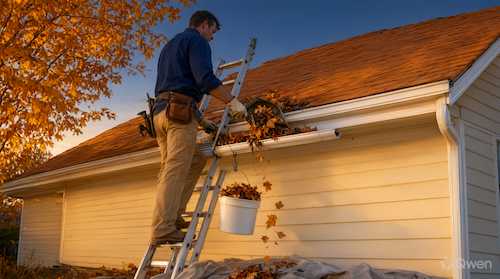
Phoenix gets 7.2 inches of rain a year, and much of it arrives in monsoon bursts between July and September. That shape of rainfall is why many desert roofs were designed without gutters at all: for most of the year there is nothing to carry. Where gutters do exist they fill with dust and grit rather than leaves, and the monsoon tests them in a way the rest of the year never does.
Roofs built without gutters
A large share of the local stock has no gutter system, and where a run exists it is often a partial one over an entry or a patio rather than the whole roof. Ask what is actually installed before assuming a full system exists, and where the roof water goes instead.
Dust and grit, not leaves
The debris load here is airborne dust, gravel from flat roofs and grit from tiles, and it collects as a fine layer that turns to a slurry in the first rain and sets when it dries. That is what blocks outlets. Ask whether the outlets are cleared of grit rather than only the visible channel.
A monsoon is the only real test
For eleven months a partially blocked run may never show a symptom, and then a monsoon storm delivers enough rain in an hour to reveal everything. Ask whether the visit happens before the monsoon rather than after.
Heat and ageing seals
Summer heat and ultraviolet degrade sealant, plastic outlets and guards faster than in a wetter climate, and joints open quietly. Ask whether joints and seals are inspected.
Communities and roof access
Much of the newer housing sits in communities with requirements about vendors and exterior access, and many roofs are tile or foam-covered, where walking them is a specializt skill. Ask what the community requires and whether the contractor works that roof type.
What to pin down in the estimate
Where this page stops
No prices are quoted and no property is assessed here. Roof condition, tile and foam systems and drainage design belong to a roofer or an engineer, and nothing here is advice about monsoon flood risk.
Phoenix metro context
The 2024 ACS 5-year estimates describe about 5.03 million residents in 1,892,613 households and 2,068,985 housing units, with 66.6% owner-occupied and 65.3% single-family detached. About 27.3% of units predate 1980. At the Phoenix Sky Harbor Intl Ap reference station January averages 56.8°F and July 95.5°F, on 7.2 inches of annual precipitation.
Phoenix reference station and housing indicators
| Indicator | Value | Source |
|---|---|---|
| January mean temperature | 56.8°F | NOAA NCEI |
| July mean temperature | 95.5°F | NOAA NCEI |
| Annual precipitation | 7.2 in. | NOAA NCEI |
| Metro population | 5,028,754 | U.S. Census Bureau |
| Owner-occupied share | 66.6% | U.S. Census Bureau |
| Housing units built before 1980 | 27.3% | U.S. Census Bureau |
Station normals are historical averages for one location, not a forecast. What a gutter has to carry depends on roof area, pitch, the debris the surrounding trees drop and whether downspouts discharge where the water can leave.
Frequently Asked Questions
Do I even need gutters in Phoenix?
Not every roof does. Where there is no system the water leaves the roof directly, and the question becomes where it lands rather than whether a run is clear.
What blocks gutters here if there are no trees?
Dust, roof gravel and tile grit. It forms a slurry in the first rain and sets in the low points and outlets.
When should gutters be cleaned?
Before the monsoon, so the run is clear for the only part of the year that tests it.
Can heat damage a gutter?
It degrades sealant and plastic parts and opens joints quietly, without any impact.
Is it safe to walk a tile roof?
That is a specializt skill and a cracked tile is expensive. Confirm the contractor works that roof type.
Do I need community approval?
Often for vendor access. Confirm before the crew arrives rather than at the gate.
Sources and review date
- American Community Survey 2024 5-year estimates (CBSA tables) — U.S. Census Bureau, 2024 ACS 5-year estimates.
- 1991–2020 station normals — PHOENIX SKY HARBOR INTL AP, AZ US (USW00023183) — NOAA National Centers for Environmental Information, 1991–2020 climate normals.
Reviewed on 2026-11-18.