
Pittsburgh, PA · metro guide
Gutter Cleaning in Pittsburgh: Hillside Runs, Steep Roofs and Retaining Walls
The oldest housing of any metro here, on slopes where the discharge point is a retaining wall or a neighbor's yard.
Metro snapshot
Pittsburgh in numbers
Sources named below each block
- Population
- 2.4M
- Households
- 1.1M
- Housing units
- 1.2M
- People / household
- 2.30
- population ÷ households
Owner-occupied homes 71%
The rest are rented. Owners are the ones who commission most exterior work.
Single-family detached 68%
Detached houses carry their own roof, gutters and exterior walls.
Built before 1980 73%
Older housing stock shapes what fails first: gutters, flashing, pipe material.
Season
The year in Pittsburgh
- Precipitation
- 39.6 in
- Snowfall
- 44.1 in
Average temperature by month, °F — the shape of the year is what decides when exterior work gets done.
Precipitation by month, inches.
Snowfall by month, inches.
| Month | Average temperature (°F) | Precipitation (in) | Snowfall (in) |
|---|---|---|---|
| January | 28.8°F | 2.96 in | 13.3 in |
| February | 31.4°F | 2.62 in | 11.7 in |
| March | 39.7°F | 3.15 in | 7.6 in |
| April | 51.5°F | 3.32 in | 1.0 in |
| May | 61.2°F | 3.83 in | 0.0 in |
| June | 69.4°F | 4.12 in | 0.0 in |
| July | 73.2°F | 4.26 in | 0.0 in |
| August | 71.8°F | 3.52 in | 0.0 in |
| September | 64.9°F | 3.30 in | 0.0 in |
| October | 53.4°F | 2.83 in | 0.4 in |
| November | 42.6°F | 2.86 in | 2.4 in |
| December | 33.7°F | 2.84 in | 7.7 in |
NOAA 1991–2020 climate normals, station PITTSBURGH INTL AP, PA US (USW00094823). Station observations, not a metro-wide average — a metro that spans a mountain range can differ by more than this record shows.
Population, households and housing shares: U.S. Census Bureau, American Community Survey 2024 5-year estimates, metropolitan statistical area.
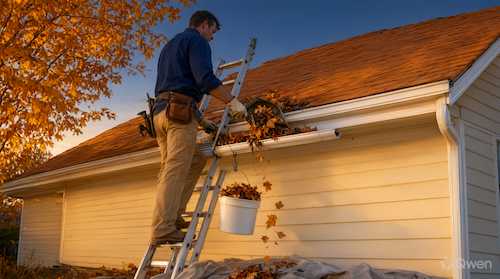
Pittsburgh has 73.1% of its housing built before 1980 and 68.0% of it detached, on hillsides where the ground behind a house is often a retaining wall rather than a yard. That geometry makes the discharge point the difficult part: a downspout that ends where the ground falls steeply sends water down a slope, onto steps or against a wall that belongs to someone else. Steep roofs also mean long downspout drops that are hard to reach and easy to leave blocked.
Discharge onto slopes, steps and walls
On a hillside lot the downspout often ends above a retaining wall, a flight of steps or a neighbor's ground, and water released there goes wherever gravity takes it. Ask where each downspout ends and what is directly below it.
Steep roofs and long drops
Steep pitches and multi-storey drops mean a downspout may run twenty or thirty feet before it reaches grade, and reaching either end is awkward. Ask how the roofline is accessed and whether the full length of the downspout is checked.
Steel-era soot and grit
Generations of industrial smoke left soot in the masonry, and rain carries it into the runs along with grit, where it sets at the low points. It blocks outlets without looking like debris.
Old runs on old roofs
With nearly three in four units predating 1980, galvanized steel and half-round runs are common, and steel that has held damp debris rusts from the inside. Ask whether the material and condition are assessed.
Ice on a slope
Freezing weather plus steep ground means overflow freezes into a sheet on steps and paths, which is a safety issue before it is a building issue. Ask when the autumn clean is scheduled.
What to pin down in the estimate
Where this page stops
No prices are quoted and no property is assessed here. Retaining walls, slope stability, steps and masonry are matters for an engineer or a contractor, and nothing here is structural advice.
Pittsburgh metro context
The 2024 ACS 5-year estimates describe about 2.44 million residents in 1,061,705 households and 1,174,149 housing units, with 70.7% owner-occupied and 68.0% single-family detached. About 73.1% of units predate 1980. At the Pittsburgh Intl Ap reference station January averages 28.8°F and July 73.2°F, on 39.6 inches of annual precipitation.
Pittsburgh reference station and housing indicators
| Indicator | Value | Source |
|---|---|---|
| January mean temperature | 28.8°F | NOAA NCEI |
| July mean temperature | 73.2°F | NOAA NCEI |
| Annual precipitation | 39.6 in. | NOAA NCEI |
| Metro population | 2,439,940 | U.S. Census Bureau |
| Owner-occupied share | 70.7% | U.S. Census Bureau |
| Housing units built before 1980 | 73.1% | U.S. Census Bureau |
Station normals are historical averages for one location, not a forecast. What a gutter has to carry depends on roof area, pitch, the debris the surrounding trees drop and whether downspouts discharge where the water can leave.
Frequently Asked Questions
Where should a downspout end on a hillside lot?
Somewhere the water does not run onto steps, a wall or a neighbor's ground. That usually needs a defined path rather than a splash block.
How do you reach gutters on a steep roof?
From the ground where possible, otherwise from an accessible roof plane. Steep pitches are not walkable in ordinary footwear.
Why does my steel gutter leak?
Galvanized steel rusts from the inside where damp debris sits, and the hole appears long before anything looks wrong outside.
Does a blocked gutter make steps dangerous in winter?
Yes. Overflow freezes on steps and paths, and that is a hazard before it is a building problem.
How often should gutters be cleared here?
Twice a year, with the autumn visit before the freeze.
Do I need to be home?
Exterior work can be done with agreed access. Nothing inside the house is involved.
Sources and review date
- American Community Survey 2024 5-year estimates (CBSA tables) — U.S. Census Bureau, 2024 ACS 5-year estimates.
- 1991–2020 station normals — PITTSBURGH INTL AP, PA US (USW00094823) — NOAA National Centers for Environmental Information, 1991–2020 climate normals.
Reviewed on 2026-11-18.