
Pittsburgh, PA · metro guide
Painting in Pittsburgh: Old Brick, Wood Siding, and Heavy Lead
With 73% of the housing predating 1980, lead and layered old paint are the default starting conditions.
Metro snapshot
Pittsburgh in numbers
Sources named below each block
- Population
- 2.4M
- Households
- 1.1M
- Housing units
- 1.2M
- People / household
- 2.30
- population ÷ households
Owner-occupied homes 71%
The rest are rented. Owners are the ones who commission most exterior work.
Single-family detached 68%
Detached houses carry their own roof, gutters and exterior walls.
Built before 1980 73%
Older housing stock shapes what fails first: gutters, flashing, pipe material.
Season
The year in Pittsburgh
- Precipitation
- 39.6 in
- Snowfall
- 44.1 in
Average temperature by month, °F — the shape of the year is what decides when exterior work gets done.
Precipitation by month, inches.
Snowfall by month, inches.
| Month | Average temperature (°F) | Precipitation (in) | Snowfall (in) |
|---|---|---|---|
| January | 28.8°F | 2.96 in | 13.3 in |
| February | 31.4°F | 2.62 in | 11.7 in |
| March | 39.7°F | 3.15 in | 7.6 in |
| April | 51.5°F | 3.32 in | 1.0 in |
| May | 61.2°F | 3.83 in | 0.0 in |
| June | 69.4°F | 4.12 in | 0.0 in |
| July | 73.2°F | 4.26 in | 0.0 in |
| August | 71.8°F | 3.52 in | 0.0 in |
| September | 64.9°F | 3.30 in | 0.0 in |
| October | 53.4°F | 2.83 in | 0.4 in |
| November | 42.6°F | 2.86 in | 2.4 in |
| December | 33.7°F | 2.84 in | 7.7 in |
NOAA 1991–2020 climate normals, station PITTSBURGH INTL AP, PA US (USW00094823). Station observations, not a metro-wide average — a metro that spans a mountain range can differ by more than this record shows.
Population, households and housing shares: U.S. Census Bureau, American Community Survey 2024 5-year estimates, metropolitan statistical area.
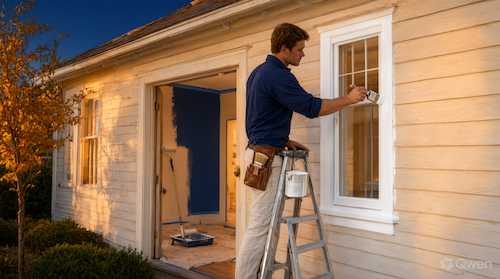
Pittsburgh has the oldest housing stock of any metro on this site — 73.1% of units predate 1980 — and that single fact defines the painting conversation. Exteriors here often combine old brick with wood siding and a great deal of original millwork: cornices, window surrounds, porch posts and soffits. Many carry six, eight, ten coats of paint applied over a century, some of it lead-based. Freeze-thaw does the damage, and preparation is where the job is won or lost.
Brick should usually stay bare
Brick that has never been painted is designed to dry through its face, and a film-forming coating traps moisture inside the wall where freeze-thaw can spall the surface. Once brick is painted it is very hard to return to an unpainted state, so the decision is close to permanent. If the masonry is sound and unpainted, deal with the mortar joints, the flashing and any staining instead. If it is already painted, the goal becomes a breathable system and careful preparation rather than another heavy coat.
The wood is the real work
Cornices, brackets and window surrounds on a pre-war house are intricate surfaces with many edges, and edges are where paint fails first. Alligatoring on the south and west faces, bare patches at the base of porch posts, and open joints around windows are the usual findings. Scraping only the loose material and painting over the rest guarantees a repeat within a few seasons. Ask what prep is included — hand scraping, sanding to feather edges, spot priming bare wood — and whether joints will be re-caulked with a sealant that can move.
Freeze-thaw and the bottom of the wall
With 44.1 inches of snow a year and January averaging 28.8°F, water enters joints and cracks and expands when it freezes, lifting the film above it. The lower courses and north elevations fail first because snow sits against them and meltwater runs down. That is why the prep budget matters more than the topcoat: a bid that prices per square foot without describing preparation is a bid for a coating that will look tired after three winters.
Lead paint is the default here, not the exception
With almost three quarters of the stock predating 1978, lead paint is likely present on at least some surfaces, and any preparation involving sanding or scraping generates dust and chips. Ask whether surfaces will be tested, how the ground and landscaping are protected, how debris is contained and removed, and what documentation is supplied. This applies inside as well, and to the millwork that needs the heaviest preparation. In older rental property the applicable rules may be stricter, so confirm the standard that applies.
A short season with hard edges
Exterior coatings need substrate and air temperatures within the product's range through curing, which here means late spring to early autumn. The shoulder weeks are where failures are created: paint applied on a cold October afternoon looks acceptable in November and peels in April. Ask how the contractor handles a job that runs into a cold snap, and whether they stop or push through.
What to pin down in the estimate
Where this page stops
No prices are published and no assessment of a specific building is made here. Masonry deterioration, spalling and flashing failures should be evaluated by someone qualified to inspect the assembly, and lead requirements belong to the federal and state authorities.
Pittsburgh metro context
The 2024 ACS 5-year estimates describe about 2.44 million residents in 1,061,705 households and 1,174,149 housing units, with 70.7% owner-occupied and 68.0% single-family detached. About 73.1% of units predate 1980, the highest share on this site, which is why lead and layered old coatings lead this page. NOAA's station records January at 28.8°F, July at 73.2°F and 44.1 inches of annual snowfall.
Pittsburgh housing age and winter conditions
| Indicator | Value | Source |
|---|---|---|
| Housing units built before 1980 | 73.1% | U.S. Census Bureau |
| Single-family detached share | 68.0% | U.S. Census Bureau |
| Owner-occupied share | 70.7% | U.S. Census Bureau |
| January mean temperature | 28.8°F | NOAA NCEI |
| Annual snowfall | 44.1 in. | NOAA NCEI |
| Annual precipitation | 39.6 in. | NOAA NCEI |
Housing age is a proxy for the number of existing coatings and for the likelihood of lead paint. It does not establish the condition of any particular building.
Frequently Asked Questions
Should the brick on my house be painted?
Usually not, if it has never been painted. Brick needs to dry through its face, and a coating traps moisture that freeze-thaw then damages from inside. Where brick is already painted, the practical approach is a breathable system and careful preparation of the failed areas.
Why does paint fail on the cornice and window trim first?
Because those are the surfaces with the most edges, the most joints and the most exposure. Edges are where a film breaks down first, and joints let water in behind the coating. That is why prep and caulking there matter more than the topcoat.
Is lead paint likely in a Pittsburgh house?
Roughly three quarters of the housing predates 1978, so the likelihood is high. Any preparation involving sanding or scraping should include testing, containment and proper debris handling, with documentation at the end.
Can I paint in October here?
Only if the product's minimum temperature holds through the curing window, which late-season weather rarely guarantees. A cold night shortly after application can prevent proper film formation and lead to peeling the following spring.
How much scraping is enough?
Enough that the remaining film is sound and well bonded, with edges feathered and bare areas primed. Painting over loose or chalky material is the single most common reason a repaint fails early.
Do I need to repaint the whole exterior at once?
Not necessarily. Exposed elevations and detailed millwork fail before the rest, so a phased approach can be sensible, provided a consistent product and color record is kept so later phases match.
Sources and review date
- American Community Survey 2024 5-year estimates (CBSA tables) — U.S. Census Bureau, 2024 ACS 5-year estimates.
- 1991–2020 station normals — PITTSBURGH INTL AP, PA US (USW00094823) — NOAA National Centers for Environmental Information, 1991–2020 climate normals.
Reviewed on 2026-11-18.