
Pittsburgh, PA · metro guide
Window Cleaning in Pittsburgh: Hillsides, Steel-Era Soot and Lake Snow
The oldest housing of any metro here, on slopes where the back of the house is a different job from the front.
Metro snapshot
Pittsburgh in numbers
Sources named below each block
- Population
- 2.4M
- Households
- 1.1M
- Housing units
- 1.2M
- People / household
- 2.30
- population ÷ households
Owner-occupied homes 71%
The rest are rented. Owners are the ones who commission most exterior work.
Single-family detached 68%
Detached houses carry their own roof, gutters and exterior walls.
Built before 1980 73%
Older housing stock shapes what fails first: gutters, flashing, pipe material.
Season
The year in Pittsburgh
- Precipitation
- 39.6 in
- Snowfall
- 44.1 in
Average temperature by month, °F — the shape of the year is what decides when exterior work gets done.
Precipitation by month, inches.
Snowfall by month, inches.
| Month | Average temperature (°F) | Precipitation (in) | Snowfall (in) |
|---|---|---|---|
| January | 28.8°F | 2.96 in | 13.3 in |
| February | 31.4°F | 2.62 in | 11.7 in |
| March | 39.7°F | 3.15 in | 7.6 in |
| April | 51.5°F | 3.32 in | 1.0 in |
| May | 61.2°F | 3.83 in | 0.0 in |
| June | 69.4°F | 4.12 in | 0.0 in |
| July | 73.2°F | 4.26 in | 0.0 in |
| August | 71.8°F | 3.52 in | 0.0 in |
| September | 64.9°F | 3.30 in | 0.0 in |
| October | 53.4°F | 2.83 in | 0.4 in |
| November | 42.6°F | 2.86 in | 2.4 in |
| December | 33.7°F | 2.84 in | 7.7 in |
NOAA 1991–2020 climate normals, station PITTSBURGH INTL AP, PA US (USW00094823). Station observations, not a metro-wide average — a metro that spans a mountain range can differ by more than this record shows.
Population, households and housing shares: U.S. Census Bureau, American Community Survey 2024 5-year estimates, metropolitan statistical area.
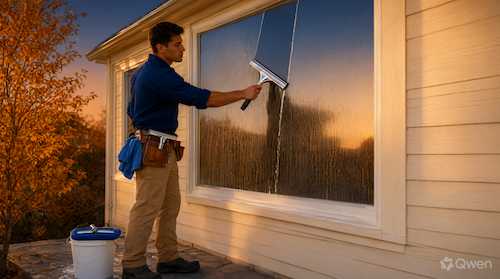
Pittsburgh has 73.1% of its housing built before 1980 and 68.0% detached, with a January mean of 28.8°F, 44.1 inches of snow and 39.6 inches of rain. The terrain is the first constraint: much of the city is built on slopes steep enough that a rear elevation sits two storeys above the ground behind it, with city steps rather than streets for access. The second is the legacy of steel, which put soot into the masonry that rain still carries onto sills and glass.
Slopes, city steps and rear elevations
A great deal of the housing sits on hillsides where the rear wall is well above the ground behind it and the only approach is steps rather than a street. That rules out ladders in many places and makes ground-level pole work the practical method. Ask how each elevation is reached and whether the quote assumed street access only.
Steel-era soot in the masonry
Generations of industrial smoke darkened the brick and stone, and rain still carries that material out of the masonry onto sills and glass. Below a weathered wall, a cleaned window does not stay clean, and no method fixes the source above it. Ask whether run-off is accounted for.
Salt with lake snow behind it
Snow here comes with lake moisture and heavy road salting, so street-facing glass, frames and hardware are in contact with brine for months. Ask whether frames and hardware are rinsed as well as the glass.
Sashes, storms and old putty
With 73.1% of the stock predating 1980, wood sashes with storm panels, checked wood and failing putty are the norm, and a share of that paint predates 1978. Soaking those frames accelerates the failure. Ask how older wood is treated and whether soft spots are reported.
A short season and steep access
Exterior work stops when water freezes, and on a slope that frozen water is also a safety problem for the crew. That squeezes the season and slows work on difficult elevations. Ask how far ahead the season is booked.
What to pin down in the estimate
Where this page stops
No prices are quoted and no property is assessed here. Rot, lead paint, masonry failure and slope stability are findings that need inspection by someone qualified in each.
Pittsburgh metro context
The 2024 ACS 5-year estimates describe about 2.44 million residents in 1,061,705 households and 1,174,149 housing units, with 70.7% owner-occupied and 68.0% single-family detached. About 73.1% of units predate 1980. At the Pittsburgh Intl Ap reference station January averages 28.8°F and July 73.2°F, on 39.6 inches of annual precipitation.
Pittsburgh reference station and housing indicators
| Indicator | Value | Source |
|---|---|---|
| January mean temperature | 28.8°F | NOAA NCEI |
| July mean temperature | 73.2°F | NOAA NCEI |
| Annual precipitation | 39.6 in. | NOAA NCEI |
| Metro population | 2,439,940 | U.S. Census Bureau |
| Owner-occupied share | 70.7% | U.S. Census Bureau |
| Housing units built before 1980 | 73.1% | U.S. Census Bureau |
Station normals are historical averages for one location, not a forecast. Glass condition depends on how often the surface is wetted and what the water carries.
Frequently Asked Questions
How do you reach windows on a hillside lot?
Usually from the ground with a pole, because a ladder may have no safe footing. The access differs from one elevation to the next.
Why do windows below brick walls stain?
Rain carries soot and mortar dust out of old masonry. The glass is clean; the wall above it is not.
Is cleaning safe for old wooden windows?
Only with a method that does not soak or scrape the frame. Failing putty and checked wood are the vulnerable parts.
Do storm windows need to come off?
For the inner pane, yes. Confirm who removes and refits them.
Is lead paint a concern here?
With this much pre-1978 housing, yes. Disturbing old paint needs lead-safe practice.
How long is the season?
From spring to the first hard freeze, and steeper sites slow the work, so booking early matters.
Sources and review date
- American Community Survey 2024 5-year estimates (CBSA tables) — U.S. Census Bureau, 2024 ACS 5-year estimates.
- 1991–2020 station normals — PITTSBURGH INTL AP, PA US (USW00094823) — NOAA National Centers for Environmental Information, 1991–2020 climate normals.
Reviewed on 2026-11-18.