
San Antonio, TX · metro guide
Electrical Work in San Antonio: Panels, Generator Inlets and Big Loads
A cooling-heavy climate turns a marginal service into an overloaded one, and the last few winters added a generator to the list.
Metro snapshot
San Antonio in numbers
Sources named below each block
- Population
- 2.7M
- Households
- 967K
- Housing units
- 1.1M
- People / household
- 2.75
- population ÷ households
Owner-occupied homes 63%
The rest are rented. Owners are the ones who commission most exterior work.
Single-family detached 66%
Detached houses carry their own roof, gutters and exterior walls.
Built before 1980 33%
Older housing stock shapes what fails first: gutters, flashing, pipe material.
Season
The year in San Antonio
- Precipitation
- 32.4 in
- Snowfall
- 0.2 in
Average temperature by month, °F — the shape of the year is what decides when exterior work gets done.
Precipitation by month, inches.
Snowfall by month, inches.
| Month | Average temperature (°F) | Precipitation (in) | Snowfall (in) |
|---|---|---|---|
| January | 52.2°F | 1.96 in | 0.0 in |
| February | 56.3°F | 1.74 in | 0.1 in |
| March | 62.8°F | 2.31 in | 0.0 in |
| April | 69.4°F | 2.42 in | 0.0 in |
| May | 76.5°F | 4.40 in | 0.0 in |
| June | 82.6°F | 3.28 in | 0.0 in |
| July | 84.8°F | 2.41 in | 0.0 in |
| August | 85.5°F | 2.15 in | 0.0 in |
| September | 79.9°F | 3.88 in | 0.0 in |
| October | 71.3°F | 3.75 in | 0.0 in |
| November | 60.7°F | 2.08 in | 0.0 in |
| December | 53.5°F | 2.00 in | 0.1 in |
NOAA 1991–2020 climate normals, station SAN ANTONIO INTL AP, TX US (USW00012921). Station observations, not a metro-wide average — a metro that spans a mountain range can differ by more than this record shows.
Population, households and housing shares: U.S. Census Bureau, American Community Survey 2024 5-year estimates, metropolitan statistical area.
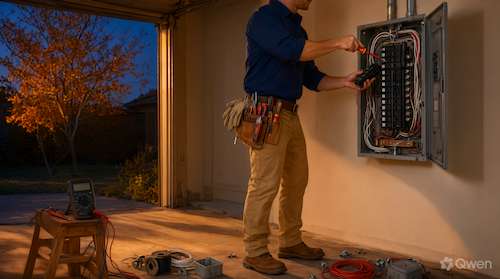
Roughly a third of the housing here predates 1980, and the panel in those houses was sized for a gas range, a few window units and lighting. Then central cooling arrived, then a pool pump, then an EV charger, and in recent years a generator inlet. Each addition is individually reasonable and collectively the reason so much work here starts with a load calculation. Because 66.1% of the stock is single-family detached, those decisions are made one household at a time rather than at building level.
Panels of the 1960s to 1980s
Some panel brands used in that period have failure histories that make them worth replacing rather than extending, and an electrician will recognize them by sight. The related question is the branch wiring: aluminum conductors appear in houses of the late 1960s and 1970s, and the connections at receptacles and switches need proper remediation rather than repeated tightening. Ask which panel is installed and whether it has a known issue, what the branch conductors are, and how aluminum connections would be handled.
Cooling, pools and the calculated load
A long cooling season means the air conditioning is the largest continuous load in the house, and a pool pump or a spa adds a second. When the load is calculated properly, the answer is often a service upgrade rather than a panel swap — new service entrance conductors, meter socket, grounding and a utility disconnect. Ask for the calculated load in writing, whether the service entrance equipment is included, and whether the utility disconnect and reconnect are booked.
Generator inlets and interlock kits
The multi-day outages of recent years made backup power a normal request, and the safe way to connect a portable generator is through a transfer switch or an interlock kit that makes backfeeding impossible. An improvised connection with a double-ended cord is a serious hazard to line workers and to the house. Standby generators raise further questions about fuel, location and clearances. Ask what the connection method is, what circuits the interlock or panel can actually carry, and whether the installation is permitted and inspected.
One utility, and its own process
San Antonio is served by a single municipal utility, which simplifies one thing and concentrates another: the interconnection process for solar, the service change procedure and the meter work all run through the same organization, and its schedule governs the project. That makes the utility step worth planning rather than discovering. Ask which applications are needed, who files them, and what the current timeline is for a service upgrade or a solar interconnection.
Outdoor kitchens, pools and patio circuits
Outdoor living space is a normal part of a house here, and it adds circuits that need protection appropriate to wet locations: patio receptacles, lighting, ceiling fans under a cover, pool and spa equipment. These are also the circuits most likely to have been added informally over the years. Ask what protection the outdoor circuits have, whether the pool equipment is bonded, and whether any of the existing work was permitted.
What to pin down in the estimate
Where this page stops
No prices are quoted and no property is assessed here. Panel condition, conductor condition and service capacity have to be judged on site by a licensed electrician, and code questions belong to the authority having jurisdiction.
San Antonio metro context
The 2024 ACS 5-year estimates describe about 2.66 million residents in 967,488 households and 1,057,823 housing units, with 63.3% owner-occupied and 66.1% single-family detached. About 32.7% of units predate 1980, which is where the smaller services and older wiring types sit. At the reference station July averages 84.8°F, so cooling dominates the electrical load for months.
San Antonio reference station and housing indicators
| Indicator | Value | Source |
|---|---|---|
| January mean temperature | 52.2°F | NOAA NCEI |
| July mean temperature | 84.8°F | NOAA NCEI |
| Annual precipitation | 32.4 in. | NOAA NCEI |
| Metro population | 2,662,733 | U.S. Census Bureau |
| Owner-occupied share | 63.3% | U.S. Census Bureau |
| Housing units built before 1980 | 32.7% | U.S. Census Bureau |
Station normals are historical averages for one location, not a forecast. The long cooling season shown here is why air conditioning is the load that usually forces the service decision.
Frequently Asked Questions
Do I need a 200-amp service for a new air conditioner?
Not automatically. The calculated load decides, and a more efficient system sometimes fits the existing service. A quote that skips the calculation cannot answer the question.
Is an older panel unsafe?
Age alone is not the diagnosis. Some brands and models have known failure histories and are worth replacing rather than extending; an electrician inspecting the panel will identify them.
Can I connect a portable generator to my panel?
Only through a transfer switch or an interlock kit that prevents backfeeding the utility lines. Improvised connections endanger line workers as well as the household.
What does an interlock actually let me run?
Whatever the selected breakers and the generator's capacity can carry — usually a few circuits chosen deliberately, not the whole house. The selection is part of the installation, not an afterthought.
Why does the utility add so much time?
Because a service change or an interconnection requires the utility's own review, and the disconnect and reconnect are scheduled by them. Planning that step early keeps it from becoming the delay.
Can aluminum wiring be left in place?
Often it can be made safer by remediating the connections with proper connectors or pigtailing copper at the devices. Whether that is sufficient depends on the inspection.
Sources and review date
- American Community Survey 2024 5-year estimates (CBSA tables) — U.S. Census Bureau, 2024 ACS 5-year estimates.
- 1991–2020 station normals — SAN ANTONIO INTL AP, TX US (USW00012921) — NOAA National Centers for Environmental Information, 1991–2020 climate normals.
Reviewed on 2026-11-18.