
San Francisco, CA · metro guide
Electrical Work in the Bay Area: Knob-and-Tube, Plaster and Small Services
Two-thirds of the housing predates 1980 and much of it predates the war — which makes rewiring a routing problem as much as an electrical one.
Metro snapshot
San Francisco in numbers
Sources named below each block
- Population
- 4.6M
- Households
- 1.7M
- Housing units
- 1.9M
- People / household
- 2.66
- population ÷ households
Owner-occupied homes 56%
The rest are rented. Owners are the ones who commission most exterior work.
Single-family detached 49%
Detached houses carry their own roof, gutters and exterior walls.
Built before 1980 67%
Older housing stock shapes what fails first: gutters, flashing, pipe material.
Season
The year in San Francisco
- Precipitation
- 19.6 in
- Snowfall
- —
Average temperature by month, °F — the shape of the year is what decides when exterior work gets done.
Precipitation by month, inches.
| Month | Average temperature (°F) | Precipitation (in) | Snowfall (in) |
|---|---|---|---|
| January | 51.3°F | 3.89 in | — |
| February | 53.5°F | 3.96 in | — |
| March | 55.5°F | 2.73 in | — |
| April | 57.3°F | 1.36 in | — |
| May | 59.9°F | 0.48 in | — |
| June | 62.5°F | 0.14 in | — |
| July | 64.0°F | 0.00 in | — |
| August | 64.9°F | 0.04 in | — |
| September | 65.3°F | 0.07 in | — |
| October | 62.9°F | 0.79 in | — |
| November | 56.4°F | 2.04 in | — |
| December | 51.4°F | 4.14 in | — |
NOAA 1991–2020 climate normals, station SAN FRANCISCO INTL AP, CA US (USW00023234). Station observations, not a metro-wide average — a metro that spans a mountain range can differ by more than this record shows.
Population, households and housing shares: U.S. Census Bureau, American Community Survey 2024 5-year estimates, metropolitan statistical area.
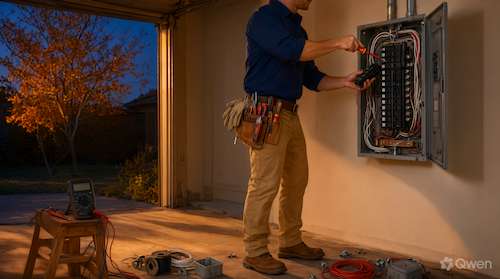
The electrical history of this metro is unusually deep. Two-thirds of the housing predates 1980 and a large share predates 1940, so knob-and-tube wiring, 60-amp and 100-amp services and plaster-and-lath walls are normal rather than exceptional. Only 48.9% of units are single-family detached, so a good share of the work happens in duplexes, small apartment buildings and condominiums where the meter stack and the common areas complicate everything. The modern loads arrive anyway: a heat pump or ductless system, an induction range, a car charger, and often a panel upgrade to make room for all three.
Small services and a modern load list
Replacing appliances with electric equivalents is the usual trigger, and it turns a small job into a load calculation. A 100-amp service that has been adequate for a gas range and a gas furnace can be marginal once a heat pump, an induction range and a car charger are added. That calculation decides whether the project is a panel swap or a service upgrade, and the two have different permits, different utility coordination and very different costs. Ask for the calculated load, whether the service entrance conductors and meter socket are being replaced, and how grounding will be brought up to current requirements.
Knob-and-tube and what to do about it
Knob-and-tube can remain in service where it is intact and undisturbed, but it cannot be buried in insulation, and it has no equipment ground. In houses of this age it is frequently found partly replaced: some circuits modernized, others still original and occasionally spliced in ways that should not have happened. Ask what the inspection found, which circuits are original, how much is accessible, and whether the answer is replacement or a considered decision to leave specific runs in place.
Fishing cable through plaster and brick
A pre-war building with plaster-and-lath walls and a brick or stucco exterior gives a contractor very few paths for new cable or conduit. The result is that the estimate varies enormously for what sounds like the same job, and that a low number sometimes means surface-mounted conduit where the owner did not expect it. Ask how the new circuits will be routed, where the patching stops, and whether the price assumes finished surfaces will be restored or merely left closed.
Duplexes, condominiums and the meter stack
In a multi-unit building the electrical system is divided in ways that are not visible from inside a unit: the meter stack, the house panel and the common-area circuits usually belong to the association or the building owner, while the panel inside the unit belongs to the occupant. Work that crosses that line needs consent as well as a permit. Ask where the meter stack is, which panel serves the unit, who authorizes work in common areas, and whether the building's service has capacity for another load.
Seismic work and the electrical scope
A retrofit or a soft-story upgrade opens walls and exposes framing, which makes it the cheapest moment to deal with wiring that would otherwise be inaccessible. It also raises questions of its own: what the electrical scope is inside the retrofit, and whether the work triggers any requirement to bring other items up to current standards. Ask whether the electrical work is being planned alongside the structural work, what it includes while the walls are open, and who is coordinating the two scopes.
What to pin down in the estimate
Where this page stops
No prices are quoted and no property is assessed here. Service capacity, conductor condition and grounding must be judged on site by a licensed electrician, and code questions belong to the authority having jurisdiction.
San Francisco metro context
The 2024 ACS 5-year estimates describe about 4.65 million residents in 1,744,070 households and 1,880,374 housing units, with 55.5% owner-occupied and 48.9% single-family detached. About 66.7% of units predate 1980, the highest share in this dataset, which is why pre-war wiring types and small services are the norm rather than the exception. No climate station is reported for this metro in the site dataset, so no temperature or precipitation normals appear on this page.
San Francisco housing indicators
| Indicator | Value | Source |
|---|---|---|
| Housing units built before 1980 | 66.7% | U.S. Census Bureau |
| Single-family detached share | 48.9% | U.S. Census Bureau |
| Owner-occupied share | 55.5% | U.S. Census Bureau |
| Metro households | 1,744,070 | U.S. Census Bureau |
| Housing units | 1,880,374 | U.S. Census Bureau |
| Metro population | 4,645,029 | U.S. Census Bureau |
No climate normals are shown because no station record is held for this metro in the site dataset. The pre-1980 share and the low detached share together explain why so much of the electrical work here involves old wiring in buildings with shared services.
Frequently Asked Questions
Do I have to rewire a house with knob-and-tube wiring?
Not automatically, but it cannot be buried in insulation and it has no equipment ground. What matters is which runs are still original, how they are being used and what the inspection finds, rather than a blanket rule.
Why is the quote so much higher than my neighbor's?
Usually routing and patching. In a plastered pre-war house, getting a circuit from the panel to a rear room is the work, and one bid may assume opening walls while another assumes surface conduit.
Can I add a heat pump to a 100-amp service?
Sometimes. The calculated load decides, and the answer may include load management rather than a service upgrade. It should be established in writing before equipment is ordered.
Who pays for electrical work in a condominium?
It depends on which portion of the system is involved. The panel inside the unit is normally the owner's; the meter stack and common circuits usually are not. Confirm before authorizing work.
Do I need a permit for a panel replacement?
Yes, and it is inspected. The permit is also the record that protects the owner at resale and with an insurer, so it is worth confirming who pulls it.
Can an EV charger be installed without upgrading the service?
Often with a load management device, which throttles charging when the house is drawing heavily. That is a design decision that depends on the calculated load and on how the car is used.
Sources and review date
- American Community Survey 2024 5-year estimates (CBSA tables) — U.S. Census Bureau, 2024 ACS 5-year estimates.
Reviewed on 2026-11-18.