
Hartford, CT · metro guide
Gutter Cleaning in Hartford: Slate Roofs, Half-Round Runs and Ice Dams
Older roofs with genuinely different drainage: half-round channels, copper, and a lot of snow behind them.
Metro snapshot
Hartford in numbers
Sources named below each block
- Population
- 1.2M
- Households
- 465K
- Housing units
- 500K
- People / household
- 2.48
- population ÷ households
Owner-occupied homes 67%
The rest are rented. Owners are the ones who commission most exterior work.
Single-family detached 59%
Detached houses carry their own roof, gutters and exterior walls.
Built before 1980 67%
Older housing stock shapes what fails first: gutters, flashing, pipe material.
Season
The year in Hartford
- Precipitation
- 47 in
- Snowfall
- 51.7 in
Average temperature by month, °F — the shape of the year is what decides when exterior work gets done.
Precipitation by month, inches.
Snowfall by month, inches.
| Month | Average temperature (°F) | Precipitation (in) | Snowfall (in) |
|---|---|---|---|
| January | 27.1°F | 3.28 in | 14.2 in |
| February | 29.6°F | 3.13 in | 14.8 in |
| March | 37.8°F | 3.81 in | 9.4 in |
| April | 49.5°F | 3.88 in | 1.1 in |
| May | 60.0°F | 3.79 in | 0.0 in |
| June | 68.9°F | 4.28 in | 0.0 in |
| July | 74.3°F | 4.17 in | 0.0 in |
| August | 72.5°F | 4.21 in | 0.0 in |
| September | 64.8°F | 4.39 in | 0.0 in |
| October | 53.0°F | 4.52 in | 0.7 in |
| November | 42.3°F | 3.51 in | 1.4 in |
| December | 32.6°F | 4.08 in | 10.1 in |
NOAA 1991–2020 climate normals, station HARTFORD BRADLEY INTL AP, CT US (USW00014740). Station observations, not a metro-wide average — a metro that spans a mountain range can differ by more than this record shows.
Population, households and housing shares: U.S. Census Bureau, American Community Survey 2024 5-year estimates, metropolitan statistical area.
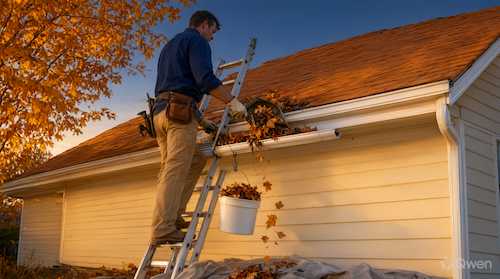
The Hartford metro has 67.4% of its housing built before 1980, and its older stock includes a lot of slate and standing-seam roofs drained by half-round gutters, some of them copper. Half-round channels behave differently from K-style: they hold less for a given width, they depend on hangers that must not be distorted, and copper has to be handled without the abrasives that would scratch it. With heavy snow, ice is the other constant.
Half-round runs and their hangers
A half-round channel carries less water than a K-style run of the same width and relies on hangers that hold its shape. Debris that compacts in it is harder to remove without distorting the profile. Ask whether the contractor works half-round runs and how they clear without bending hangers.
Copper and standing-seam roofs
Copper runs and standing-seam roofs need care: abrasives scratch copper and boots on a metal roof can be damaged by careless ladder placement. Ask how the roofline is reached and whether the contractor has worked metal roofs.
Ice dams on older roofs
With heavy snow and older roofs, ice at the eave is a recurring problem, and the run is where the meltwater is supposed to go. A blocked run concentrates the ice and pushes water back under the covering. Ask when the autumn visit is scheduled.
Heavy deciduous debris
The region's mature hardwoods drop a substantial leaf load, and on a large roof that means several runs filling at once. Ask whether all elevations are covered rather than the front only.
Gutters on buildings that predate them
Some older houses were built before gutters were fitted at all, and the runs added later do not always match the roof's valleys and pitches. Ask whether the run actually follows the roof's low points, because a gutter that does not will overflow whatever its condition.
What to pin down in the estimate
Where this page stops
No prices are quoted and no property is assessed here. Slate and metal roof condition, ice-dam causes and structural repair belong to a roofer, and nothing here is a roof assessment.
Hartford metro context
The 2024 ACS 5-year estimates describe about 1.15 million residents in 465,181 households and 499,522 housing units, with 67.3% owner-occupied and 59.3% single-family detached. About 67.4% of units predate 1980. No climate station is reported for this metro in the site dataset, so no temperature or precipitation normals appear on this page.
Hartford housing indicators
| Indicator | Value | Source |
|---|---|---|
| Housing units built before 1980 | 67.4% | U.S. Census Bureau |
| Single-family detached share | 59.3% | U.S. Census Bureau |
| Owner-occupied share | 67.3% | U.S. Census Bureau |
| Metro households | 465,181 | U.S. Census Bureau |
| Housing units | 499,522 | U.S. Census Bureau |
| Metro population | 1,153,112 | U.S. Census Bureau |
Station normals are historical averages for one location, not a forecast. What a gutter has to carry depends on roof area, pitch, the debris the surrounding trees drop and whether downspouts discharge where the water can leave.
Frequently Asked Questions
Is half-round different to clean?
Yes. It holds less water and its hangers are easier to distort, so it needs a method that does not bend the profile.
Can copper gutters be cleaned normally?
Not with abrasives, which scratch the surface. Ask what the contractor uses before work starts.
Why do I get ice dams every year?
Snow plus a run that cannot drain. The ice forms where meltwater has nowhere to go, and the gutter is the first place to fix.
How often do gutters need clearing here?
Twice a year at least, with the autumn visit before the freeze being the one that protects the house.
Do I need to be home?
Exterior work can be done with agreed access. Nothing inside the house is involved unless interior damage is being inspected.
What if my gutters were added later?
They should still follow the roof's low points. A run that does not will overflow regardless of how clean it is.
Sources and review date
- American Community Survey 2024 5-year estimates (CBSA tables) — U.S. Census Bureau, 2024 ACS 5-year estimates.
Reviewed on 2026-11-18.
Other Home Services in Hartford–West Hartford–East Hartford
All guides for the Hartford–West Hartford–East Hartford metro area