
Las Vegas, NV · metro guide
Gutter Cleaning in Las Vegas: Flash Floods, Desert Dust and Very Hard Water
Almost no rain, then a storm that arrives all at once over ground that cannot absorb it.
Metro snapshot
Las Vegas in numbers
Sources named below each block
- Population
- 2.3M
- Households
- 863K
- Housing units
- 949K
- People / household
- 2.70
- population ÷ households
Owner-occupied homes 58%
The rest are rented. Owners are the ones who commission most exterior work.
Single-family detached 60%
Detached houses carry their own roof, gutters and exterior walls.
Built before 1980 18%
Older housing stock shapes what fails first: gutters, flashing, pipe material.
Season
The year in Las Vegas
- Precipitation
- 4.2 in
- Snowfall
- 0.2 in
Average temperature by month, °F — the shape of the year is what decides when exterior work gets done.
Precipitation by month, inches.
Snowfall by month, inches.
| Month | Average temperature (°F) | Precipitation (in) | Snowfall (in) |
|---|---|---|---|
| January | 49.5°F | 0.56 in | 0.0 in |
| February | 53.5°F | 0.80 in | 0.0 in |
| March | 60.8°F | 0.42 in | 0.0 in |
| April | 67.7°F | 0.20 in | 0.0 in |
| May | 77.3°F | 0.07 in | 0.0 in |
| June | 87.6°F | 0.04 in | 0.0 in |
| July | 93.2°F | 0.38 in | 0.0 in |
| August | 91.7°F | 0.32 in | 0.0 in |
| September | 83.6°F | 0.32 in | 0.0 in |
| October | 70.4°F | 0.32 in | 0.0 in |
| November | 57.2°F | 0.30 in | 0.0 in |
| December | 48.2°F | 0.45 in | 0.2 in |
NOAA 1991–2020 climate normals, station LAS VEGAS MCCARRAN AP, NV US (USW00023169). Station observations, not a metro-wide average — a metro that spans a mountain range can differ by more than this record shows.
Population, households and housing shares: U.S. Census Bureau, American Community Survey 2024 5-year estimates, metropolitan statistical area.
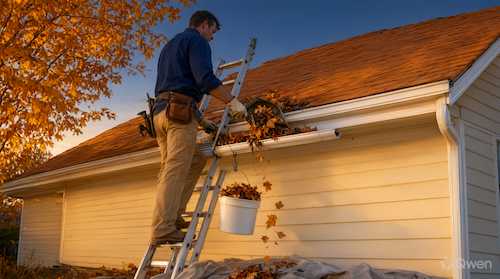
Las Vegas gets very little rain, and what falls tends to arrive in violent summer storms over ground that does not absorb it — the valleys and washes are designed to carry water away fast precisely because there is so little soak-in. On a house, that means a gutter system is either absent or partial, and where it exists the channel holds dust and grit through the dry months and then faces an event it was never sized for.
Partial systems on desert roofs
Many houses have gutters over an entry or a patio only, and the rest of the roof sheds directly. That is a legitimate local design, but it changes what cleaning means. Ask what is installed and where the uncollected water lands.
Dust and grit that set in the channel
The dry months deposit a fine desert dust that mixes with gravel from flat roofs and sets when it is wetted. It blocks outlets without looking like much. Ask whether outlets are cleared of grit.
Summer storms and capacity
Rain arrives in short intense bursts, and a run that has never been tested can overflow at the fascia. Ask whether the visit happens before the summer storm season and whether the outlet is confirmed to flow.
Very hard water staining
Local water leaves mineral marks on fascia, stucco and masonry wherever splash or overflow occurs, and those marks are difficult to remove later. Ask whether staining is reported.
Community requirements
Much of the newer stock sits in communities with vendor and access rules, and stucco walls and tile roofs limit where equipment can be placed. Ask what the community requires and how the roofline is reached.
What to pin down in the estimate
Where this page stops
No prices are quoted and no property is assessed here. Flash-flood risk, grading and roof condition belong to the local authority, an engineer or a roofer.
Las Vegas metro context
The 2024 ACS 5-year estimates describe about 2.33 million residents in 862,518 households and 948,995 housing units, with 57.8% owner-occupied and 60.2% single-family detached. About 17.5% of units predate 1980. No climate station is reported for this metro in the site dataset, so no temperature or precipitation normals appear on this page.
Las Vegas housing indicators
| Indicator | Value | Source |
|---|---|---|
| Housing units built before 1980 | 17.5% | U.S. Census Bureau |
| Single-family detached share | 60.2% | U.S. Census Bureau |
| Owner-occupied share | 57.8% | U.S. Census Bureau |
| Metro households | 862,518 | U.S. Census Bureau |
| Housing units | 948,995 | U.S. Census Bureau |
| Metro population | 2,329,548 | U.S. Census Bureau |
Station normals are historical averages for one location, not a forecast. What a gutter has to carry depends on roof area, pitch, the debris the surrounding trees drop and whether downspouts discharge where the water can leave.
Frequently Asked Questions
Why would a house here have only partial gutters?
Because most of the year there is nothing to carry. Many desert roofs shed directly, and gutters protect specific areas such as entries and patios.
What blocks a gutter with no trees nearby?
Desert dust and roof grit. It sets in the channel and the outlets when it gets wet.
Will gutters stop my yard flooding in a storm?
No. A summer storm exceeds residential capacity, and the ground does not absorb it. Gutters only decide where the roof water goes.
Why are there marks on my stucco?
Hard water from splash and overflow leaves mineral staining that is hard to remove once it has set.
When should I have gutters checked?
Before the summer storm season, so the run is clear when it is actually tested.
Is a tile roof walkable?
Not casually. Broken tiles are expensive, so confirm the contractor works that roof type.
Sources and review date
- American Community Survey 2024 5-year estimates (CBSA tables) — U.S. Census Bureau, 2024 ACS 5-year estimates.
Reviewed on 2026-11-18.
Other Home Services in Las Vegas–Henderson–North Las Vegas
All guides for the Las Vegas–Henderson–North Las Vegas metro area