
Minneapolis, MN-WI · metro guide
Electrical in Minneapolis: Cold Loads and Century-Old Wiring
January averages 16°F here and half the metro's housing predates 1980. Both facts meet at the panel.
Metro snapshot
Minneapolis in numbers
Sources named below each block
- Population
- 3.7M
- Households
- 1.5M
- Housing units
- 1.6M
- People / household
- 2.51
- population ÷ households
Owner-occupied homes 71%
The rest are rented. Owners are the ones who commission most exterior work.
Single-family detached 60%
Detached houses carry their own roof, gutters and exterior walls.
Built before 1980 49%
Older housing stock shapes what fails first: gutters, flashing, pipe material.
Season
The year in Minneapolis
- Precipitation
- 31.6 in
- Snowfall
- 51.2 in
Average temperature by month, °F — the shape of the year is what decides when exterior work gets done.
Precipitation by month, inches.
Snowfall by month, inches.
| Month | Average temperature (°F) | Precipitation (in) | Snowfall (in) |
|---|---|---|---|
| January | 16.2°F | 0.89 in | 11.0 in |
| February | 20.6°F | 0.87 in | 9.5 in |
| March | 33.3°F | 1.68 in | 8.2 in |
| April | 47.1°F | 2.91 in | 3.5 in |
| May | 59.5°F | 3.91 in | 0.0 in |
| June | 69.7°F | 4.58 in | 0.0 in |
| July | 74.3°F | 4.06 in | 0.0 in |
| August | 71.8°F | 4.34 in | 0.0 in |
| September | 63.5°F | 3.02 in | 0.0 in |
| October | 49.5°F | 2.58 in | 0.8 in |
| November | 34.8°F | 1.61 in | 6.8 in |
| December | 22.0°F | 1.17 in | 11.4 in |
NOAA 1991–2020 climate normals, station MINNEAPOLIS/ST PAUL AP, MN US (USW00014922). Station observations, not a metro-wide average — a metro that spans a mountain range can differ by more than this record shows.
Population, households and housing shares: U.S. Census Bureau, American Community Survey 2024 5-year estimates, metropolitan statistical area.
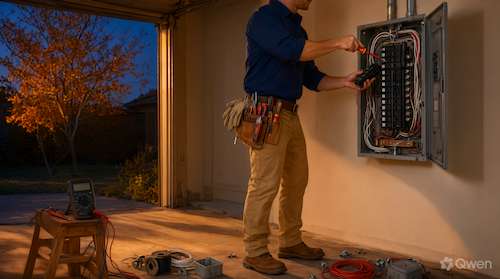
The Twin Cities electrical picture splits by decade, and the split follows the map. Minneapolis and St. Paul carry a large stock of houses built between 1900 and 1930, when a service of 30 to 60 amps covered lighting and a refrigerator and nobody expected air conditioning. Bloomington, Roseville, Eagan, Plymouth and Coon Rapids filled in mostly after 1945 with 100-amp panels serving a range, a dryer, and a window unit in one room. ACS estimates put 49.0% of metro housing before 1980, 60.2% of units as single-family detached, and 70.7% owner-occupied, which means most electrical decisions here are made by the person who will live with the result for the next twenty years.
Ramblers reach their limit quietly
A 1955 rambler wired for a gas range and no air conditioning will usually accept central air on a 100-amp service. Add a heat pump with electric auxiliary heat, an EV charger in the garage, and a finished basement with a dryer, and the calculation changes. The useful question is not "is 100 amps enough" but "what does the calculation say for this specific set of loads" — and it should be run before equipment is chosen, not after the panel is already full.
Pre-war wiring in the two core cities
Knob-and-tube is still present in parts of Powderhorn, Longfellow, Seward, Frogtown and the North Side, often spliced into newer circuits during a kitchen remodel forty years ago. It has no equipment ground, which matters for receptacles, for anything with a metal case, and for how an insurer reads the file. Two things are worth asking: which circuits are still on the old wiring, and whether the answer is replacement, GFCI protection at the receptacle, or a documented decision to leave it. The third option is sometimes reasonable and always worth writing down.
Aluminum branch circuits from 1965 to 1973
Homes built in that window sometimes have aluminum branch wiring to receptacles and switches. It is not automatically a hazard and it is not automatically fine; the failure points are the connections at devices and in junction boxes. Ask whether the panel and a sample of devices were opened, what treatment is proposed for the connections, and whether the work is done by someone who has handled aluminum before. A blanket answer in either direction is a reason to get a second opinion.
January is when the service proves itself
NOAA's Twin Cities station averages 16.2°F in January, and cold snaps run well below that for days. Electric resistance heat, a heat pump in auxiliary mode, a block heater, a pipe heater on a crawlspace line — these are winter-only loads that never appear in a summer walkthrough. If the plan includes any of them, the calculation should assume the coldest week of the year rather than an annual average, and it should state what the panel does when the heat strips and the dryer run at the same time.
Permits, inspection, and putting the plaster back
Minnesota licenses electrical contractors and inspects the work, and the authority with jurisdiction is the city or the state depending on the address. Ask who pulls the permit, who meets the inspector, and what happens if the inspection finds something the original scope did not cover. Then ask about restoration: opening a plaster wall in a 1925 house is a different job from patching drywall in a 1975 one, and finish carpentry, skim coating and painting are frequently outside the electrician's scope. Get that boundary in the estimate, not in the conversation afterwards.
Six questions worth asking first
Where this page stops
Nothing here diagnoses a specific house, and no prices are published because they depend on the property, the permit authority and the scope. Electrical work should be done by a licensed professional, and code questions belong to the authority responsible for the address.
Twin Cities metro context
The 2024 ACS 5-year estimates count about 3.7 million residents in 1.48 million households across 1.55 million housing units. Roughly 70.7% of occupied homes are owner-occupied, 60.2% of units are single-family detached, and 49.0% were built before 1980. NOAA's station at Minneapolis–St. Paul International Airport records a January mean of 16.2°F, July at 74.3°F, 31.6 inches of precipitation and 51.2 inches of snow in a typical year.
Twin Cities reference station and housing indicators
| Indicator | Value | Source |
|---|---|---|
| January mean temperature | 16.2°F | NOAA NCEI |
| July mean temperature | 74.3°F | NOAA NCEI |
| Annual snowfall | 51.2 in. | NOAA NCEI |
| Metro population | 3,713,668 | U.S. Census Bureau |
| Single-family detached share | 60.2% | U.S. Census Bureau |
| Housing units built before 1980 | 49.0% | U.S. Census Bureau |
Station normals describe one location over a 30-year period, not a forecast or a metro-wide average. Census values describe the metro area, not an individual property.
Frequently Asked Questions
Is a 100-amp service enough for a heat pump in the Twin Cities?
Often it is, sometimes it is not. What decides it is a load calculation that includes the heat pump, its auxiliary heat, and the other large loads in the house running at the same time in cold weather. Ask for the calculation rather than a yes or no.
Does knob-and-tube wiring have to be replaced?
Not always and not immediately. What matters is the condition of the wiring, whether the circuits are protected appropriately, and how the insurer views it. Ask which circuits are involved and what options exist before agreeing to a whole-house rewiring.
How do I compare electrical estimates?
Line up the same six items on every bid: service rating, what is replaced versus reused, permit handling, inspection responsibility, restoration after walls are opened, and what happens if the inspection adds scope. A lower number with a narrower scope is not a lower number.
Do older Minneapolis homes need a grounded receptacle upgrade for insurance?
Requirements and preferences vary by carrier and policy. Ask the insurer what they want in writing, then ask the electrician what the least invasive option is that satisfies it. Grounding a receptacle without a real ground path is not a solution.
Can electrical work be done in winter here?
Interior work generally yes, and many homeowners schedule it while the house is closed up. Exterior work such as a service mast or a meter relocation depends on weather and on the utility's schedule, so ask about the timeline before the season starts.
What is the population of the Minneapolis–St. Paul metro area?
The U.S. Census Bureau's 2024 ACS 5-year estimates report about 3.7 million residents in the metro area. The figure describes regional scale, not the number of homes or available contractors.
Sources and review date
- American Community Survey 2024 5-year estimates (CBSA tables) — U.S. Census Bureau, 2024 ACS 5-year estimates.
- 1991–2020 station normals — MINNEAPOLIS/ST PAUL AP, MN US (USW00014922) — NOAA National Centers for Environmental Information, 1991–2020 climate normals.
Reviewed on 2026-11-18.
Other Home Services in Minneapolis–St. Paul–Bloomington
All guides for the Minneapolis–St. Paul–Bloomington metro area