
Philadelphia, PA-NJ-DE-MD · metro guide
Landscaping in Philadelphia: Small Lots and Street Trees
Philadelphia yards are small and mostly shaded. The plan has to work with mature trees, tight access, and water that has nowhere to go.
Metro snapshot
Philadelphia in numbers
Sources named below each block
- Population
- 6.3M
- Households
- 2.5M
- Housing units
- 2.6M
- People / household
- 2.54
- population ÷ households
Owner-occupied homes 67%
The rest are rented. Owners are the ones who commission most exterior work.
Single-family detached 43%
Detached houses carry their own roof, gutters and exterior walls.
Built before 1980 67%
Older housing stock shapes what fails first: gutters, flashing, pipe material.
Season
The year in Philadelphia
- Precipitation
- 44.1 in
- Snowfall
- 23.1 in
Average temperature by month, °F — the shape of the year is what decides when exterior work gets done.
Precipitation by month, inches.
Snowfall by month, inches.
| Month | Average temperature (°F) | Precipitation (in) | Snowfall (in) |
|---|---|---|---|
| January | 33.7°F | 3.13 in | 7.1 in |
| February | 35.9°F | 2.75 in | 8.4 in |
| March | 43.6°F | 3.96 in | 3.6 in |
| April | 54.5°F | 3.47 in | 0.3 in |
| May | 64.3°F | 3.34 in | 0.0 in |
| June | 73.5°F | 4.04 in | 0.0 in |
| July | 78.7°F | 4.38 in | 0.0 in |
| August | 76.8°F | 4.29 in | 0.0 in |
| September | 69.9°F | 4.40 in | 0.0 in |
| October | 58.2°F | 3.47 in | 0.0 in |
| November | 47.4°F | 2.91 in | 0.2 in |
| December | 38.6°F | 3.97 in | 3.5 in |
NOAA 1991–2020 climate normals, station PHILADELPHIA INTL AP, PA US (USW00013739). Station observations, not a metro-wide average — a metro that spans a mountain range can differ by more than this record shows.
Population, households and housing shares: U.S. Census Bureau, American Community Survey 2024 5-year estimates, metropolitan statistical area.
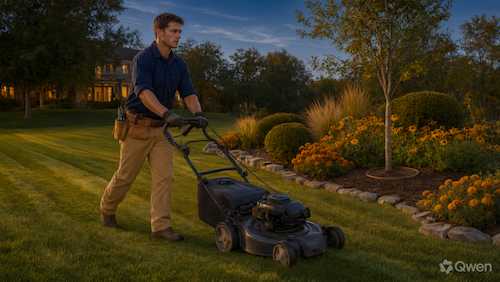
A Philadelphia yard is often a rear patio, a narrow side strip, or a shared courtyard. About 43.4% of metro housing units are single-family detached, according to ACS estimates, which means most households do not have a conventional lawn at all. The work here is closer to urban garden design than to suburban landscaping, and access is part of the price.
Access changes the scope
Ask how materials and equipment reach the site: through the house, down an alley, over a wall, or by crane. A rowhouse backyard may be unreachable by wheelbarrow, which affects labor and how soil and stone are delivered. A quote that ignores access usually grows later.
Shade and root competition
Ask which plants are proposed and how much sun the site actually gets, hour by hour. Mature street trees and neighboring buildings create shade patterns that change through the season, and tree roots compete for water and space. A plant list chosen for full sun will not thrive under a canopy.
Urban soil
Ask how soil is assessed and amended, and whether raised beds are proposed. Soil in older urban lots can be compacted, alkaline from masonry rubble, or contaminated from historic use. For food gardens especially, ask whether testing is recommended before planting.
Where the water goes
Ask how the design handles runoff from roofs and paving. Downspouts that discharge next to a foundation, or paving that slopes toward the house, create basement water problems that landscaping can either fix or worsen. Ask whether the plan includes grading, disconnection, or a planted area designed to absorb water.
Questions to ask before approving a plan
Where this page stops
This page does not design a landscape or estimate cost for a specific property. Street tree rules, right-of-way requirements, and permit needs vary by city and by site, and should be confirmed locally.
Philadelphia metro context
The 2024 ACS 5-year estimates put the metro at about 6.3 million residents and 2.5 million households. About 66.8% of occupied homes are owner-occupied, and about 43.4% of housing units are single-family detached, so most households work within shared or very small outdoor spaces. About 66.6% of housing units were built before 1980.
Philadelphia metro housing indicators
| Indicator | Value | Source |
|---|---|---|
| Metro population | 6,272,014 | U.S. Census Bureau |
| Households | 2,467,761 | U.S. Census Bureau |
| Owner-occupied share | 66.8% | U.S. Census Bureau |
| Single-family detached share | 43.4% | U.S. Census Bureau |
| Housing units built before 1980 | 66.6% | U.S. Census Bureau |
Census values describe the metro area, not an individual property. A climate station is not reported for this metro in the site dataset.
Mapped in OpenStreetMap
Landscaping businesses mapped in the Philadelphia metro
OpenStreetMap contributors have mapped 27 landscaping entries inside the Philadelphia-Camden-Wilmington, PA-NJ-DE-MD CBSA; 27 have a name. This is a map-coverage indicator, not a count of all licensed landscaping businesses in the metro.
- Mapped entries
- 27
- OSM features
- Phone listed
- 70%
- 19 of 27
- Website listed
- 56%
- 15 of 27
- Street address
- 74%
- 20 of 27
OSM coverage varies by area: a low count can mean low mapping activity, not a small market. OpenStreetMap does not record contractor licenses. To check a license, use the Pennsylvania HIC registration search. Search the Attorney General's Home Improvement Contractor registration.
Query: craft=gardener.
Snapshot: 2026-11-17. Data:
© OpenStreetMap contributors,
ODbL 1.0.
CBSA boundary:
U.S. Census Bureau, 2023.
Frequently Asked Questions
What should a Philadelphia landscaping estimate include?
Ask for the plan drawing, plant list with sizes, soil preparation or raised beds, mulch, hardscape, drainage work, access arrangements, disposal, a schedule, exclusions, and the establishment or warranty terms.
Why does access matter so much here?
Many rear yards cannot be reached by wheelbarrow or truck, so materials have to be carried through the house or over a wall. That labor is a real cost and should be priced explicitly.
How do I keep water out of the basement?
Grading away from the foundation, extending or disconnecting downspouts, and directing runoff to a planted area are the usual measures. Ask the plan to show where water goes during a storm.
Do I need permission to plant or remove a street tree?
Street trees are often regulated separately from trees on private property. Confirm with the local authority before planning work in the right-of-way.
Should urban soil be tested?
It is worth considering, especially for vegetable beds in older neighborhoods. Ask whether testing is recommended and how the results would change the plan.
What is the population of the Philadelphia metro area?
The U.S. Census Bureau's 2024 ACS 5-year estimates report about 6.3 million residents in the metro area. The figure describes regional scale, not the number of homes or providers.
Sources and review date
- American Community Survey 2024 5-year estimates (CBSA tables) — U.S. Census Bureau, 2024 ACS 5-year estimates.
- OpenStreetMap contributors — craft=gardener features in the Philadelphia-Camden-Wilmington, PA-NJ-DE-MD CBSA — OpenStreetMap contributors, Snapshot 2026-11-17.
Reviewed on 2026-11-18.
Other Home Services in Philadelphia–Camden–Wilmington
All guides for the Philadelphia–Camden–Wilmington metro area