
Sacramento, CA · metro guide
Painting in Sacramento: Wood Siding, Stucco and a Century of Coatings
Two housing eras, two substrates, and one climate that gives you a clear window to work in.
Metro snapshot
Sacramento in numbers
Sources named below each block
- Population
- 2.4M
- Households
- 882K
- Housing units
- 955K
- People / household
- 2.75
- population ÷ households
Owner-occupied homes 63%
The rest are rented. Owners are the ones who commission most exterior work.
Single-family detached 68%
Detached houses carry their own roof, gutters and exterior walls.
Built before 1980 44%
Older housing stock shapes what fails first: gutters, flashing, pipe material.
Season
The year in Sacramento
- Precipitation
- 18.1 in
- Snowfall
- —
Average temperature by month, °F — the shape of the year is what decides when exterior work gets done.
Precipitation by month, inches.
| Month | Average temperature (°F) | Precipitation (in) | Snowfall (in) |
|---|---|---|---|
| January | 47.6°F | 3.66 in | — |
| February | 51.4°F | 3.49 in | — |
| March | 55.4°F | 2.68 in | — |
| April | 59.5°F | 1.26 in | — |
| May | 66.1°F | 0.75 in | — |
| June | 72.2°F | 0.23 in | — |
| July | 75.9°F | 0.00 in | — |
| August | 75.3°F | 0.04 in | — |
| September | 72.5°F | 0.09 in | — |
| October | 64.5°F | 0.85 in | — |
| November | 53.9°F | 1.66 in | — |
| December | 47.3°F | 3.43 in | — |
NOAA 1991–2020 climate normals, station SACRAMENTO EXECUTIVE AP, CA US (USW00023232). Station observations, not a metro-wide average — a metro that spans a mountain range can differ by more than this record shows.
Population, households and housing shares: U.S. Census Bureau, American Community Survey 2024 5-year estimates, metropolitan statistical area.
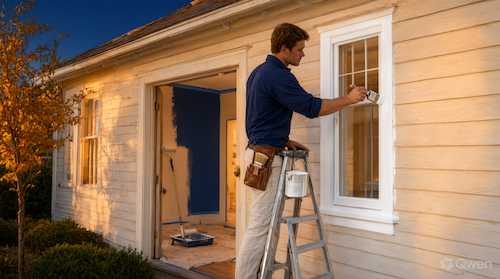
Painting in this metro splits along the housing line. The central neighborhoods and the older suburbs are largely wood clapboard and shingle on bungalows and four-squares, often with a century of coatings and a lot of original trim. The post-war and later subdivisions are stucco over different substrates, which behaves nothing like wood. Nearly 44% of the stock predates 1980, and with a dry summer followed by a wet winter, the scheduling window is wide but the consequences of a wet-season failure are the same: water behind the film, and a repair that costs more than the paint.
Wood siding in the older neighborhoods
Clapboard that has been painted repeatedly fails in predictable places: the south and west faces where sun breaks the film down, the bottom courses where splash-back from the ground keeps the wood wet, and the joints at window surrounds. Once water gets behind a lap, the wood swells, the paint lifts and the repair becomes carpentry. Ask how much scraping and feathering is included, whether bare wood is spot-primed, whether any soft or rotted sections are being replaced as part of the scope, and how the bottom of the wall will be kept clear of soil.
Stucco needs a breathable answer
On the newer housing the wall is stucco, and the rule is the same as anywhere: it has to be able to dry outward. A heavy film over a wall that is trapping moisture blisters, and the blisters are evidence of water behind the coating rather than a failure of the paint itself. Cracks usually follow openings and control joints, and painting over them without addressing the movement or the water that finds them just postpones the problem. Ask what the cracks indicate, whether the product is breathable, and whether flashings and penetrations will be checked before coating.
Lead on the pre-1978 stock
A large share of these houses predate the lead paint restrictions, and exterior preparation is exactly the activity that generates the dust and chips the rules address. On a house that old, the sequence matters: test or assume, contain the ground and the planting, use compliant removal methods, and verify clean-up. Ask whether the firm follows lead-safe renovation practices, how debris and wash water are contained, and what documentation is left at the end.
A dry summer and a wet winter
The practical calendar here is generous — months of dry weather when coating and curing are predictable — and that makes scheduling a matter of choosing the right season rather than fighting the weather. The exception is the shoulder weeks, when a warm afternoon can be followed by a cold night or an early storm. Ask how the contractor handles a job that runs into the first rain, and whether the schedule is built so that no elevation is left with primer and no topcoat.
Trim, doors and the wood that takes the weather
Even on a stucco house, the failures cluster at the wood: door bottoms, window sills, porch posts and the fascia behind the gutter. These are the parts that get the rain, the sun and the splash-back, and they are also the parts where preparation is skipped because they are fiddly. Ask how the trim is prepared, whether any of it is being replaced rather than painted, and whether doors are being taken off their hinges to coat the edges.
What to pin down in the estimate
Where this page stops
No prices are quoted and no building is assessed here. Lead requirements, historic review and any rot or stucco damage need inspection and, where relevant, a certified firm or the local authority.
Sacramento metro context
The 2024 ACS 5-year estimates describe about 2.43 million residents in 881,889 households and 954,751 housing units, with 63.0% owner-occupied and 68.4% single-family detached. About 43.9% of units predate 1980, so lead-safe practices and original trim details come up routinely on the older houses. No climate station is reported for this metro in the site dataset, so no temperature or precipitation normals appear on this page.
Sacramento housing indicators
| Indicator | Value | Source |
|---|---|---|
| Housing units built before 1980 | 43.9% | U.S. Census Bureau |
| Single-family detached share | 68.4% | U.S. Census Bureau |
| Owner-occupied share | 63.0% | U.S. Census Bureau |
| Metro households | 881,889 | U.S. Census Bureau |
| Housing units | 954,751 | U.S. Census Bureau |
| Metro population | 2,426,388 | U.S. Census Bureau |
No climate normals are shown because no station record is held for this metro in the site dataset. The pre-1980 share splits the metro into a wood-siding cohort and a stucco one, and the preparation in each is a different trade.
Frequently Asked Questions
When is the best time to paint outside here?
The dry months, when coating and curing are predictable. The risk sits in the shoulder weeks, when a warm afternoon can turn into a cold night or an early storm before the film has formed.
Do I need to worry about lead paint?
On a house built before 1978, yes — exterior preparation is what generates lead dust and chips. Ask whether the firm follows lead-safe practices and how the ground and planting are protected.
Why does the paint peel at the bottom of the wall?
Usually because soil or paving holds splash-back against the wood, so the bottom courses stay wet. Fixing the paint without fixing the drainage or raising the clearance repeats the failure.
Can stucco be painted with any exterior product?
It needs a breathable coating. A heavy film on a wall that is trapping moisture blisters, and the blistering is a symptom of water behind the coating rather than of the paint.
Should I repair or replace rotted trim?
Replace it. Painting over soft wood hides the problem for one season and leaves the water path intact, and the carpentry will be needed either way.
How often does a house here need repainting?
It depends on the substrate, the exposure of each elevation and the product used. South and west faces generally fail first, which is why some owners repaint those elevations on a shorter cycle.
Sources and review date
- American Community Survey 2024 5-year estimates (CBSA tables) — U.S. Census Bureau, 2024 ACS 5-year estimates.
Reviewed on 2026-11-18.