
San Antonio, TX · metro guide
Painting in San Antonio: Stucco, Limestone and Sun on Both Sides
A hot, bright climate ages a coating quickly — and the shaded side fails for the opposite reason.
Metro snapshot
San Antonio in numbers
Sources named below each block
- Population
- 2.7M
- Households
- 967K
- Housing units
- 1.1M
- People / household
- 2.75
- population ÷ households
Owner-occupied homes 63%
The rest are rented. Owners are the ones who commission most exterior work.
Single-family detached 66%
Detached houses carry their own roof, gutters and exterior walls.
Built before 1980 33%
Older housing stock shapes what fails first: gutters, flashing, pipe material.
Season
The year in San Antonio
- Precipitation
- 32.4 in
- Snowfall
- 0.2 in
Average temperature by month, °F — the shape of the year is what decides when exterior work gets done.
Precipitation by month, inches.
Snowfall by month, inches.
| Month | Average temperature (°F) | Precipitation (in) | Snowfall (in) |
|---|---|---|---|
| January | 52.2°F | 1.96 in | 0.0 in |
| February | 56.3°F | 1.74 in | 0.1 in |
| March | 62.8°F | 2.31 in | 0.0 in |
| April | 69.4°F | 2.42 in | 0.0 in |
| May | 76.5°F | 4.40 in | 0.0 in |
| June | 82.6°F | 3.28 in | 0.0 in |
| July | 84.8°F | 2.41 in | 0.0 in |
| August | 85.5°F | 2.15 in | 0.0 in |
| September | 79.9°F | 3.88 in | 0.0 in |
| October | 71.3°F | 3.75 in | 0.0 in |
| November | 60.7°F | 2.08 in | 0.0 in |
| December | 53.5°F | 2.00 in | 0.1 in |
NOAA 1991–2020 climate normals, station SAN ANTONIO INTL AP, TX US (USW00012921). Station observations, not a metro-wide average — a metro that spans a mountain range can differ by more than this record shows.
Population, households and housing shares: U.S. Census Bureau, American Community Survey 2024 5-year estimates, metropolitan statistical area.
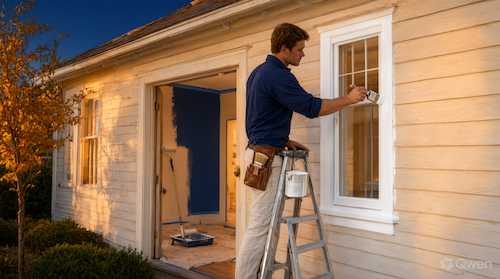
Most of the housing here is masonry: stucco over block or frame in the suburbs, limestone and brick in the older neighborhoods, with wood limited to trim, doors and the occasional porch. That changes what a paint job is for. On masonry the coating is a sacrificial layer protecting a wall that must also be able to dry, so the wrong product does more damage than no product at all. And this is a bright, hot climate, so south and west faces chalk and fade quickly while north faces in the shade stay damp long enough for mildew — two failures with opposite causes on the same building.
Stucco and limestone have to breathe
Masonry walls dry through their face, and a heavy film-forming coating blocks that path, trapping moisture inside until it blisters the film or spalls the surface. Limestone is especially unforgiving: once it is coated, it is very difficult to return to a natural finish. If the wall has never been painted, that is a decision to take seriously rather than a default. Ask whether the surface has been coated before, what product is specified for each substrate, and whether the coating is breathable.
UV and the exposed elevations
The same sun that makes outdoor work unpleasant for half the year breaks down the binder in a coating, so south and west elevations chalk and lose color first. Chalking matters beyond appearance, because a powdery surface is a release layer that the next coat will not bond to. That makes cleaning and testing part of the job, not a preliminary. Ask how the existing surface will be washed and checked for chalk, whether a more UV-stable product is quoted for the exposed elevations, and what the expected interval is before the next repaint.
The shaded side fails differently
North-facing walls and any surface under heavy tree cover stay cooler and damper, and in this climate that is where mildew grows. Painting over it without treating it simply seals the growth under a film, and it returns through the coating. The fix is cleaning and a product rated for the exposure, plus attention to the water source if a wall stays wet because a downspout or a sprinkler hits it. Ask how mildew will be treated, whether the irrigation or drainage is wetting the wall, and what product is specified for shaded faces.
Cracks, patching and the water path
Stucco cracks along control joints and around openings, and the crack is usually a symptom of movement or of water finding a way in at a flashing. Filling it without addressing the source guarantees it returns. On older masonry the same logic applies to deteriorated mortar: painting over soft or failing joints hides a repair that is needed. Ask which cracks and joints are being repaired, how they are being filled, and whether flashings at the roof line and the window heads will be checked before anything is coated.
Lead and the older third of the stock
About a third of the housing predates 1980, and on houses built before the lead restrictions, exterior preparation is the activity that generates dust and chips. That is a specification question rather than a reason to avoid the work. Ask whether the firm follows lead-safe renovation practices, how the ground and planting are protected, and what documentation is provided at the end.
What to pin down in the estimate
Where this page stops
No prices are quoted and no building is assessed here. Masonry condition, water intrusion and lead requirements need inspection and, where relevant, a certified firm or the local authority.
San Antonio metro context
The 2024 ACS 5-year estimates describe about 2.66 million residents in 967,488 households and 1,057,823 housing units, with 63.3% owner-occupied and 66.1% single-family detached. About 32.7% of units predate 1980. At the reference station July averages 84.8°F, and annual precipitation is 32.4 inches — bright enough to age a coating quickly, wet enough to grow mildew on the faces that stay shaded.
San Antonio reference station and housing indicators
| Indicator | Value | Source |
|---|---|---|
| January mean temperature | 52.2°F | NOAA NCEI |
| July mean temperature | 84.8°F | NOAA NCEI |
| Annual precipitation | 32.4 in. | NOAA NCEI |
| Metro population | 2,662,733 | U.S. Census Bureau |
| Owner-occupied share | 63.3% | U.S. Census Bureau |
| Housing units built before 1980 | 32.7% | U.S. Census Bureau |
Station normals are historical averages for one location, not a forecast. Sun exposure and rainfall combine here so that different elevations of the same wall fail in different ways.
Frequently Asked Questions
Should I paint my limestone or brick house?
If it has never been painted, usually not. Masonry needs to dry through its face, and once limestone is coated it is very difficult to return to a natural finish.
Why does the paint look powdery?
Chalking, which is how a coating fails under UV. It has to be removed before recoating, because a powdery surface will not hold the next film.
Why is there mildew on one side only?
Because that side stays shaded and damp. Treating it and using a product rated for the exposure helps, but if a sprinkler or downspout keeps the wall wet, the mildew will return.
Do I need to fix stucco cracks first?
Yes, and the movement or water source behind them should be understood. Filling a crack without addressing the cause means it reappears, usually within a season.
When is the best time to paint here?
When temperatures are moderate and the wall is not in full afternoon sun, so the film can form properly. Working a hot west wall in mid-afternoon is a common cause of premature failure.
What about lead on an older house?
Houses built before 1978 may have lead-based coatings, and exterior preparation generates dust and chips. Ask whether the firm follows lead-safe practices and how debris is contained.
Sources and review date
- American Community Survey 2024 5-year estimates (CBSA tables) — U.S. Census Bureau, 2024 ACS 5-year estimates.
- 1991–2020 station normals — SAN ANTONIO INTL AP, TX US (USW00012921) — NOAA National Centers for Environmental Information, 1991–2020 climate normals.
Reviewed on 2026-11-18.