
Seattle, WA · metro guide
Gutter Cleaning in Seattle: Fir Needles, Moss and Eight Wet Months
Not leaves but needles — the debris that mats, holds water and blocks a run from the inside.
Metro snapshot
Seattle in numbers
Sources named below each block
- Population
- 4.1M
- Households
- 1.6M
- Housing units
- 1.7M
- People / household
- 2.53
- population ÷ households
Owner-occupied homes 60%
The rest are rented. Owners are the ones who commission most exterior work.
Single-family detached 56%
Detached houses carry their own roof, gutters and exterior walls.
Built before 1980 43%
Older housing stock shapes what fails first: gutters, flashing, pipe material.
Season
The year in Seattle
- Precipitation
- 39.3 in
- Snowfall
- 6.3 in
Average temperature by month, °F — the shape of the year is what decides when exterior work gets done.
Precipitation by month, inches.
Snowfall by month, inches.
| Month | Average temperature (°F) | Precipitation (in) | Snowfall (in) |
|---|---|---|---|
| January | 42.8°F | 5.78 in | 1.8 in |
| February | 44.0°F | 3.76 in | 2.2 in |
| March | 47.1°F | 4.17 in | 0.4 in |
| April | 51.3°F | 3.18 in | 0.0 in |
| May | 57.5°F | 1.88 in | 0.0 in |
| June | 62.0°F | 1.45 in | 0.0 in |
| July | 67.1°F | 0.60 in | 0.0 in |
| August | 67.4°F | 0.97 in | 0.0 in |
| September | 62.6°F | 1.61 in | 0.0 in |
| October | 53.8°F | 3.91 in | 0.0 in |
| November | 46.5°F | 6.31 in | 0.2 in |
| December | 42.0°F | 5.72 in | 1.7 in |
NOAA 1991–2020 climate normals, station SEATTLE TACOMA INTL AP, WA US (USW00024233). Station observations, not a metro-wide average — a metro that spans a mountain range can differ by more than this record shows.
Population, households and housing shares: U.S. Census Bureau, American Community Survey 2024 5-year estimates, metropolitan statistical area.
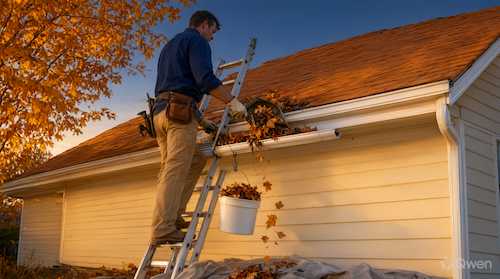
Seattle gets 39.3 inches of rain with very little of it in July, which means almost the whole year's water arrives between autumn and spring — exactly when the conifers are dropping. Douglas fir and cedar needles behave nothing like broad leaves: they are small, they interlock, and they form a mat that holds water and stops the run draining rather than simply filling it. Moss then establishes in the damp channel, and once it does the gutter is a growing medium as much as a channel.
Needles mat rather than fill
Fir and cedar needles weave together into a layer that traps water and slows flow long before the gutter looks full from the ground. That is why a run can overflow in a downpour while appearing half empty. Ask whether the contractor clears needles specifically and how they check the run is flowing rather than merely clear.
Moss in the channel and on the roof edge
In a climate this wet, moss establishes in the gutter and along the roof edge, and it holds moisture against the metal and the fascia. Clearing the debris without addressing the growth leaves the conditions that produced it. Ask whether moss is removed from the channel and whether the contractor reports it on the roof.
Eight wet months and a dry summer
Because the rain is concentrated, the critical clean is the late-autumn one, before the wet season loads the run. A spring clean alone misses it. Ask when the contractor schedules the autumn visit and how far ahead it books.
Steep lots and fast discharge
Much of the metro is built on slopes, and a downspout that discharges onto a steep grade sends water away quickly but can also cut a channel or run along the foundation first. Ask where each downspout ends and whether extensions are part of the work.
Downspouts that go underground
Many houses route downspouts into buried drain lines to a storm system or a dry well, and those lines block with needles and silt where the gutter meets them. A run that drains slowly at the bottom may be clear at the top. Ask whether the buried line is checked or only the visible gutter.
What to pin down in the estimate
Where this page stops
No prices are quoted and no property is assessed here. Roof moss treatment, rot and buried drain repair are separate trades, and nothing here is a statement about drainage design.
Seattle metro context
The 2024 ACS 5-year estimates describe about 4.06 million residents in 1,608,596 households and 1,704,523 housing units, with 60.0% owner-occupied and 56.0% single-family detached. About 42.7% of units predate 1980. At the Seattle Tacoma Intl Ap reference station January averages 42.8°F and July 67.1°F, on 39.3 inches of annual precipitation.
Seattle reference station and housing indicators
| Indicator | Value | Source |
|---|---|---|
| January mean temperature | 42.8°F | NOAA NCEI |
| July mean temperature | 67.1°F | NOAA NCEI |
| Annual precipitation | 39.3 in. | NOAA NCEI |
| Metro population | 4,061,920 | U.S. Census Bureau |
| Owner-occupied share | 60.0% | U.S. Census Bureau |
| Housing units built before 1980 | 42.7% | U.S. Census Bureau |
Station normals are historical averages for one location, not a forecast. What a gutter has to carry depends on roof area, pitch, the debris the surrounding trees drop and whether downspouts discharge where the water can leave.
Frequently Asked Questions
Why do my gutters overflow when they look half empty?
Needles mat into a layer that holds water and blocks flow. The channel can look clear and still not drain.
When is the important clean here?
Late autumn, before the wet season. A spring clean alone leaves the run loaded through the months that matter.
Does moss in the gutter matter?
It holds moisture against the metal and the fascia, and it keeps the channel damp enough to re-establish after clearing.
My downspout goes into the ground — does that get checked?
It should be. Buried lines block with needles and silt, and the gutter can be clear while the outlet is not.
Where should water go on a steep lot?
Away from the foundation and into something that will not scour. On a slope that usually needs an extension or a defined path.
Do guards help with needles?
They keep large debris out but needles pass through and mat on top. They reduce the frequency, not the need.
Sources and review date
- American Community Survey 2024 5-year estimates (CBSA tables) — U.S. Census Bureau, 2024 ACS 5-year estimates.
- 1991–2020 station normals — SEATTLE TACOMA INTL AP, WA US (USW00024233) — NOAA National Centers for Environmental Information, 1991–2020 climate normals.
Reviewed on 2026-11-18.