
Portland, OR-WA · metro guide
Gutter Cleaning in Portland: Fir Needles, Moss and Buried Downspouts
A wet-season metro where the debris is needles and the outlet is often underground.
Metro snapshot
Portland in numbers
Sources named below each block
- Population
- 2.5M
- Households
- 1.0M
- Housing units
- 1.1M
- People / household
- 2.50
- population ÷ households
Owner-occupied homes 62%
The rest are rented. Owners are the ones who commission most exterior work.
Single-family detached 60%
Detached houses carry their own roof, gutters and exterior walls.
Built before 1980 46%
Older housing stock shapes what fails first: gutters, flashing, pipe material.
Season
The year in Portland
- Precipitation
- 36.9 in
- Snowfall
- 4.2 in
Average temperature by month, °F — the shape of the year is what decides when exterior work gets done.
Precipitation by month, inches.
Snowfall by month, inches.
| Month | Average temperature (°F) | Precipitation (in) | Snowfall (in) |
|---|---|---|---|
| January | 41.9°F | 5.03 in | 1.7 in |
| February | 44.1°F | 3.68 in | 1.2 in |
| March | 48.3°F | 3.97 in | 0.1 in |
| April | 52.8°F | 2.89 in | 0.0 in |
| May | 59.4°F | 2.51 in | 0.0 in |
| June | 64.2°F | 1.63 in | 0.0 in |
| July | 70.2°F | 0.51 in | 0.0 in |
| August | 70.6°F | 0.54 in | 0.0 in |
| September | 65.4°F | 1.52 in | 0.0 in |
| October | 55.6°F | 3.42 in | 0.0 in |
| November | 47.1°F | 5.45 in | 0.0 in |
| December | 41.6°F | 5.77 in | 1.2 in |
NOAA 1991–2020 climate normals, station PORTLAND INTL AP, OR US (USW00024229). Station observations, not a metro-wide average — a metro that spans a mountain range can differ by more than this record shows.
Population, households and housing shares: U.S. Census Bureau, American Community Survey 2024 5-year estimates, metropolitan statistical area.
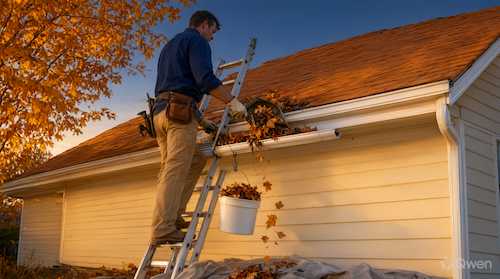
Portland gets 36.9 inches of rain, almost all of it between autumn and spring, and the roofs are surrounded by conifers. That produces the same needle mat that afflicts the whole Pacific Northwest, plus a local complication: a great many houses route their downspouts into buried lines that lead to a storm system, a dry well or a simple gravel pit, and those lines block with needles and silt in a way that is invisible from the gutter.
Needle mat in the channel
Fir and cedar needles interlock into a layer that holds water and slows flow, so a run can overflow while looking half full. Ask whether needles are removed rather than flushed toward the outlet, because flushing a mat simply packs it tighter.
Moss and the damp channel
In a climate this wet, moss establishes in the gutter and along the roof edge and keeps the channel damp enough to re-establish after clearing. Ask whether moss is removed from the channel and whether the roofline is reported.
Buried downspouts and invisible blockages
Downspouts that disappear into the ground lead somewhere — a storm line, a dry well, a gravel pit — and that somewhere blocks. A gutter that is clear at the top and slow at the bottom is the classic symptom. Ask whether the buried line is checked and whether the outlet can be located.
The autumn clean is the one that matters
Because the wet season carries nearly all the rain, a run that is clear in October is doing the work for the whole year. A spring clean is housekeeping by comparison. Ask when the autumn visit is scheduled and how far ahead it books.
Steep lots and where the water goes
Much of the metro is built on slopes, and a buried line that has failed discharges onto a grade and either scours it or runs along the foundation. Ask where the water ends up, not only where the downspout ends.
What to pin down in the estimate
Where this page stops
No prices are quoted and no property is assessed here. Buried drain repair, roof moss treatment and rot are separate trades, and nothing here is a drainage design opinion.
Portland metro context
The 2024 ACS 5-year estimates describe about 2.52 million residents in 1,010,265 households and 1,062,495 housing units, with 61.7% owner-occupied and 60.2% single-family detached. About 45.5% of units predate 1980. At the Portland Intl Ap reference station January averages 41.9°F and July 70.2°F, on 36.9 inches of annual precipitation.
Portland reference station and housing indicators
| Indicator | Value | Source |
|---|---|---|
| January mean temperature | 41.9°F | NOAA NCEI |
| July mean temperature | 70.2°F | NOAA NCEI |
| Annual precipitation | 36.9 in. | NOAA NCEI |
| Metro population | 2,520,987 | U.S. Census Bureau |
| Owner-occupied share | 61.7% | U.S. Census Bureau |
| Housing units built before 1980 | 45.5% | U.S. Census Bureau |
Station normals are historical averages for one location, not a forecast. What a gutter has to carry depends on roof area, pitch, the debris the surrounding trees drop and whether downspouts discharge where the water can leave.
Frequently Asked Questions
Why do my gutters overflow in heavy rain?
Needles mat and hold water, so the run stops draining before it looks full. The mat has to be removed, not flushed.
My downspout goes into the ground — what is it connected to?
Usually a storm line, a dry well or a gravel pit. Whatever it is, it can block, and that is the part nobody checks.
Does moss in the gutter cause damage?
It holds moisture against the metal and the fascia and keeps the channel damp, so clearing debris without it leaves the problem.
When is the important clean?
Late autumn, before the wet season. That single visit protects the run through the months that carry the rain.
Where should water go on a slope?
Away from the foundation and into something that will not scour. On a steep lot that needs a defined path or a working buried line.
Can I clear fir needles myself?
It is possible at ground level with the right tools, but the outlet and the roofline are where the risk is. Fall risk is the reason most households hire it.
Sources and review date
- American Community Survey 2024 5-year estimates (CBSA tables) — U.S. Census Bureau, 2024 ACS 5-year estimates.
- 1991–2020 station normals — PORTLAND INTL AP, OR US (USW00024229) — NOAA National Centers for Environmental Information, 1991–2020 climate normals.
Reviewed on 2026-11-18.