
Seattle, WA · metro guide
Painting in Seattle: Damp Walls and Short Dry Windows
In Seattle the paint does not fail from sun. It fails from moisture behind it, and the season for fixing that is short.
Metro snapshot
Seattle in numbers
Sources named below each block
- Population
- 4.1M
- Households
- 1.6M
- Housing units
- 1.7M
- People / household
- 2.53
- population ÷ households
Owner-occupied homes 60%
The rest are rented. Owners are the ones who commission most exterior work.
Single-family detached 56%
Detached houses carry their own roof, gutters and exterior walls.
Built before 1980 43%
Older housing stock shapes what fails first: gutters, flashing, pipe material.
Season
The year in Seattle
- Precipitation
- 39.3 in
- Snowfall
- 6.3 in
Average temperature by month, °F — the shape of the year is what decides when exterior work gets done.
Precipitation by month, inches.
Snowfall by month, inches.
| Month | Average temperature (°F) | Precipitation (in) | Snowfall (in) |
|---|---|---|---|
| January | 42.8°F | 5.78 in | 1.8 in |
| February | 44.0°F | 3.76 in | 2.2 in |
| March | 47.1°F | 4.17 in | 0.4 in |
| April | 51.3°F | 3.18 in | 0.0 in |
| May | 57.5°F | 1.88 in | 0.0 in |
| June | 62.0°F | 1.45 in | 0.0 in |
| July | 67.1°F | 0.60 in | 0.0 in |
| August | 67.4°F | 0.97 in | 0.0 in |
| September | 62.6°F | 1.61 in | 0.0 in |
| October | 53.8°F | 3.91 in | 0.0 in |
| November | 46.5°F | 6.31 in | 0.2 in |
| December | 42.0°F | 5.72 in | 1.7 in |
NOAA 1991–2020 climate normals, station SEATTLE TACOMA INTL AP, WA US (USW00024233). Station observations, not a metro-wide average — a metro that spans a mountain range can differ by more than this record shows.
Population, households and housing shares: U.S. Census Bureau, American Community Survey 2024 5-year estimates, metropolitan statistical area.
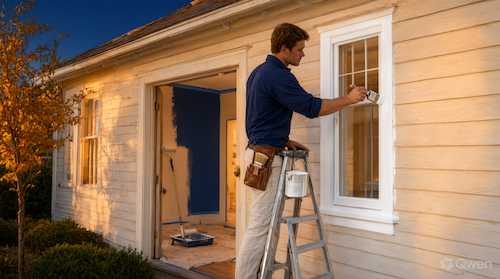
Seattle gets about 39.3 inches of rain a year, most of it between October and April, and July averages only 0.6 inches. That leaves a narrow window for exterior painting, and it makes moisture the central question: what is wet, why, and whether the surface will be dry enough long enough to accept a coating.
Prep here means drying, not just scraping
Ask what washing, scraping, sanding, patching, and priming are included, and how surface moisture is checked before painting. Siding that has absorbed water will trap it under a new coat. A quote that lists paint and labor but not surface preparation is a price for covering a problem.
Mildew and the north wall
Mildew on a shaded wall usually means moisture and poor air movement, not dirty paint. Ask whether the source was investigated — a leaking gutter, a failed caulk joint, a bathroom vent discharging into the attic — and what treatment is proposed. Painting over active mildew brings it back, often within a season.
The exterior season is short
Ask how the schedule handles rain, how surfaces are protected, and whether the crew returns to finish. Most exterior products need surface and air temperatures within a specified range, and mornings here can be damp well into spring. The product data sheet, not the calendar, should decide when work happens.
Interior coatings and ventilation
Ask how the house is ventilated while interior coatings cure, and whether any rooms have persistent condensation on windows. A bathroom or kitchen without working exhaust will keep producing the moisture that caused the original problem. Painting is the last step, not the fix.
Questions to ask before you sign
Where this page stops
This page does not estimate cost or specify products for a particular property. Coating performance depends on the substrate, moisture, preparation, and application, and lead-safe requirements apply to older housing, which should be confirmed with the responsible local authority.
Seattle metro context
The 2024 ACS 5-year estimates put the metro at about 4.1 million residents and 1.6 million households. About 60.0% of occupied homes are owner-occupied, and about 42.7% of housing units were built before 1980, so a large share of exteriors are older assemblies with their own history of repairs. NOAA's Sea-Tac station records January averaging 42.8°F, July 67.1°F, and about 39.3 inches of precipitation a year.
Seattle reference station and housing indicators
| Indicator | Value | Source |
|---|---|---|
| January precipitation | 5.78 in. | NOAA NCEI |
| July precipitation | 0.6 in. | NOAA NCEI |
| Annual precipitation | 39.3 in. | NOAA NCEI |
| Metro population | 4,061,920 | U.S. Census Bureau |
| Owner-occupied share | 60.0% | U.S. Census Bureau |
| Housing units built before 1980 | 42.7% | U.S. Census Bureau |
Station normals are historical averages for one location, not a forecast. Census values describe the metro area, not an individual property.
Frequently Asked Questions
When is the best time to paint an exterior in Seattle?
It depends on the coating and the weather rather than a fixed month. Ask the contractor to follow the product's temperature and moisture requirements, and to describe how they handle rain and damp mornings.
Why does paint peel here?
Moisture behind the coating is a common cause, along with inadequate preparation or applying a product in the wrong conditions. The source of the moisture should be investigated before repainting.
How is mildew handled before painting?
The surface should be cleaned and treated, and the moisture source addressed. Painting over active mildew without fixing the cause usually leads to it returning.
Can I paint in winter?
Most exterior products have minimum temperature requirements for both the surface and the air, which winter conditions often fail. Interior work is usually a better use of the season.
What should a painting estimate include?
Surface preparation, products with names and sheens, number of coats, protection of adjacent surfaces, disposal, schedule, exclusions, and the warranty. Ask how much surface repair is covered.
What is the population of the Seattle metro area?
The U.S. Census Bureau's 2024 ACS 5-year estimates report about 4.1 million residents in the metro area. The figure describes regional scale, not the number of homes or providers.
Sources and review date
- American Community Survey 2024 5-year estimates (CBSA tables) — U.S. Census Bureau, 2024 ACS 5-year estimates.
- 1991–2020 station normals — SEATTLE TACOMA INTL AP, WA US (USW00024233) — NOAA National Centers for Environmental Information, 1991–2020 climate normals.
Reviewed on 2026-11-17.