
Portland, OR-WA · metro guide
Painting in Portland: Wood Siding, Moss and a Short Dry Window
Here the paint is not protecting a wall from sun — it is the wall's only defense against staying wet.
Metro snapshot
Portland in numbers
Sources named below each block
- Population
- 2.5M
- Households
- 1.0M
- Housing units
- 1.1M
- People / household
- 2.50
- population ÷ households
Owner-occupied homes 62%
The rest are rented. Owners are the ones who commission most exterior work.
Single-family detached 60%
Detached houses carry their own roof, gutters and exterior walls.
Built before 1980 46%
Older housing stock shapes what fails first: gutters, flashing, pipe material.
Season
The year in Portland
- Precipitation
- 36.9 in
- Snowfall
- 4.2 in
Average temperature by month, °F — the shape of the year is what decides when exterior work gets done.
Precipitation by month, inches.
Snowfall by month, inches.
| Month | Average temperature (°F) | Precipitation (in) | Snowfall (in) |
|---|---|---|---|
| January | 41.9°F | 5.03 in | 1.7 in |
| February | 44.1°F | 3.68 in | 1.2 in |
| March | 48.3°F | 3.97 in | 0.1 in |
| April | 52.8°F | 2.89 in | 0.0 in |
| May | 59.4°F | 2.51 in | 0.0 in |
| June | 64.2°F | 1.63 in | 0.0 in |
| July | 70.2°F | 0.51 in | 0.0 in |
| August | 70.6°F | 0.54 in | 0.0 in |
| September | 65.4°F | 1.52 in | 0.0 in |
| October | 55.6°F | 3.42 in | 0.0 in |
| November | 47.1°F | 5.45 in | 0.0 in |
| December | 41.6°F | 5.77 in | 1.2 in |
NOAA 1991–2020 climate normals, station PORTLAND INTL AP, OR US (USW00024229). Station observations, not a metro-wide average — a metro that spans a mountain range can differ by more than this record shows.
Population, households and housing shares: U.S. Census Bureau, American Community Survey 2024 5-year estimates, metropolitan statistical area.
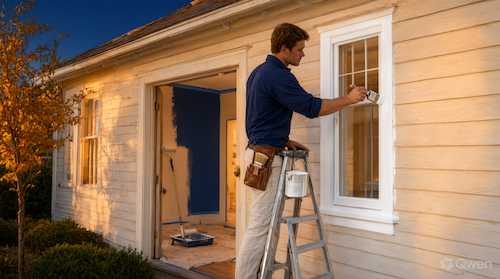
A great deal of this metro's older housing is wood: clapboard, shingle and original trim on bungalows and four-squares, with 45.5% of the stock predating 1980. In a climate with 36.9 inches of rain and a July mean of 70.2°F, the wood is wet for months at a time, and the coating is what stands between it and rot. That changes the priorities. The enemy is not ultraviolet degradation but persistent moisture, mildew on shaded faces, and the joints where water sits — and the practical constraint is that the reliable dry window is short, roughly from June to September.
Moisture is the mechanism
When siding stays damp, the failure starts at the bottom of the wall and at the joints: paint blisters, the wood behind it softens, and the repair becomes carpentry rather than coating. The usual contributors are a gutter that overflows, a downspout discharging at the foundation, shrubs holding damp against the wall, and soil piled above the siding. Ask how the contractor handles the bottom courses, whether any water source will be corrected before painting, and whether soft wood is being replaced rather than sealed.
Mildew and algae on the shaded faces
North-facing walls and surfaces under trees grow mildew and algae here, and it is a maintenance cycle rather than a one-time problem. Coating over growth without treating it seals it under the film and it returns through the surface. Products formulated for the exposure help, but the cleaning step is what matters. Ask how the growth will be treated, whether the wall is being kept wet by irrigation or a downspout, and what product is specified for the shaded elevations.
Working inside a short dry season
Coating needs the surface dry and the conditions within the product's range through curing, and in this climate that concentrates the work into a few months when every contractor is busy. The shoulder weeks are where failures are made: a warm September afternoon can be followed by rain before the film has formed. Ask how the schedule is built around the weather, what happens if a job runs into October, and whether the scope is sized realiztically for the season.
Preparation and the lead question
On a house of this age, exterior preparation is most of the labor: scraping, sanding to feather edges, spot priming bare wood, re-caulking joints and treating any growth. It is also the activity that generates dust and chips, which is why houses built before the lead restrictions need lead-safe practices. Ask for the preparation steps in writing, whether the firm is certified for lead-safe renovation, and how debris and wash water are contained on a tight urban lot.
Trim, windows and the ends of the wood
The places that fail first on a house here are the ones where water sits and the wood is end-grain: window sills, the bottom of door slabs, the ends of clapboard at a corner, and the fascia behind a gutter. These are also the fiddly parts that get skipped when a job is priced tightly. Ask how the trim is prepared, whether any of it is being replaced, and whether doors and windows are being coated on their edges rather than only on the face.
What to pin down in the estimate
Where this page stops
No prices are quoted and no building is assessed here. Rot, water intrusion and lead requirements need inspection and, where relevant, a certified firm or the local authority.
Portland metro context
The 2024 ACS 5-year estimates describe about 2.52 million residents in 1,010,265 households and 1,062,495 housing units, with 61.7% owner-occupied and 60.2% single-family detached. About 45.5% of units predate 1980, so wood siding and original trim are still widespread. At the reference station annual precipitation is 36.9 inches, with 5.03 inches in January and 0.51 inches in July.
Portland reference station and housing indicators
| Indicator | Value | Source |
|---|---|---|
| January mean temperature | 41.9°F | NOAA NCEI |
| July mean temperature | 70.2°F | NOAA NCEI |
| Annual precipitation | 36.9 in. | NOAA NCEI |
| Metro population | 2,520,987 | U.S. Census Bureau |
| Owner-occupied share | 61.7% | U.S. Census Bureau |
| Housing units built before 1980 | 45.5% | U.S. Census Bureau |
Station normals are historical averages for one location, not a forecast. The gap between January and July rainfall is what defines the working season here, and it is narrow.
Frequently Asked Questions
When can exterior painting be done here?
Realiztically from June through September, when surfaces dry and stay dry long enough for the film to form. Pushing into October risks a rain event before the coating has cured.
Why does the paint peel at the bottom of the wall?
Because that is where water sits: splash-back, a downspout discharging nearby, soil against the siding or shrubs holding damp. Painting without correcting that repeats the failure.
Do I need lead-safe practices?
On a house built before 1978, yes — exterior preparation generates the dust and chips the rules address. Ask whether the firm is certified and how the ground and planting are protected.
Why does one wall go green?
Shade plus moisture. North-facing and tree-shaded walls stay damp and grow mildew and algae. Cleaning and treating is necessary, and a product rated for the exposure delays the return.
Should I replace or repair rotted trim?
Replace it. Sealing soft wood hides the problem for a season while the water path stays open, and the carpentry is needed either way.
Is a breathable paint better for wood here?
A coating that lets moisture escape helps in a wet climate, provided the wood is protected from liquid water. The bigger factor remains the detail work: joints, ends and the bottom of the wall.
Sources and review date
- American Community Survey 2024 5-year estimates (CBSA tables) — U.S. Census Bureau, 2024 ACS 5-year estimates.
- 1991–2020 station normals — PORTLAND INTL AP, OR US (USW00024229) — NOAA National Centers for Environmental Information, 1991–2020 climate normals.
Reviewed on 2026-11-18.