
Fresno, CA · metro guide
Landscaping in Fresno: Valley Heat, Water Rules, and Alkaline Soil
In the valley, a tree placed on the west side is an air-conditioning decision.
Metro snapshot
Fresno in numbers
Sources named below each block
- Population
- 1.2M
- Households
- 370K
- Housing units
- 396K
- People / household
- 3.18
- population ÷ households
Owner-occupied homes 57%
The rest are rented. Owners are the ones who commission most exterior work.
Single-family detached 69%
Detached houses carry their own roof, gutters and exterior walls.
Built before 1980 46%
Older housing stock shapes what fails first: gutters, flashing, pipe material.
Season
The year in Fresno
- Precipitation
- 11 in
- Snowfall
- 0 in
Average temperature by month, °F — the shape of the year is what decides when exterior work gets done.
Precipitation by month, inches.
| Month | Average temperature (°F) | Precipitation (in) | Snowfall (in) |
|---|---|---|---|
| January | 48.0°F | 2.16 in | 0.0 in |
| February | 52.3°F | 1.93 in | 0.0 in |
| March | 57.4°F | 1.90 in | 0.0 in |
| April | 62.3°F | 1.04 in | 0.0 in |
| May | 70.2°F | 0.42 in | 0.0 in |
| June | 77.6°F | 0.24 in | 0.0 in |
| July | 83.5°F | 0.03 in | 0.0 in |
| August | 82.2°F | 0.00 in | 0.0 in |
| September | 77.1°F | 0.05 in | 0.0 in |
| October | 66.7°F | 0.56 in | 0.0 in |
| November | 55.1°F | 0.87 in | 0.0 in |
| December | 47.5°F | 1.79 in | 0.0 in |
NOAA 1991–2020 climate normals, station FRESNO YOSEMITE INTL AP, CA US (USW00093193). Station observations, not a metro-wide average — a metro that spans a mountain range can differ by more than this record shows.
Population, households and housing shares: U.S. Census Bureau, American Community Survey 2024 5-year estimates, metropolitan statistical area.
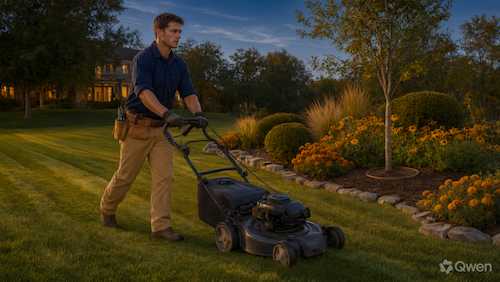
Fresno gardens are designed inside two constraints that are both non-negotiable: the summer heat and the water budget. California's rules on irrigation and turf have tightened repeatedly, local water retailers run their own programs and restrictions, and a landscape that ignores them becomes expensive fast. Below all that sits the soil, which in much of the valley is alkaline clay that drains slowly, holds salts and resists the planting plan that would work in a milder climate with better ground.
The water budget is the design
Ask how the irrigation is zoned, whether drip is used for beds and separate valves for any turf, whether the controller adjusts to weather, and who tunes it through the year. Then ask what the current local rules require for the address — some districts limit turf area on new or renovated landscapes and many run conversion programs. A design that assumes unlimited water fails in the second summer rather than the first, which is exactly when the warranty has run out.
Alkaline clay and salt accumulation
Valley soil tends alkaline and clay-heavy, which locks up some nutrients and drains slowly once saturated. Irrigation with local water adds salts over time, and where drainage is poor those salts accumulate in the root zone. The practical responses are to choose species that tolerate the chemistry, to leach occasionally with a deep watering, and to avoid planting in a basin that cannot drain. Ask whether the soil has been tested, what the pH and salinity are, and how the plant list was chosen.
Shade is the cheapest cooling available
A tree on the west or south side reduces the heat load on the building, which in a valley summer is a direct saving on the cooling bill. That makes tree placement a design question rather than decoration: distance from the wall, mature canopy width, root behavior near slabs and sewer lines, and whether the species suits the soil and the water budget. Ask what the mature canopy size will be rather than the nursery size, and whether the tree is placed for shade on the house or for appearance from the street.
Turf is a decision, not a default
A lawn is the thirstiest part of most landscapes and the part most exposed to regulation. Where turf remains, it should be a deliberate choice with an efficient irrigation zone and a realiztic expectation of water use. Where it is being reduced, the alternatives are groundcover, mulch and drought-adapted planting, and the transition needs a plan for the irrigation that used to serve the grass. Ask what the design proposes and how it complies with current rules.
Who keeps it alive afterwards
A water-efficient garden is not a maintenance-free one. It needs seasonal adjustment of the irrigation, pruning at the right time, and renewal of mulch, and in this heat a failure to water in the first two summers kills young plants quickly. Ask what the maintenance agreement covers, who adjusts the controller, and who waters during establishment. A design that assumes a gardener forever is one that fails when the gardener leaves.
What to put in a landscaping brief
Where this page stops
This page does not evaluate a property and publishes no prices. Soil, drainage and utility locations must be confirmed on site, and water-use rules and rebate programs are set locally and change over time.
Fresno metro context
The 2024 ACS 5-year estimates count about 1.18 million residents in 370,081 households across 395,909 housing units. About 69.1% of units are single-family detached and 57.0% are owner-occupied, while 46.0% were built before 1980. A climate station is not reported for this metro in the site dataset, so no temperature or precipitation figures appear here.
Fresno housing and ownership indicators
| Indicator | Value | Source |
|---|---|---|
| Single-family detached share | 69.1% | U.S. Census Bureau |
| Owner-occupied share | 57.0% | U.S. Census Bureau |
| Housing units built before 1980 | 46.0% | U.S. Census Bureau |
| Metro households | 370,081 | U.S. Census Bureau |
| Housing units | 395,909 | U.S. Census Bureau |
| Metro population | 1,177,665 | U.S. Census Bureau |
No climate normals are shown because no station record is held for this metro in the site dataset. Water supply conditions vary by district and by year, so current rules should be confirmed for the address.
Frequently Asked Questions
How much turf can I have in Fresno?
It depends on the water retailer and on whether the landscape is new or being renovated, and the rules have tightened over time. Some districts limit turf area and many offer conversion incentives. Confirm the current requirement for the address before the design is finalized.
Why do plants struggle in valley soil?
Alkaline clay locks up some nutrients and drains slowly, and irrigation water adds salts over time. Choosing tolerant species, improving drainage and leaching occasionally with a deep watering work better than adding more fertiliser.
Do trees really reduce cooling costs here?
Shade on west and south exposures reduces heat gain into the building, which in a long hot summer is a real saving. Placement, mature canopy size and root behavior near slabs and sewer lines all matter as much as species.
What is the best time to plant?
Autumn is generally kinder than midsummer, because roots can establish through the cooler months without the plant fighting extreme heat. Spring works with reliable irrigation. Midsummer planting is possible but demands water discipline.
Are there rebates for removing lawn?
Many districts have run turf conversion programs, but they change and they usually have conditions on the replacement planting and on irrigation. Ask the local water retailer what is currently available for the address rather than relying on last year's program.
Is artificial turf allowed?
In many places it is, and it removes irrigation from that area entirely. It also gets very hot in direct sun, has a limited lifespan, and may not qualify for conversion incentives. It is a trade-off rather than a free solution.
Sources and review date
- American Community Survey 2024 5-year estimates (CBSA tables) — U.S. Census Bureau, 2024 ACS 5-year estimates.
Reviewed on 2026-11-18.