
Orlando, FL · metro guide
Painting in Orlando: Block Walls, Humidity and Mildew Pressure
In this humidity a coating is judged by what grows on it as much as by how it wears.
Metro snapshot
Orlando in numbers
Sources named below each block
- Population
- 2.8M
- Households
- 1.0M
- Housing units
- 1.1M
- People / household
- 2.73
- population ÷ households
Owner-occupied homes 63%
The rest are rented. Owners are the ones who commission most exterior work.
Single-family detached 59%
Detached houses carry their own roof, gutters and exterior walls.
Built before 1980 24%
Older housing stock shapes what fails first: gutters, flashing, pipe material.
Season
The year in Orlando
- Precipitation
- 51.5 in
- Snowfall
- 0 in
Average temperature by month, °F — the shape of the year is what decides when exterior work gets done.
Precipitation by month, inches.
| Month | Average temperature (°F) | Precipitation (in) | Snowfall (in) |
|---|---|---|---|
| January | 60.6°F | 2.48 in | 0.0 in |
| February | 63.6°F | 2.04 in | 0.0 in |
| March | 67.3°F | 3.03 in | 0.0 in |
| April | 72.2°F | 2.58 in | 0.0 in |
| May | 77.3°F | 4.02 in | 0.0 in |
| June | 81.2°F | 8.05 in | 0.0 in |
| July | 82.6°F | 7.46 in | 0.0 in |
| August | 82.6°F | 7.69 in | 0.0 in |
| September | 81.0°F | 6.37 in | 0.0 in |
| October | 75.5°F | 3.46 in | 0.0 in |
| November | 68.2°F | 1.79 in | 0.0 in |
| December | 63.3°F | 2.48 in | 0.0 in |
NOAA 1991–2020 climate normals, station ORLANDO INTL AP, FL US (USW00012815). Station observations, not a metro-wide average — a metro that spans a mountain range can differ by more than this record shows.
Population, households and housing shares: U.S. Census Bureau, American Community Survey 2024 5-year estimates, metropolitan statistical area.
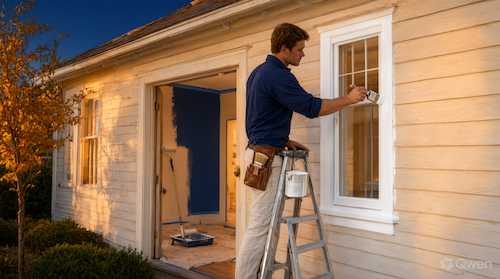
The exterior here is almost always masonry — concrete block finished in stucco, with wood limited to trim, soffits, doors and the occasional decorative element. That means the painting decisions are about moisture movement and biological growth rather than about rot. With humidity high most of the year, a north-facing or tree-shaded wall stays damp long enough for mildew to establish, and once it is under a film it keeps coming back. Only 23.8% of the housing predates 1980, so lead is a much smaller concern here than in older metros; the recurring issue is what the climate grows rather than what the paint contains.
Mildew is the recurring failure
Mildew appears as dark streaking on shaded faces and under eaves, and it feeds on moisture, dirt and the film itself. Cleaning it is not enough on its own: if the wall stays wet because a sprinkler hits it or a soffit traps air, it will return. Products formulated for the exposure and a proper wash before coating are the baseline. Ask how the existing growth will be treated rather than covered, whether the irrigation is wetting the wall, and what product is specified for the shaded elevations.
Block and stucco have to dry outward
A masonry wall releases moisture through its face, so the coating has to allow that. A heavy film applied over a wall that holds water blisters, and on block the blistering often follows the mortar joints, which are the path the water takes. Cracks at joints and around openings are usually movement, and painting over them without addressing the cause brings them straight back. Ask whether the coating is breathable, how cracks are being repaired before painting, and whether flashings and window heads have been checked.
Sun on top of humidity
South and west elevations get the sun and fade or chalk first, while north and east faces stay damp. That split shows up in a finished job as a building that looks uneven after a few years, and it is worth planning for. A more UV-stable product on the exposed elevations, and a mildew-resistant one on the shaded faces, is a legitimate specification rather than an upsell. Ask whether the same product is proposed everywhere, and why.
Pressure washing, patching and timing
Preparation here starts with washing, which removes dirt, chalk and growth — and also drives water into any crack that is not yet repaired. The sequence therefore matters: repairs and patching first where needed, then cleaning, then coating, with the wall dry before anything is applied. Coating a wall that is still damp from washing or from rain is one of the most common reasons a new paint job fails early. Ask what the preparation sequence is, how the contractor decides the wall is dry, and what happens if a rainy week interrupts the schedule.
Associations and approved colors
A large share of this housing sits under an association with an approved exterior palette, and repainting outside it is the kind of mistake that ends in a second full paint job at the owner's expense. The submission usually wants the product, color and sometimes a sample, and the association may also define which surfaces the owner is responsible for. Ask whether the colors are on the approved palette, who submits, and whether the association requires notice before the work begins.
What to pin down in the estimate
Where this page stops
No prices are quoted and no building is assessed here. Stucco damage, water intrusion and association requirements need inspection or confirmation from the relevant party rather than a description on a page.
Orlando metro context
The 2024 ACS 5-year estimates describe about 2.79 million residents in 1,022,315 households and 1,145,360 housing units, with 63.1% owner-occupied and 58.5% single-family detached. Only 23.8% of units predate 1980, which is why lead-safe work is rarely part of an exterior painting scope here and mildew control usually is. No climate station is reported for this metro in the site dataset, so no temperature or precipitation normals appear on this page.
Orlando housing indicators
| Indicator | Value | Source |
|---|---|---|
| Housing units built before 1980 | 23.8% | U.S. Census Bureau |
| Single-family detached share | 58.5% | U.S. Census Bureau |
| Owner-occupied share | 63.1% | U.S. Census Bureau |
| Metro households | 1,022,315 | U.S. Census Bureau |
| Housing units | 1,145,360 | U.S. Census Bureau |
| Metro population | 2,793,746 | U.S. Census Bureau |
No climate normals are shown because no station record is held for this metro in the site dataset. The young stock explains why exterior painting here is mostly a maintenance cycle on block and stucco rather than lead-safe work on old wood.
Frequently Asked Questions
Why does mildew keep coming back on one wall?
Because the wall keeps getting wet. Cleaning and coating help, but if a sprinkler hits it, a soffit traps air or the face stays shaded, the growth returns. The water source is the first thing to solve.
Can block be painted with any exterior paint?
It needs a breathable coating. Block and stucco release moisture through the face, and a heavy film that seals it will blister, often along the mortar joints where the water travels.
Is pressure washing always the first step?
It is where a lot of jobs begin, but it should follow any structural repairs and it drives water into cracks. The wall also has to be dry before coating, which is why the sequence matters.
Do I need lead-safe practices?
Rarely here, because most housing postdates the lead restrictions. On a pre-1978 property it is worth asking, since exterior preparation is what generates dust and chips.
Why does one elevation fade faster?
Sun exposure. South and west faces take the most UV and chalk first, while shaded faces fail by mildew instead. Specifying per elevation is a legitimate approach.
Does the association approve colors?
Usually, and the palette is defined. An unapproved color can mean repainting the whole house, so the submission is worth doing before ordering paint.
Sources and review date
- American Community Survey 2024 5-year estimates (CBSA tables) — U.S. Census Bureau, 2024 ACS 5-year estimates.
Reviewed on 2026-11-18.