
Salt Lake City, UT · metro guide
Gutter Cleaning in Salt Lake City: Lakebed Dust, Hard Water Crust and Snow
Dust that sets like cement once the hard water has touched it.
Metro snapshot
Salt Lake City in numbers
Sources named below each block
- Population
- 1.3M
- Households
- 450K
- Housing units
- 475K
- People / household
- 2.83
- population ÷ households
Owner-occupied homes 67%
The rest are rented. Owners are the ones who commission most exterior work.
Single-family detached 61%
Detached houses carry their own roof, gutters and exterior walls.
Built before 1980 42%
Older housing stock shapes what fails first: gutters, flashing, pipe material.
Season
The year in Salt Lake City
- Precipitation
- 15.5 in
- Snowfall
- 51.9 in
Average temperature by month, °F — the shape of the year is what decides when exterior work gets done.
Precipitation by month, inches.
Snowfall by month, inches.
| Month | Average temperature (°F) | Precipitation (in) | Snowfall (in) |
|---|---|---|---|
| January | 31.4°F | 1.43 in | 12.7 in |
| February | 36.6°F | 1.30 in | 10.7 in |
| March | 45.8°F | 1.75 in | 5.9 in |
| April | 51.8°F | 2.16 in | 2.9 in |
| May | 61.5°F | 1.82 in | 0.1 in |
| June | 71.6°F | 0.95 in | 0.0 in |
| July | 81.1°F | 0.49 in | 0.0 in |
| August | 79.1°F | 0.58 in | 0.0 in |
| September | 68.4°F | 1.06 in | 0.0 in |
| October | 54.6°F | 1.26 in | 0.5 in |
| November | 41.7°F | 1.32 in | 7.0 in |
| December | 32.2°F | 1.40 in | 12.1 in |
NOAA 1991–2020 climate normals, station SALT LAKE CITY INTL AP, UT US (USW00024127). Station observations, not a metro-wide average — a metro that spans a mountain range can differ by more than this record shows.
Population, households and housing shares: U.S. Census Bureau, American Community Survey 2024 5-year estimates, metropolitan statistical area.
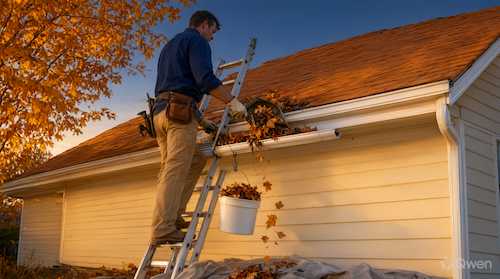
Salt Lake City's gutters collect two things that combine badly: fine dust from the exposed lakebed and surrounding valley, and very hard water. Dust that would rinse away elsewhere sets into a crust once mineral water has wetted and dried it, and that crust holds water against the metal and narrows the channel. Winter then adds lake-effect snow and ice at the outlet.
Lakebed and valley dust
Fine material from the receding lake and the valley floor settles on roofs and washes into runs, where it collects at low points. It is alkaline and does not rinse away cleanly. Ask whether the outlets are cleared of this material.
Hard water crust
Local water leaves minerals behind, and dust wetted by it sets into a hard layer in the channel. That layer survives an ordinary flush. Ask how set material is removed rather than only loose debris.
Lake snow and frozen outlets
Lake-effect snow and hard freezes plug outlets, and a run that cannot drain backs meltwater under the roof edge. Ask when the autumn visit is scheduled relative to the first freeze.
Snow load and hangers
Heavy snow loads old hangers, and a run pulled out of alignment holds water even when clean. Ask whether hangers and pitch are checked.
Older runs and added area
With 42.3% of the stock predating 1980, narrow runs are common, and additions have usually increased the roof area. Ask what profile is fitted.
What to pin down in the estimate
Where this page stops
No prices are quoted and no property is assessed here. Ice-dam causes, hanger repair and roof condition need inspection by the right trade.
Salt Lake City metro context
The 2024 ACS 5-year estimates describe about 1.28 million residents in 450,170 households and 474,627 housing units, with 67.0% owner-occupied and 60.9% single-family detached. About 42.3% of units predate 1980. No climate station is reported for this metro in the site dataset, so no temperature or precipitation normals appear on this page.
Salt Lake City housing indicators
| Indicator | Value | Source |
|---|---|---|
| Housing units built before 1980 | 42.3% | U.S. Census Bureau |
| Single-family detached share | 60.9% | U.S. Census Bureau |
| Owner-occupied share | 67.0% | U.S. Census Bureau |
| Metro households | 450,170 | U.S. Census Bureau |
| Housing units | 474,627 | U.S. Census Bureau |
| Metro population | 1,275,870 | U.S. Census Bureau |
Station normals are historical averages for one location, not a forecast. What a gutter has to carry depends on roof area, pitch, the debris the surrounding trees drop and whether downspouts discharge where the water can leave.
Frequently Asked Questions
Why is the sediment in my gutter so hard?
Hard water wets the dust and it dries into a crust. An ordinary flush does not move it.
What is the lakebed dust?
Fine material from the exposed lake bed and the valley floor. It settles on roofs and washes into runs.
When should gutters be cleaned here?
In late autumn, before the first hard freeze, so the outlet is clear for the winter.
Can snow damage a gutter?
Heavy snow loads old hangers and can pull a run out of alignment, which then holds water.
Is a four-inch run a problem?
It holds less, and additions usually increased the roof area it drains.
Do I need to be home?
Exterior work can be done with agreed access. Nothing inside the house is involved.
Sources and review date
- American Community Survey 2024 5-year estimates (CBSA tables) — U.S. Census Bureau, 2024 ACS 5-year estimates.
Reviewed on 2026-11-18.